

Daily Quizzes
Mock Tests
No tests attempted yet.
Select Category
NEET UG 2027 CBT Mode Explained: Exam Pattern, Changes & Updates
The NEET UG 2027 CBT Mode introduces the biggest reform in India's medical entrance exam. Discover how the shift from OMR sheets to computer-based testing will impact exam security, result processing, normalization, and preparation strategies for aspiring medical students.

Get in Touch with Class24 for All Your Needs!
NEET UG 2027 CBT Mode marks a historic transformation in India's medical entrance examination system. The National Eligibility cum Entrance Test will now be conducted in Computer-Based Test (CBT) mode, replacing the traditional pen-and-paper format. This reform aims to strengthen exam security, prevent paper leaks, and improve transparency in the evaluation process. For every NEET aspirant, understanding these changes and adapting early will be crucial for success in 2027.
Official Announcement: NTA Supreme Court Confirmation | NTA has submitted an affidavit confirming readiness to conduct NEET-UG in CBT mode from 2027.
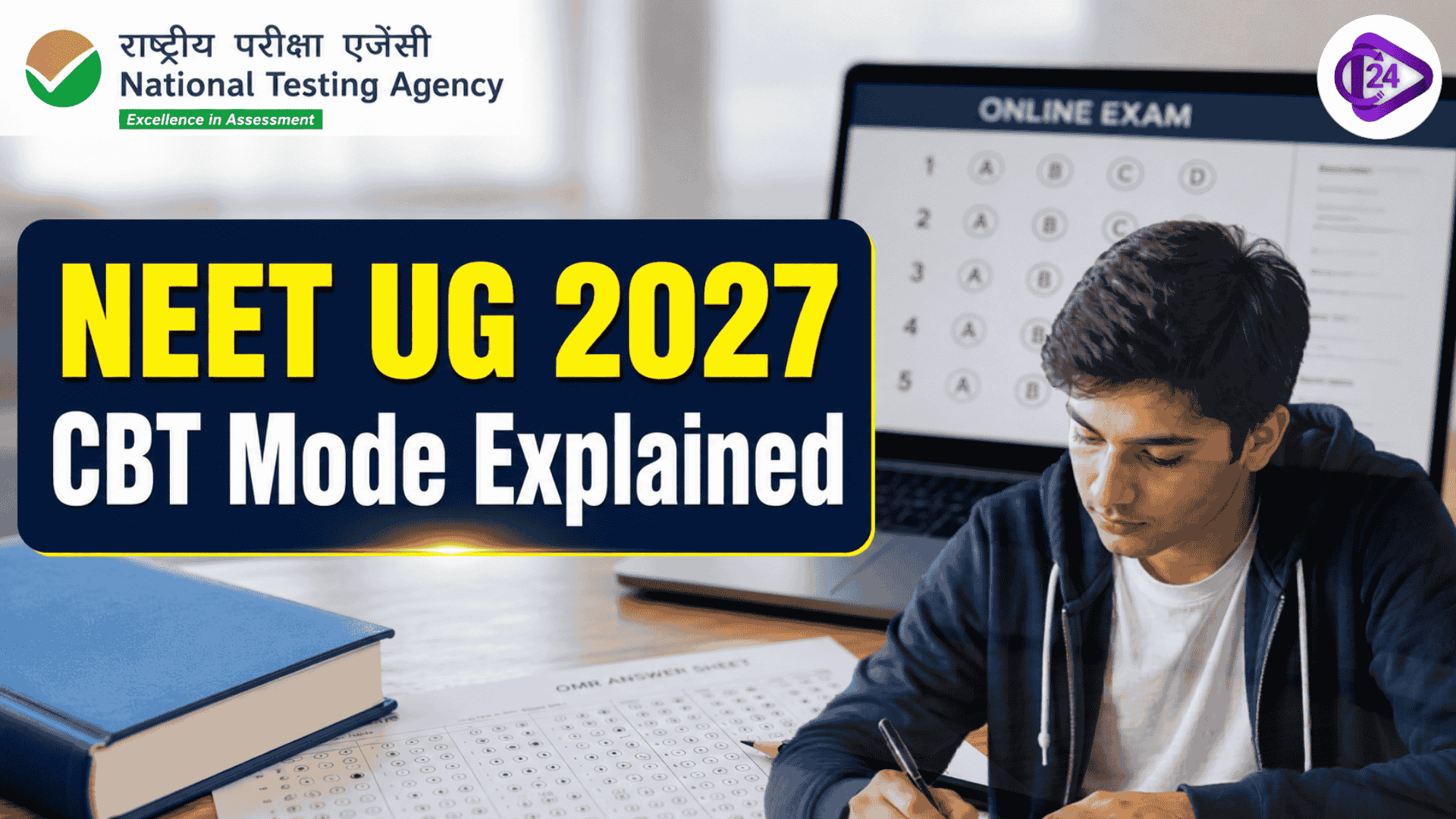
India's most competitive medical entrance exam is getting its biggest makeover in over a decade. NEET UG 2027 will be conducted in Computer-Based Test (CBT) mode - replacing the traditional pen-and-paper OMR format that has been in use since NEET's inception in 2013.
The announcement came directly from Union Education Minister Dharmendra Pradhan on May 15, 2026, following the cancellation of NEET UG 2026 due to a paper leak controversy. For over 2.2 million students who appear for NEET every year, this is a change they cannot afford to ignore.
This article covers everything you need to know - what changes, what stays the same, why this decision was made, and how you should prepare right now.
What Is CBT Mode? A Quick Explainer
A Computer-Based Test (CBT) is an examination conducted on a computer at designated test centers, rather than using physical OMR answer sheets and printed question papers. Students see questions on a screen, select answers using a mouse or keyboard, and submit digitally.
JEE Main, CUET, and most other NTA-conducted exams already use CBT mode. NEET UG has been the only major NTA exam still running in pen-and-paper format - until now.
Why Is NEET Shifting to CBT Mode?
1. Paper Leak Crisis - The Tipping Point
The primary driver is the recurring paper leak scandal. NEET UG 2026 was cancelled entirely after widespread paper leak allegations, forcing the NTA to schedule a re-examination on June 21, 2026. This followed a similar controversy in 2024 that shook public trust in the exam.
The pen-and-paper format requires printing millions of question papers, physically transporting them to thousands of exam centers across India, and storing them securely at each location. Every step in this chain creates a vulnerability for leaks.
2. Radhakrishnan Committee Recommendations
The shift to CBT was not an overnight decision. The Radhakrishnan Committee, formed after the 2024 NEET controversy, specifically identified the OMR-based system as the root vulnerability and formally recommended transitioning to computer-based testing as a more secure alternative.
This recommendation was further reinforced by the High-Level Committee of Experts (HLCE), which was also consulted in finalizing the CBT transition plan.
3. Digital Security Advantages
In CBT mode, question papers are delivered through encrypted servers directly to each computer terminal at exam time. There are no physical papers to print, ship, or store - eliminating the primary leakage points.
Official Announcement: Key Facts
| Detail | Information |
|---|---|
| Announced by | Union Education Minister Dharmendra Pradhan |
| Announcement Date | May 15, 2026 |
| Effective From | NEET UG 2027 |
| Last Pen-and-Paper NEET | NEET UG 2026 Re-Exam (June 21, 2026) |
| Implementing Body | National Testing Agency (NTA) |
| Estimated Candidates Affected | 2.2+ million annually |
What Changes in NEET UG 2027?
1. Exam Delivery Medium
Instead of OMR sheets and printed booklets, students will answer questions on a computer screen at an authorized NTA test center.
2. No Physical Question Paper
Questions will be delivered through secure, encrypted digital servers. This removes the paper printing and transportation chain entirely.
3. Digital Answer Submission
Students will click on answer options rather than filling bubbles on an OMR sheet. Answers are saved digitally in real time.
4. AI-Based Monitoring
AI-powered surveillance and digital tracking systems will be deployed at exam centers to prevent malpractice, making it harder to cheat compared to traditional centers.
5. Multi-Shift Possibility
CBT mode makes it technically feasible to conduct NEET across multiple days and shifts - similar to JEE Main - which could reduce pressure on a single exam day. According to recent NTA disclosures, the exam may need to be conducted across approximately 20 shifts to accommodate the large number of candidates, though the final shift structure will be confirmed only in the official information bulletin.
6. Faster Results
Digital evaluation means faster result processing. Students can expect a quicker turnaround from exam date to result declaration.
What Does NOT Change in NEET UG 2027?
This is equally important. Many students are worried about major disruptions - here is what remains the same:
| Aspect | Status |
|---|---|
| Syllabus (NCERT Class 11 & 12) | No change |
| Total Questions (200 MCQs, 180 to attempt) | Expected to remain the same |
| Total Marks (720) | Expected to remain the same |
| Exam Duration (3 hours 20 minutes) | Expected to remain the same |
| Marking Scheme (+4 / -1) | Expected to remain the same |
| Subjects (Physics, Chemistry, Biology) | No change |
| Eligibility Criteria | No change |
Note: NTA will release the official notification for NEET UG 2027 with complete exam pattern details. The above is based on current government statements.
How Will CBT Scoring Work? What About Normalization?
One concern students have is whether scores will be normalized across different shifts, as is done in JEE Main. NTA Director General Abhishek Singh has explained that if NEET is conducted across multiple shifts, a normalization process would adjust scores to account for difficulty differences between sessions, based on relative performance within each session.
The exact normalization policy for NEET UG 2027 will be clarified in the official notification.
Concerns Raised by Stakeholders
The CBT shift has not been without criticism:
Infrastructure Gap: India has thousands of rural exam centers. Ensuring every center has adequate computers, stable internet, and power backup is a significant logistical challenge.
Digital Divide: Students from rural areas or lower-income backgrounds may have had limited computer exposure. Critics argue this creates an uneven playing field.
State Government Concerns: Some state leaders have called for exemptions or alternative admission criteria, citing systemic vulnerabilities.
NTA's Response: The agency has acknowledged these concerns and is expected to announce infrastructure development plans and candidate orientation programs before NEET 2027.
Fee Relief: NTA has confirmed that the registration fee paid by NEET UG 2026 candidates will be refunded, reducing the financial burden of the paper-leak-related re-exam.
Important Links
How to Prepare for CBT Mode: A Practical Guide
If you are preparing for NEET 2027, here is what you should start doing today:
1. Practice on Online Platforms Daily
Take at least one mock test per week on a computer or tablet. Platforms like NTA Abhyas App, Embibe, and Allen's online test series simulate the CBT environment.
2. Get Comfortable with the Interface
Learn to navigate between sections, use the "Mark for Review" option, and manage the on-screen timer. These seem small but consume mental energy on exam day if unfamiliar.
3. Use NTA Abhyas App
NTA's official practice app is free and mirrors the actual CBT interface. Students with only smartphone access can use this to build digital familiarity.
4. Do Not Change Your Core Preparation Strategy
NCERT is still your bible. The subject matter, question types, and mark structure are unchanged. Do not let the format change distract you from content preparation.
5. Simulate Exam Conditions
Take full-length 3-hour 20-minute mock tests on a screen. Train your eyes and concentration for sustained screen reading - it is different from reading a paper booklet.
Timeline: NEET UG 2026 → 2027 Transition
| Date | Event |
|---|---|
| May 3, 2026 | NEET UG 2026 Exam Cancelled (Paper Leak) |
| May 15, 2026 | Education Minister Announces CBT Mode from 2027 |
| June 7, 2026 | City Intimation Slip Released (Re-Exam) |
| June 14, 2026 | Admit Card Released for Re-Exam |
| June 21, 2026 | NEET UG 2026 Re-Exam (Last Pen-and-Paper NEET) |
| 2027 | NEET UG 2027 - First-Ever CBT Mode NEET |
Conclusion - NEET UG CBT Mode 2027
The shift of NEET UG to CBT mode from 2027 is the most significant reform in the exam's history. Born out of the paper leak crisis of 2024 and 2026, this change is designed to make India's medical entrance exam more secure, transparent, and tamper-proof.
For students targeting NEET 2027, the core message is simple: your subject preparation does not change - only the delivery medium does. Start practicing on digital platforms today, build comfort with the online interface, and stay updated through NTA's official website for the 2027 notification.
The last pen-and-paper NEET is on June 21, 2026. After that, a new era begins.
FAQ - NEET UG CBT Mode 2027
Our Courses








Post a Comment
Your email address will not be published. Required fields are marked *