

Daily Quizzes
Mock Tests
No tests attempted yet.
Select Category
SSC MTS Exam Analysis 2026: Shift-wise Difficulty & Good Attempts
The SSC MTS Exam Analysis 2026 gives candidates a complete overview of difficulty level, section-wise breakdown, good attempts and expected cutoff based on the CBT conducted across multiple shifts in February 2026.

Get in Touch with Class24 for All Your Needs!
SSC MTS Exam Analysis 2026 reveals the CBT held between 4–19 February was rated Easy to Moderate, with English and Reasoning scoring well while Numerical Ability remained calculation-heavy. Good attempts ranged between 72–77 out of 90 questions, helping aspirants gauge preparation strategy for upcoming shifts.
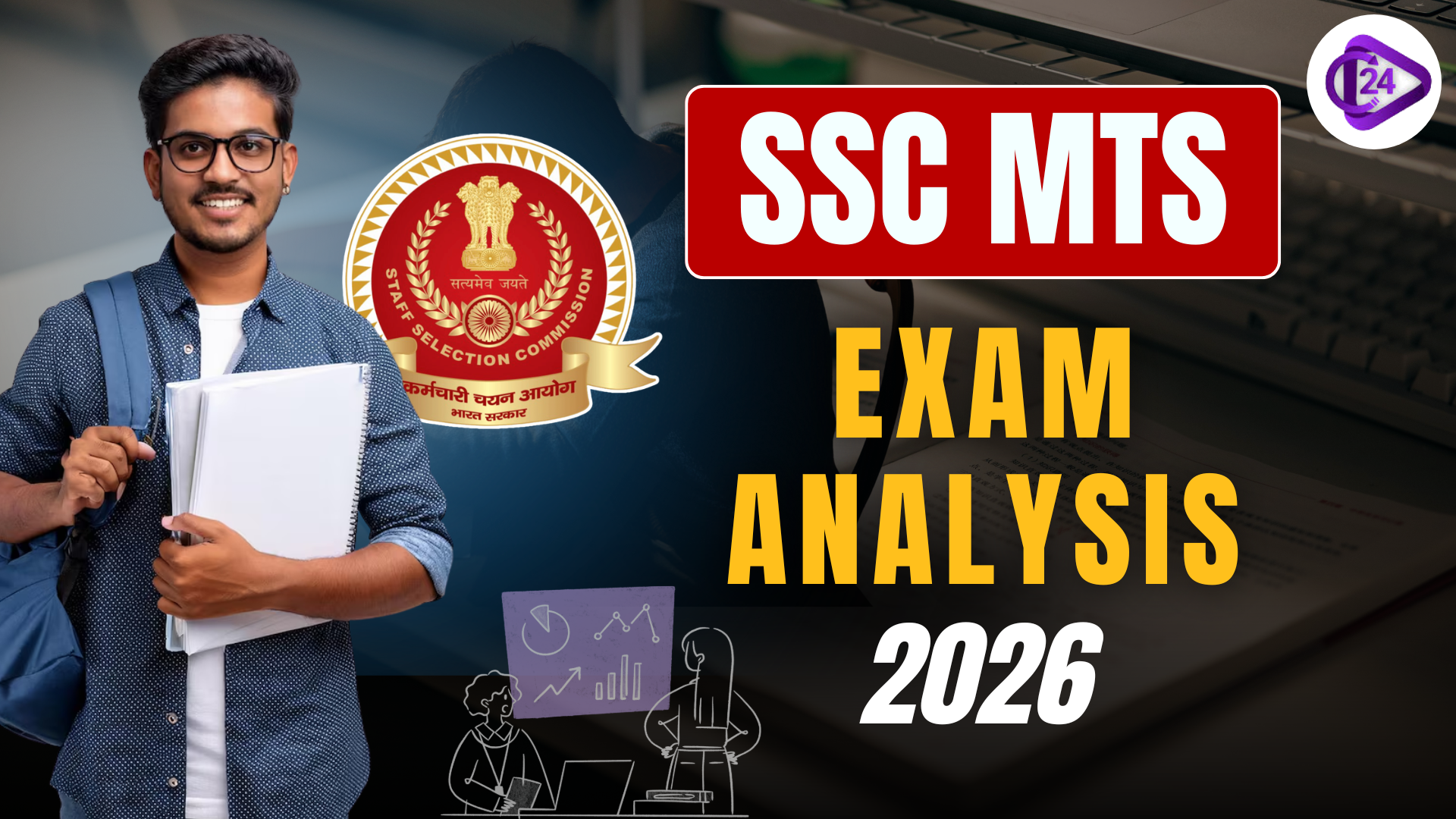
SSC MTS Exam Analysis 2026 gives candidates a clear picture of how the Computer-Based Test actually played out, based on the CBT conducted by the Staff Selection Commission across multiple shifts between 4 and 19 February 2026 for 7,948 MTS and Havaldar vacancies. This analysis is particularly useful for aspirants of upcoming shifts, since it reveals the real difficulty trend, section-wise pattern and safe attempt range reported after the exam.
This SSC MTS Exam Analysis 2026 guide covers the overall and section-wise difficulty level, good attempts, shift timings, topic-wise question trends, candidate reactions and expected cutoff, all in one place. Note that this analysis relates to the SSC MTS CBT already conducted in February 2026, which is a separate cycle from the fresh SSC MTS 2026 notification still awaited from the Commission.
SSC MTS Exam Analysis 2026 - Overview
The SSC MTS Exam Analysis 2026 overview below summarises the exam structure candidates faced, based on the pattern followed across all shifts of the Computer-Based Test.
| Particulars | Details |
|---|---|
| Exam Name | SSC MTS & Havaldar Examination |
| Exam Mode | Computer-Based Test (CBT) |
| Exam Dates | 4 to 19 February 2026 |
| Number of Applicants | Approx. 36.17 lakh |
| Total Questions | 90 |
| Total Marks | 270 |
| Exam Duration | 90 minutes |
| Sections | Numerical Ability, Reasoning, General Awareness, English |
| Overall Difficulty | Easy to Moderate |
SSC MTS Exam Analysis 2026 - Date-wise & Shift-wise Schedule
The SSC MTS exam 2026 was conducted across several dates in February, with each exam day split into three shifts to accommodate the large number of applicants.
| Shift | Exam Timing |
|---|---|
| Shift 1 | 9:00 AM – 10:30 AM |
| Shift 2 | 1:30 PM – 3:00 PM |
| Shift 3 | 4:30 PM – 6:00 PM |
Two of the widely discussed shifts during this exam window were 5 February (Shift 3) and 6 February (Shift 1), which are covered in more detail further below.
SSC MTS Exam Analysis 2026: Overall Difficulty Level
The SSC MTS exam analysis 2026 rates the overall paper as Easy to Moderate, making it a student-friendly exam for candidates who revised the basics thoroughly before appearing.
- English Language & Comprehension was the easiest section for most candidates.
- Numerical & Mathematical Ability was reported as the most time-consuming section.
- Reasoning Ability questions were largely straightforward and scoring.
- General Awareness leaned heavily on recent current affairs from the past year.
SSC MTS Exam Analysis 2026 - Shift-wise Difficulty Level
Difficulty levels showed only minor variation across shifts, with most candidates reporting a similar overall experience regardless of the exam date or session.
5 February 2026, Shift 3 - Difficulty Level
Based on similar-pattern practice papers designed around this shift, the difficulty stayed in the Easy to Moderate range, with Numerical Ability carrying slightly lengthier calculation-based questions on topics like profit percentage, simple interest, mixtures and time-speed-distance, while Reasoning and English remained largely direct and scoring.
6 February 2026, Shift 1 - Difficulty Level
This shift's similar-pattern practice paper suggests a comparable Easy to Moderate level, with Numerical Ability again being calculation-intensive (percentage, averages, work-efficiency, geometry) and General Awareness carrying a mix of static GK and current-affairs-based questions.
SSC MTS Section-wise Analysis 2026
A closer look at each section of the SSC MTS exam analysis 2026 helps candidates preparing for upcoming shifts understand where to focus their remaining preparation time.
Numerical Aptitude - Analysis
Numerical Ability was widely considered the most demanding section, with calculation-intensive and slightly lengthy questions that tested time management as much as concept clarity.
| Aspect | Detail |
|---|---|
| Candidate Experience | Slower candidates struggled to complete this section within the allotted time. |
| Commonly Seen Topics | Percentage, profit and loss, simple interest, averages, time-speed-distance, mixtures and basic geometry. |
| Preparation Advice | Practising daily arithmetic and improving calculation speed is advised for upcoming shifts. |
Reasoning Ability - Analysis
Reasoning Ability turned out to be one of the most scoring sections, with mostly direct questions requiring basic logical thinking rather than heavy calculation.
| Aspect | Detail |
|---|---|
| Expected Topics | Analogy, Coding-Decoding, Number Series, Classification and Direction-based questions. |
| Candidate Experience | Candidates who practised mock tests regularly were able to attempt nearly all questions with high accuracy. |
| Preparation Advice | Accuracy in this section can meaningfully boost the overall score. |
General Awareness - Analysis
General Awareness was rated Moderate, with a strong focus on recent current affairs from 2024 and 2025 alongside static GK topics.
| Aspect | Detail |
|---|---|
| Weightage Trend | Current affairs carried higher weightage than in some previous SSC MTS cycles. |
| Commonly Seen Topics | Folk dances, major sporting events like the Olympics and Youth Games, and recent appointments. |
| Preparation Advice | Reviewing the last 10–12 months of current affairs alongside regular static GK revision is recommended. |
English Language - Analysis
English Language & Comprehension was rated the easiest section, with many candidates attempting almost every question.
| Aspect | Detail |
|---|---|
| Question Trend | Questions leaned more towards narration and active-passive voice conversions than antonyms or synonyms this time. |
| Commonly Seen Topics | Grammar-based and sentence transformation questions were common. |
| Preparation Advice | Strong performance here can help offset time lost in the tougher Numerical Ability section. |
SSC MTS Good Attempts 2026 (Shift-wise)
Good attempts indicate the number of questions a candidate should aim to solve accurately to stay competitive in the SSC MTS exam analysis 2026.
| Section | No. of Questions | Good Attempts |
|---|---|---|
| Numerical Ability | 20 | 18 |
| Reasoning | 20 | 18 |
| General Awareness | 25 | 14–16 |
| English | 25 | 20–22 |
| Overall | 90 | 72–77 |
SSC MTS Questions Asked in Exam 2026 (Topic-wise)
The topics below are based on similar-pattern practice papers designed around the actual shift difficulty and are meant to give a representative idea of the question trends, rather than a confirmed word-for-word recall of the real exam.
Important Questions Asked on 5 February 2026 (Shift 3)
| Subject | Topics Covered |
|---|---|
| Quantitative Aptitude | BODMAS-based simplification, pie chart and bar graph interpretation, simple interest with two principal amounts, successive discounts, relative speed (same direction), time-and-work with efficiency change, exterior angle theorem in triangles, surds and algebraic identities. |
| Reasoning | Linear and circular seating arrangement, number/letter analogy clusters, missing number series, dictionary-based word ordering, coded sentence logic, calendar-based day calculation. |
| General Awareness | Troposphere and atmospheric layers, mineral production in Odisha, Indian language families, Delhi Sultanate coinage, Operation Flood, monetary policy tools (CRR, OMO), folk dances of Odisha and Tamil Nadu, the new Rs. 100 note, Indus Valley Civilization features. |
| English | Idioms and one-word substitutions, spelling correction, synonym-antonym pairs, para jumbles, preposition-based fill-ups, reading comprehension based on a socio-economic theme. |
Important Questions Asked on 6 February 2026 (Shift 1)
| Subject | Topics Covered |
|---|---|
| Quantitative Aptitude | Profit percentage, percentage-based number problems, average of numbers with replacement, HCF-based tiling problems, simple interest and part-payment questions, successive discount percentage, train crossing (same direction), partnership profit-sharing, LCM-based remainder problems, pipes and cisterns. |
| Reasoning | Alphanumeric series, seating arrangement (linear and circular), coded number-letter clusters, missing series completion, height/blood-relation-based puzzles, clock angle calculation, figure-based clockwise rotation logic. |
| General Awareness | Agriculture types (mixed farming), LIC establishment year, lunar revolution period, periodic table arrangement, National Development Council, Financial Emergency (Article 360), ancient India (Mauryan diplomacy), tertiary sector economics, sports terminology (Powerplay, wicketkeeper gloves). |
| English | Sentence improvement (active-passive voice), preposition fill-ups, spelling and grammar error identification, one-word substitution, synonym-antonym pairs. |
SSC MTS Exam Analysis 2026 - Memory-Based Questions
Memory-based questions shared by test-takers after each shift generally reinforce the same topic trends seen in the section-wise analysis above, with Reasoning puzzles, percentage-based Quant problems and recent current affairs being the most commonly recalled question types across shifts.
- Reasoning: coding-decoding and series-completion questions were among the most frequently recalled.
- Quantitative Aptitude: percentage, simple interest and time-work problems appeared consistently across multiple shifts.
- General Awareness: static GK on Indian history, geography and government schemes, along with recent sports and appointment-based current affairs.
SSC MTS Exam Review - Candidates' Reactions
Overall candidate feedback on the SSC MTS exam 2026 was largely positive, with most describing the paper as manageable within the given time.
- Many candidates found English the most comfortable section to complete quickly.
- Numerical Ability drew the most complaints regarding time pressure and lengthy calculations.
- First-time aspirants generally rated the exam easier than repeat candidates expected, citing direct reasoning questions as a relief.
SSC MTS Exam Analysis 2026 vs Previous Year
Comparing the SSC MTS exam analysis 2026 with previous cycles shows a broadly similar difficulty trend, with a few shifts in question style.
| Particulars | SSC MTS 2026 | Previous Cycle |
|---|---|---|
| Overall Difficulty | Easy to Moderate | Easy to Moderate |
| Toughest Section | Numerical Ability | Numerical Ability |
| Easiest Section | English | English/Reasoning |
| English Question Trend | More narration & active-passive | More antonym-synonym based |
| Good Attempts (Overall) | 72–77 | Similar range reported |
SSC MTS Expected Cutoff 2026 (Based on Analysis)
Based on the Easy to Moderate difficulty level and the reported good attempts range of 72–77 questions, the SSC MTS expected cutoff 2026 is likely to stay close to or slightly above previous-cycle trends, though the final cutoff depends on total applicants, category-wise vacancies and the normalization process applied by SSC across shifts.
SSC MTS Exam Analysis 2026: Preparation Tips for Upcoming Shifts
Candidates still awaiting their shift can use this SSC MTS exam analysis 2026 to fine-tune their final preparation strategy with a few practical, high-impact steps.
| Preparation Tip | Detail |
|---|---|
| Attempt easy questions first | Build confidence and secure quick marks before tackling lengthy Numerical Ability questions. |
| Avoid getting stuck | Skip a calculation-heavy question if it takes too long and return to it later if time permits. |
| Revise current affairs daily | Focus on the last 10–12 months, especially sports, appointments and government schemes. |
| Practice at least one mock test | Simulate real exam conditions to improve speed and time management before the actual shift. |
| Prioritise accuracy over guessing | Since Reasoning is scoring, aim for high accuracy rather than attempting every question blindly. |
| Manage time across sections | Divide the 90 minutes proportionally, keeping extra buffer time for Numerical Ability. |
Conclusion
The SSC MTS Exam Analysis 2026 shows a student-friendly paper overall, with English and Reasoning offering strong scoring opportunities while Numerical Ability tested patience and calculation speed. With good attempts hovering around 72–77 out of 90 questions, candidates preparing for upcoming shifts should focus on accuracy, time management and consistent current affairs revision to perform confidently in the remaining SSC MTS 2026 exam sessions.
FAQs
Recent Quizzes

Recent Articles

Our Courses








Post a Comment
Your email address will not be published. Required fields are marked *