

Daily Quizzes
Mock Tests
No tests attempted yet.
Select Category
Molecular Basis of Inheritance Notes for NEET 2026 - Complete Study Guide
Molecular Basis of Inheritance is a high-weightage chapter in NEET Biology carrying 5–7 questions (20–28 marks) every year. This complete study guide covers DNA structure, DNA replication enzymes, transcription in prokaryotes and eukaryotes, translation steps, genetic code properties, Lac Operon regulation, the Human Genome Project, and DNA fingerprinting — all based on NCERT Class 12 Biology for NEET 2026 preparation.


Get in Touch with Class24 for All Your Needs!
Molecular Basis of Inheritance is one of the most important and highest-scoring chapters for NEET 2026, contributing 5 to 7 questions and up to 28 marks every year. This chapter from Class 12 NCERT Biology Unit - Genetics and Evolution - explains how genetic information stored in DNA is replicated, transcribed into RNA, and translated into proteins. Whether you are a NEET 2026 aspirant revising at the last minute or building your concepts from scratch, this complete study guide covers every topic from the NEET syllabus - including DNA structure, DNA replication, Central Dogma, transcription in prokaryotes and eukaryotes, genetic code, translation, Lac Operon gene regulation, Human Genome Project, and DNA fingerprinting - with diagrams, previous year questions, important scientists, and quick revision tables. Since over 90% of NEET questions from this chapter are directly NCERT-based, mastering this guide is your fastest route to scoring full marks in Molecular Basis of Inheritance NEET 2026.
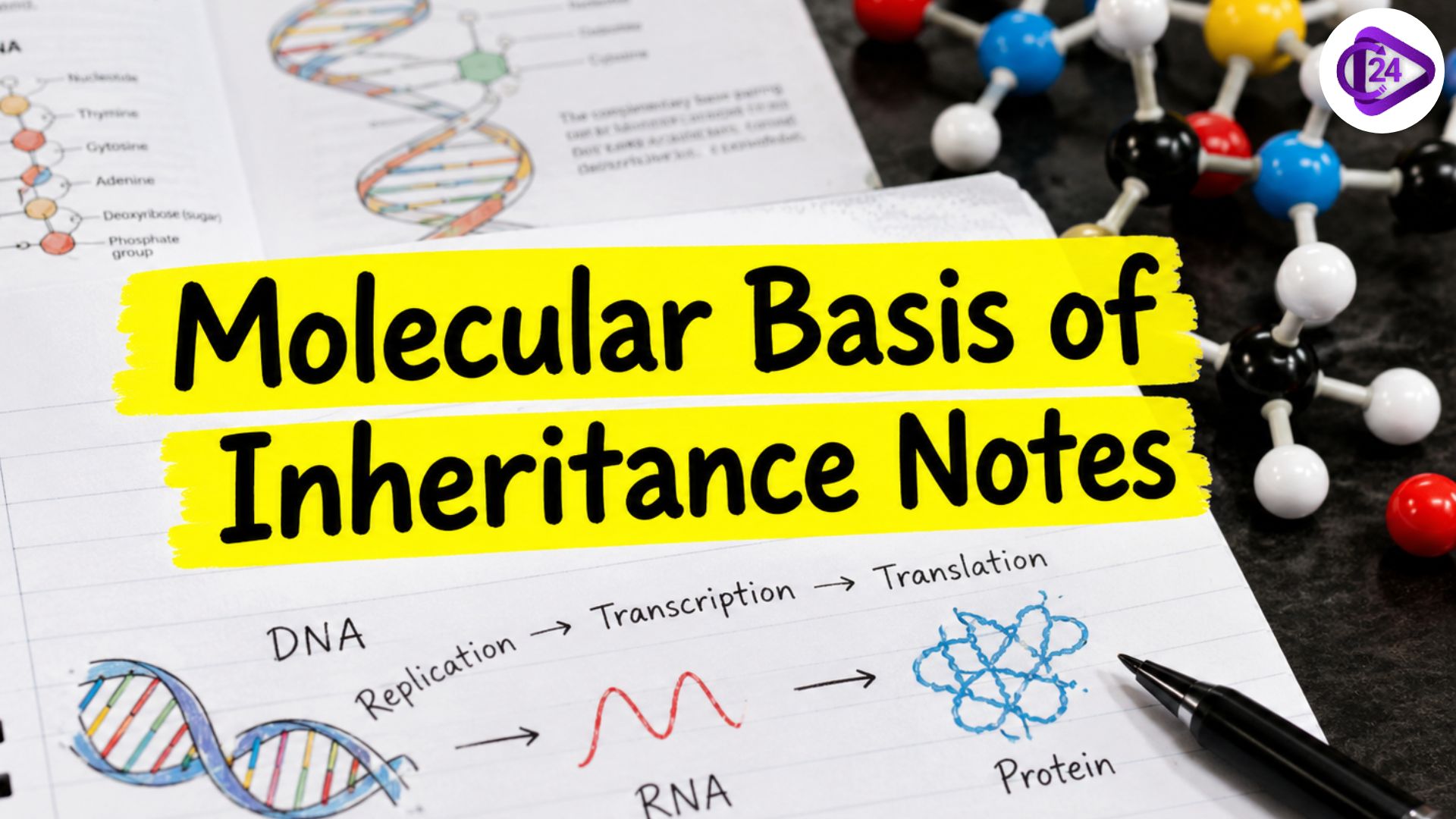
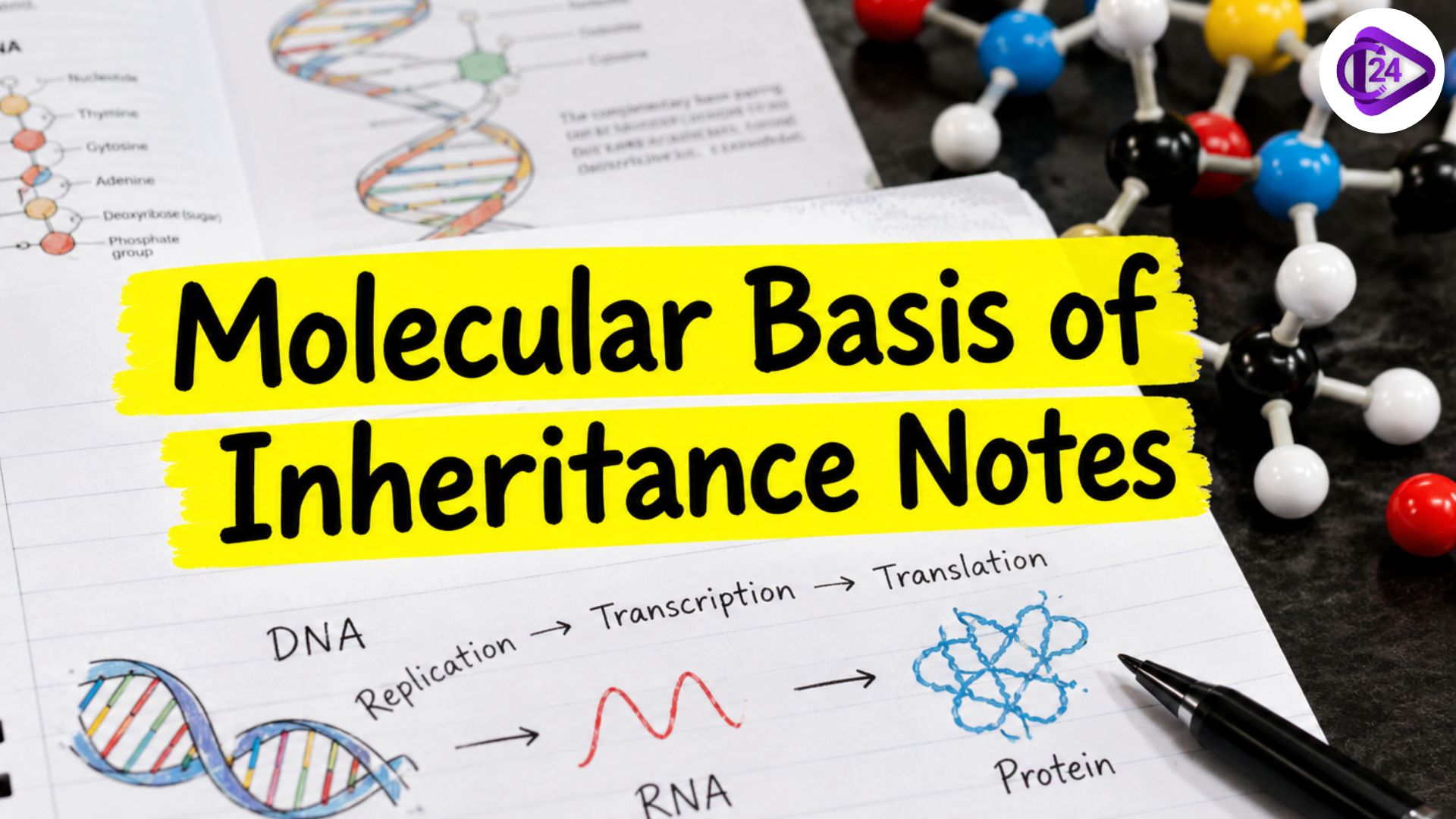
Molecular Basis of Inheritance is one of the most important chapters in NEET Biology. It explains how genetic information stored in DNA is passed from one generation to the next. The chapter covers DNA structure, DNA replication, transcription, translation, genetic code, gene regulation, and DNA fingerprinting.
According to NEET previous-year analysis, 5 to 7 questions appear from this chapter every year, making it a high-priority topic for every NEET aspirant.
NEET Weightage - Molecular Basis of Inheritance
| Parameter | Details |
|---|---|
| Unit | Genetics and Evolution (Class 12) |
| Expected Questions in NEET | 5–7 questions |
| Total Marks | 20–28 marks |
| Difficulty Level | Medium to High |
| NCERT-Based | Yes - 90% questions directly from NCERT |
Key Topics in Molecular Basis of Inheritance (NEET Syllabus 2026)
- Search for Genetic Material
- DNA Structure and Packaging
- RNA Structure
- DNA Replication
- Central Dogma
- Transcription in Prokaryotes and Eukaryotes
- Genetic Code
- Translation (Protein Synthesis)
- Gene Expression and Regulation (Lac Operon)
- Human Genome Project
- DNA Fingerprinting
1. Search for Genetic Material
Griffith's Experiment (1928)
- Frederick Griffith worked on Streptococcus pneumoniae (Pneumococcus).
- Two strains: S-strain (Smooth, virulent) and R-strain (Rough, non-virulent).
- When heat-killed S-strain was mixed with living R-strain and injected into mice → mice died.
- This proved that some transforming principle from dead S-strain converted R-strain into S-strain.
- Griffith called this the Transformation phenomenon.
Avery, MacLeod & McCarty Experiment (1944)
- They identified the transforming principle as DNA.
- Treated S-strain extract with:
- DNase → No transformation (proved DNA is the genetic material)
- RNase → Transformation occurred
- Protease → Transformation occurred
- Conclusion: DNA is the genetic material.
Hershey and Chase Experiment (1952) - Blender Experiment
- Used bacteriophage T2 (virus) to infect E. coli.
- Labelled DNA with radioactive ³²P and Protein with radioactive ³⁵S.
- After infection:
- ³²P (DNA) → found inside bacteria
- ³⁵S (Protein) → remained outside
- Conclusion: DNA, not protein, is the genetic material.
NEET Tip: Griffith's experiment = Transformation | Hershey-Chase = confirmed DNA as genetic material
2. DNA Structure - The Double Helix
Discovery
- James Watson and Francis Crick proposed the Double Helix model of DNA in 1953.
- Based on X-ray diffraction data by Rosalind Franklin and Maurice Wilkins.
Chemical Composition of DNA
DNA is made up of nucleotides. Each nucleotide has 3 components:
- Deoxyribose sugar (5-carbon sugar)
- Phosphate group
- Nitrogenous base - 4 types:
- Purines: Adenine (A), Guanine (G)
- Pyrimidines: Thymine (T), Cytosine (C)
Chargaff's Rules
- A = T (connected by 2 hydrogen bonds)
- G = C (connected by 3 hydrogen bonds)
- This is called complementary base pairing.
Watson-Crick Double Helix Features
| Feature | Details |
|---|---|
| Structure | Two polynucleotide chains coiled around each other |
| Direction | Antiparallel (one 5'→3', other 3'→5') |
| Pitch | 3.4 nm per complete turn |
| Base Pairs per Turn | 10 base pairs |
| Diameter | 2 nm |
| Bonds | Phosphodiester bond (backbone) + Hydrogen bonds (between bases) |
Nucleosome - DNA Packaging
- DNA in eukaryotes is tightly packed around histone proteins.
- Histone octamer = 2 copies each of H2A, H2B, H3, H4.
- DNA wraps around a histone octamer = Nucleosome.
- Nucleosomes connected by H1 histone = Beads on a string.
- This further coils to form chromatin → chromosome.
NEET Tip: 200 bp of DNA = 1 nucleosome (146 bp wrapped + 54 bp linker DNA)
3. RNA Structure
Types of RNA and Their Functions
| Type of RNA | Full Form | Function |
|---|---|---|
| mRNA | Messenger RNA | Carries genetic information from DNA to ribosomes. |
| tRNA | Transfer RNA | Carries amino acids to the ribosome and contains an anticodon. |
| rRNA | Ribosomal RNA | Structural and catalytic component of ribosomes. |
| hnRNA | Heterogeneous Nuclear RNA | Pre-mRNA in eukaryotes before processing. |
Differences Between DNA and RNA
| Feature | DNA | RNA |
|---|---|---|
| Sugar | Deoxyribose | Ribose |
| Bases | A, T, G, C | A, U, G, C |
| Strands | Double-stranded | Usually single-stranded |
| Stability | More stable | Less stable |
| Location | Nucleus, mitochondria, chloroplast | Nucleus and Cytoplasm |
4. DNA Replication
Meselson and Stahl Experiment (1958)
- Proved Semiconservative Replication using E. coli.
- Heavy nitrogen (¹⁵N) to label DNA.
- After 1st generation → Hybrid DNA (¹⁵N-¹⁴N)
- After 2nd generation → 50% Hybrid + 50% Light DNA
- Conclusion: DNA replication is Semiconservative - each new DNA molecule has one old strand and one new strand.
Key Enzymes in DNA Replication
| Enzyme | Function |
|---|---|
| Helicase | Unwinds and separates the two DNA strands |
| DNA Primase | Synthesizes short RNA primers |
| DNA Polymerase III | Main enzyme; adds nucleotides in 5'→3' direction |
| DNA Polymerase I | Removes RNA primer and fills the gap |
| DNA Ligase | Joins Okazaki fragments (seals nicks) |
| Topoisomerase | Relieves tension ahead of replication fork |
| SSB Proteins | Stabilizes single-stranded DNA |
Important Replication Facts
- Replication begins at Origin of Replication (ori).
- E. coli has 1 origin of replication; Eukaryotes have multiple origins.
- Leading strand - synthesized continuously in 5'→3' direction.
- Lagging strand - synthesized discontinuously as Okazaki fragments.
- Okazaki fragments are joined by DNA Ligase.
NEET Tip: DNA Polymerase always works in 5'→3' direction only. It cannot initiate synthesis - needs a primer.
5. Central Dogma
Proposed by Francis Crick in 1958.
DNA → Transcription → RNA → Translation → Protein
Reverse Transcription (Temin's Discovery)
- In retroviruses (e.g., HIV), RNA acts as genetic material.
- RNA is converted back to DNA by the enzyme Reverse Transcriptase.
- This is called Reverse Transcription.
6. Transcription
Transcription is the process of synthesizing RNA from a DNA template.
Transcription in Prokaryotes
- RNA Polymerase is the key enzyme - it does not need a primer.
- RNA Polymerase has a sigma (σ) factor that helps it recognize the promoter region.
- Transcription occurs in 3 steps:
- Initiation - sigma factor binds to promoter
- Elongation - RNA polymerase moves along the template strand (3'→5') and synthesizes RNA in the 5'→3' direction
- Termination - at terminator sequence
Transcription in Eukaryotes
- 3 different RNA Polymerases:
- RNA Pol I → rRNA
- RNA Pol II → mRNA (hnRNA)
- RNA Pol III → tRNA and 5S rRNA
Post-Transcriptional Modifications (in Eukaryotes)
The primary transcript (hnRNA) undergoes RNA Processing:
- Capping - 7-methyl guanosine added at 5' end
- Tailing - Poly-A tail added at 3' end
- Splicing - Introns removed; Exons joined
| Term | Definition |
|---|---|
| Introns | Non-coding sequences - removed from RNA |
| Exons | Coding sequences - present in mature mRNA |
| Splicing | Removal of introns and joining of exons |
7. Genetic Code
The genetic code explains how the sequence of nucleotides in mRNA determines the sequence of amino acids in a protein.
Properties of Genetic Code
| Property | Explanation |
|---|---|
| Triplet | Each codon = 3 nucleotides |
| Degenerate | More than one codon codes for the same amino acid |
| Non-overlapping | Codons are read one at a time without overlapping |
| Commaless | No punctuation between codons |
| Universal | Same code in almost all organisms |
| Unambiguous | Each codon codes for only one amino acid |
Important Codons to Remember
| Codon | Meaning |
|---|---|
| AUG | Start codon (codes for Methionine) |
| UAA | Stop codon (Ochre) |
| UAG | Stop codon (Amber) |
| UGA | Stop codon (Opal/Umber) |
NEET Tip: Total codons = 4³ = 64 | 61 code for amino acids | 3 are stop codons | Only 1 start codon (AUG)
Wobble Hypothesis (Crick)
- The third base of an anticodon can pair with more than one base in a codon.
- This explains why the genetic code is degenerate.
8. Translation (Protein Synthesis)
Translation is the process of synthesizing protein from mRNA.
Components Required for Translation
- mRNA (template)
- Ribosomes (site of protein synthesis)
- tRNA (adaptor molecule - carries amino acids)
- Amino acids
- Enzymes + ATP
Structure of tRNA
- tRNA has a cloverleaf structure (2D) / L-shaped (3D).
- Has an anticodon loop - pairs with a codon on mRNA.
- Has an amino acid acceptor end (3'-CCA-OH) - where the amino acid attaches.
Steps of Translation
- Activation - Amino acid gets attached to tRNA (aminoacylation) - uses ATP
- Initiation - Small ribosomal subunit binds mRNA at the start codon (AUG)
- Elongation - Amino acids are added one by one; a peptide bond forms
- Termination - Stop codon (UAA/UAG/UGA) is reached; Release Factor binds; polypeptide is released
Ribosome Sites
| Site | Full Form | Function |
|---|---|---|
| A site | Aminoacyl site | Incoming aminoacyl-tRNA binds |
| P site | Peptidyl site | Growing polypeptide chain stays here |
| E site | Exit site | Uncharged tRNA exits |
9. Gene Expression and Regulation - Lac Operon
The Lac Operon was proposed by Jacob and Monod (1961) in E. coli.
Structure of the Lac Operon
| Component | Function |
|---|---|
| Regulator gene (i) | Produces repressor protein |
| Promoter (p) | RNA polymerase binding site |
| Operator (o) | Repressor binding site |
| Structural genes | z (β-galactosidase), y (permease), a (transacetylase) |
How Lac Operon Works
In the absence of lactose (Operon OFF):
- Repressor protein binds to operator → blocks RNA polymerase → genes not expressed.
In the presence of lactose (Operon ON):
- Lactose acts as an inducer.
- Lactose binds to repressor → repressor cannot bind to operator → RNA polymerase transcribes structural genes → enzymes are produced to metabolize lactose.
NEET Tip: The Lac Operon is an example of negative regulation- the repressor normally keeps it OFF. Lactose acts as an inducer (not a repressor).
10. Human Genome Project (HGP)
Key Facts About HGP
| Feature | Details |
|---|---|
| Started | 1990 |
| Completed | 2003 |
| Goals | Sequence all 3 billion bp of human DNA; identify all human genes |
| Total genes | ~30,000 genes |
| Total base pairs | ~3 × 10⁹ (3 billion) |
| Repetitive sequences | A large portion of the genome (no coding function) |
| Technologies used | BAC (Bacterial Artificial Chromosome), YAC (Yeast Artificial Chromosome) |
Goals of HGP
- Identify all ~20,000–25,000 genes in human DNA.
- Determine the sequence of the 3 billion chemical base pairs.
- Store information in databases.
- Improve tools for data analysis.
- Address ethical, legal, and social issues (ELSI).
Important Terms
- EST (Expressed Sequence Tags) - an approach to identify all genes expressed in an organism.
- Sequence Annotation - assigning functions to the sequenced DNA.
11. DNA Fingerprinting
DNA Fingerprinting was developed by Alec Jeffreys in 1985.
Principle
- Every individual has unique sequences of DNA called VNTRs (Variable Number of Tandem Repeats) or Satellite DNA.
- These repetitive sequences differ in number and pattern from person to person (except in identical twins).
Steps in DNA Fingerprinting
- DNA Isolation from blood, hair, saliva, semen, etc.
- Restriction digestion - DNA is cut with restriction enzymes.
- Gel Electrophoresis - DNA fragments are separated by size.
- Southern Blotting - DNA transferred from gel to nitrocellulose membrane.
- Hybridization - Radioactive VNTR probes added.
- Autoradiography - Pattern of bands detected as a DNA fingerprint.
Applications of DNA Fingerprinting
- Forensic science - identify criminals
- Paternity disputes - determine biological parents
- Phylogenetic studies - study evolutionary relationships
- Identifying disaster victims
NEET Tip: DNA Fingerprinting → VNTRs → Satellite DNA → Same in identical twins, different in all other individuals.
Quick Revision - Important Scientists & Their Contributions
| Scientist | Contribution |
|---|---|
| Friedrich Miescher (1869) | First isolated nucleic acid ("Nuclein") from pus cells |
| Frederick Griffith (1928) | Discovered Transformation in Pneumococcus |
| Avery, MacLeod & McCarty (1944) | Proved that DNA is the transforming principle |
| Hershey & Chase (1952) | Confirmed DNA as genetic material using bacteriophage |
| Watson & Crick (1953) | Proposed the double helix model of DNA |
| Rosalind Franklin | X-ray diffraction data of DNA |
| Meselson & Stahl (1958) | Proved Semiconservative Replication |
| Francis Crick | Proposed Central Dogma + Wobble Hypothesis |
| Jacob & Monod (1961) | Proposed the Lac Operon model |
| Marshall Nirenberg | Deciphered the first genetic codon (UUU = Phe) |
| Alec Jeffreys (1985) | Developed DNA Fingerprinting |
Common NEET Mistakes to Avoid
- Don't confuse: Template strand is read 3'→5', but RNA is synthesized 5'→3'
- Don't confuse: Introns = removed (intervening sequences) | Exons = expressed
- Don't confuse: AUG = Start codon on mRNA | But in DNA, it is ATG
- Don't confuse: Lac Operon - Lactose is the inducer, NOT the repressor
- Don't confuse: Meselson-Stahl used ¹⁵N (heavy nitrogen), NOT radioactive material
- Don't confuse: Hershey and Chase used ³²P for DNA and ³⁵S for protein
Summary Table - Must Memorise for NEET
| Topic | Key Fact |
|---|---|
| Genetic material in most organisms | DNA |
| Genetic material in TMV, HIV | RNA |
| DNA structure proposed by | Watson & Crick (1953) |
| A-T bond | 2 hydrogen bonds |
| G-C bond | 3 hydrogen bonds |
| Semiconservative replication was proved by | Meselson & Stahl |
| Okazaki fragments joined by | DNA Ligase |
| Start codon | AUG (Methionine) |
| Stop codons | UAA, UAG, UGA |
| Total codons | 64 |
| Codons for amino acids | 61 |
| Lac Operon proposed by | Jacob & Monod |
| Inducer in Lac Operon | Lactose |
| DNA Fingerprinting developed by | Alec Jeffreys (1985) |
| Human Genome Project completed | 2003 |
| Total human base pairs | ~3 billion (3 × 10⁹) |
Previous Year NEET Questions - Molecular Basis of Inheritance
Q1. The two strands of DNA are antiparallel. What does this mean?
Ans. One strand runs in the 5'→3' direction and the other runs in the 3'→5' direction.
Q2. Which enzyme joins Okazaki fragments during DNA replication?
Ans. DNA Ligase.
Q3. The first codon to be deciphered was:
Ans. UUU - codes for Phenylalanine (deciphered by Marshall Nirenberg).
Q4. Which of the following is NOT a property of the genetic code?
Ans. Overlapping (the genetic code is Non-overlapping).
Q5. In the Lac Operon, the structural gene 'z' codes for:
Ans. β-galactosidase.
Q6. DNA fingerprinting involves which type of DNA sequences?
Ans. Satellite DNA / VNTRs (Variable Number of Tandem Repeats).
Q7. The experiment that proved DNA replication is semiconservative was done by:
Ans. Meselson and Stahl (1958).
Q8. Which RNA acts as an adapter molecule during translation?
Ans. tRNA (Transfer RNA).
Important Links
| NEET 2026 Syllabus | NEET Paper Analysis 2026 |
| Free NEET Study Material | NEET 2025 Biology Analysis |
| NEET PYQ Papers | NEET Last Minute Tips |
| NEET 2025 Question Paper | NEET Last 7 Days Strategy |
Conclusion
Molecular Basis of Inheritance is a must-master chapter for NEET 2026 aspirants. From DNA replication and transcription to translation, genetic code, Lac Operon, and DNA fingerprinting - every topic carries direct NEET marks. Since 90% of questions are NCERT-based, consistent revision of this Molecular Basis of Inheritance study guide, combined with solving previous-year NEET questions, will help you score maximum marks from this high-weightage chapter in NEET 2026.
FAQs - Molecular Basis of Inheritance NEET 2026
Our Courses







Post a Comment
Your email address will not be published. Required fields are marked *