

Daily Quizzes
Mock Tests
No tests attempted yet.
Select Category
SSC CPO Preparation Tips 2026: Paper 1, Paper 2, Physical Test & 4-Month Study Plan
SSC CPO Preparation Tips 2026 provides a complete strategy for preparing for Paper 1, Paper 2 and the PST/PET. It covers subject-wise preparation for Reasoning, General Knowledge, Quantitative Aptitude and English, along with current affairs revision, previous year papers, mock tests, time management, physical training and a structured 4-month study plan. Candidates can learn how to start SSC CPO 2026 preparation, create an effective daily routine and prepare for the physical test alongside their written exam preparation.


Get in Touch with Class24 for All Your Needs!
The Staff Selection Commission has released a fresh notice for Sub-Inspector in Delhi Police and CAPFs Examination, 2026, with online applications open from 10.09.2026 to 30.09.2026. Since the exam pattern has changed from earlier cycles, SSC CPO Preparation Tips 2026 need to be rebuilt around the new structure rather than last year's strategy.
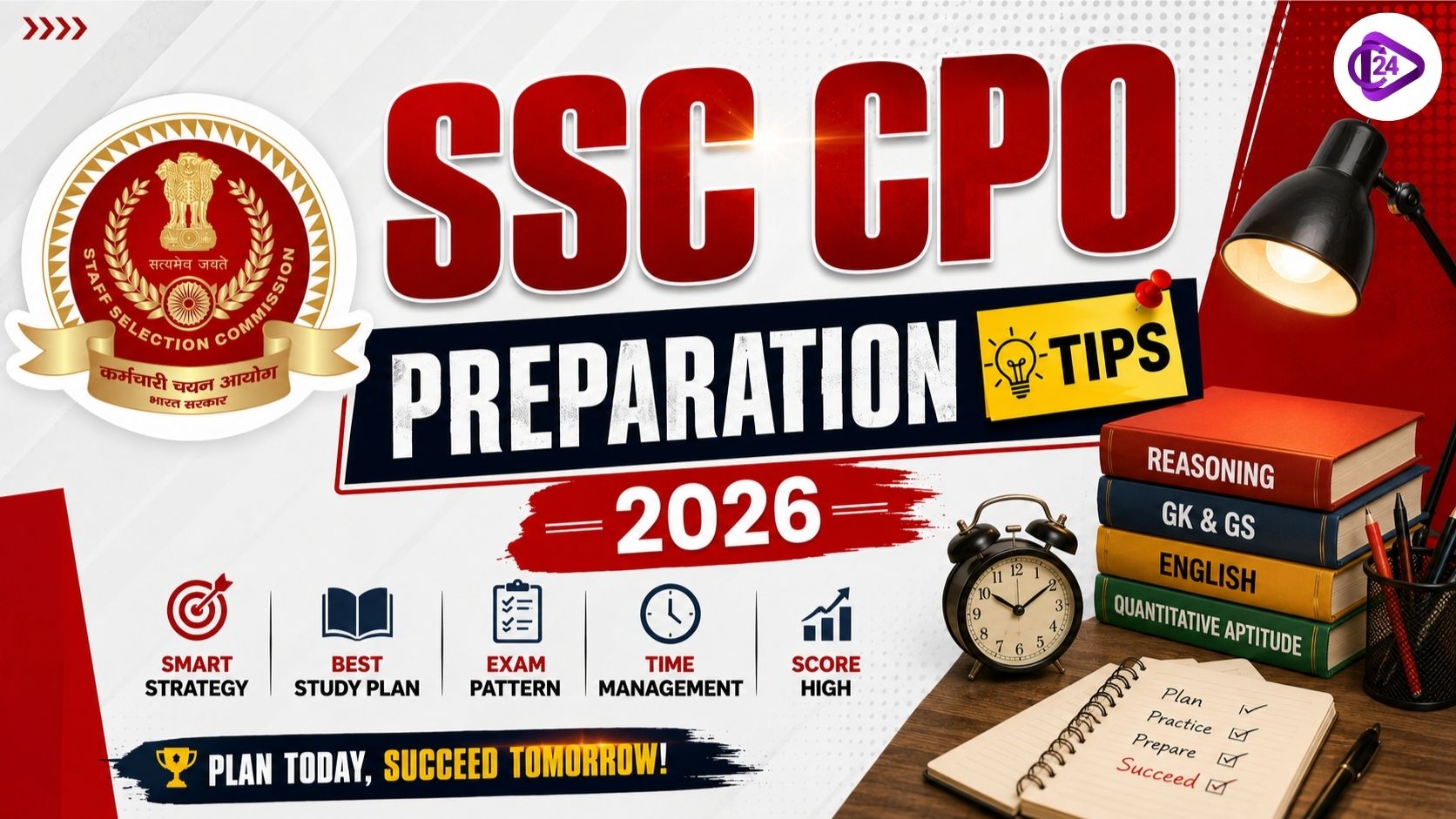
A clear plan covering Reasoning, General Knowledge, Quantitative Aptitude, English, and physical training can make the real difference between clearing and missing the cut-off this cycle. SSC CPO selection runs through Paper-I, PST/PET, Paper-II, and a Detailed Medical Examination, so starting early on both academic revision and physical training gives candidates a genuine edge over last-minute cramming.
Understanding the SSC CPO Exam Pattern First
Before diving into subject-wise revision, candidates preparing for SSC CPO 2026 should have a clear grasp of the revised exam structure, since Paper-I and Paper-II now carry different questions, marks and sectional timers.
| Paper | Subjects | Questions | Marks |
|---|---|---|---|
| Paper-I | Reasoning, GK, Quantitative Aptitude, English (25 each) | 100 | 100 |
| Paper-II | Reasoning, GK, Quant (20 each) + English (100) | 160 | 320 |
Paper-I runs for 1 hour with a strict 15-minute sectional timer on each part, so candidates cannot borrow time from one section to finish another. Negative marking is 0.25 marks per wrong answer in Paper-I and 0.50 marks per wrong answer in Paper-II, and Paper-II's difficulty level is higher than Paper-I.
How to Prepare for SSC CPO Paper-I
Cracking Paper-I calls for building speed and accuracy across four sections, since each part now has its own fixed 15-minute window and there is no combined time cushion to fall back on.
Reasoning and General Intelligence
| Topic | What to Practice | Preparation Tip |
|---|---|---|
| Analogies & Coding-Decoding | Word, letter, and number-based analogy sets; standard and mixed coding patterns | Practice 15-20 questions daily to build pattern recognition speed |
| Blood Relations & Syllogism | Family tree problems, coded relations, and Venn diagram-based syllogisms | Draw quick diagrams instead of solving mentally to avoid errors |
| Space Visualization & Pattern Folding | Punched hole, paper folding and figural pattern questions | Solve one timed set daily to build recognition speed |
| Direction Sense & Series | Distance and direction problems, number/figural series | Use rough diagrams for direction questions to save time |
| Statement & Conclusion | Syllogistic reasoning, drawing inferences, critical thinking | Revise common question formats weekly to spot them instantly |
General Knowledge and Current Affairs
| Topic | What to Practice | Preparation Tip |
|---|---|---|
| Current Affairs | National and international news, government schemes, and appointments | Read a daily current affairs digest, since GK gets only 15 minutes |
| Static GK | Indian history, geography, and constitutional framework | Revise one static topic every day on a fixed rotation |
| Science & Technology | Basic physics, chemistry, biology, and recent developments | Focus on application-based facts rather than deep theory |
| Sports & Awards | Major tournaments, winners, and national/international awards | Maintain a short weekly notes page for quick revision |
| Police & Defence Updates | Recent developments related to Delhi Police, CAPFs, and defence forces | Follow official press releases for accurate, exam-relevant updates |
Quantitative Aptitude
| Topic | What to Practice | Preparation Tip |
|---|---|---|
| Percentage, Ratio & Profit-Loss | Basic to moderate-level word problems with shortcuts | Learn 8-10 core formulas and apply them through daily practice sets |
| Time, Speed & Work | Combined work problems, pipes and cisterns, relative speed | Practice unit-conversion tricks to solve faster under the 15-minute cap |
| Data Interpretation | Bar graphs, pie charts, and tabular data-based questions | Attempt one DI set daily to build calculation speed and accuracy |
| Algebra & Number System | Simplification, HCF-LCM, and basic algebraic identities | Revise formulas weekly and solve mixed-topic quizzes |
| Mensuration & Geometry | Area, perimeter, and circle-based questions | Focus only on frequently asked question types from previous papers |
English Comprehension
| Topic | What to Practice | Preparation Tip |
|---|---|---|
| Grammar & Error Detection | Tense, subject-verb agreement, articles, and prepositions | Revise one grammar rule daily and apply it through error-spotting practice |
| Vocabulary | Synonyms, antonyms, one-word substitutions, and idioms | Maintain a daily word list and revise it every weekend |
| Reading Comprehension | Passage-based questions testing inference and central idea | Practice one timed passage daily to improve reading speed |
| Sentence Improvement | Sentence correction and fill-in-the-blanks | Focus on commonly repeated error patterns from past papers |
Sectional Time Management in Paper-I and Paper-II
Since SSC CPO now runs on fixed sectional timers, budgeting time correctly matters as much as subject knowledge.
| Part | Paper-I (per part) | Paper-II (per part) |
|---|---|---|
| Reasoning | 15 minutes (25 questions) | 20 minutes (20 questions) |
| GK & GA | 15 minutes (25 questions) | 20 minutes (20 questions) |
| Quantitative Aptitude | 15 minutes (25 questions) | 20 minutes (20 questions) |
| English Comprehension | 15 minutes (25 questions) | 60 minutes, separate slot (100 questions) |
Since time cannot be shifted between parts, practising each subject as an isolated, timed mock is more useful than only attempting full-length papers.
Tips to Adapt to the New SSC CPO Exam Pattern 2026
The sectional timers and the higher Paper-II negative marking are the biggest changes this cycle, so a few pattern-specific habits are worth building early.
| Pattern Change | What to Do | Why It Matters |
|---|---|---|
| Fixed sectional timers (15 min Paper-I, 20 min Paper-II) | Always mock with a stopwatch set to the exact section time, never an open combined timer | The real exam will not allow borrowing time from one section to finish another |
| No time flexibility between parts | Attempt the easiest section first within its own window | A locked timer means marks lost in one part cannot be recovered from another |
| Separate 60-minute English slot in Paper-II | Practice English Comprehension as its own longer, standalone block | It now runs on its own slot with 100 questions, not mixed with other sections |
| Higher Paper-II negative marking (0.50) | Treat Paper-II like a distinct exam rather than "the same subjects again" | A tougher difficulty level and higher penalty call for a more selective attempt strategy |
| Short per-part duration | Track accuracy per section, not just overall accuracy | A 15-minute cap punishes overthinking on one tough question far more than a flexible limit did |
| Limited time per question | Revise formulas and shortcuts to instant-recall level for Quant and Reasoning | 25 or 20 questions in 15-20 minutes leaves little room to derive a method mid-exam |
Physical Standards for SSC CPO PST/PET
Clearing the written test is only half the journey. The Physical Standard Test and Physical Endurance Test are mandatory qualifying stages that follow Paper-I.
| Test | Standard |
|---|---|
| Height (Male, General) | 170 cm (relaxation for hill areas, ST and reserved categories) |
| Height (Female, General) | 157 cm (relaxation for hill areas, ST and reserved categories) |
| Chest (Male, General) | 80 cm, expandable to 85 cm |
| Race (Male) | 100 m in 16 seconds; 1.6 km in 6.5 minutes |
| Race (Female) | 100 m in 18 seconds; 800 m in 4 minutes |
| Long/High Jump (Male) | 3.65 m / 1.2 m, in 3 chances each |
| Long/High Jump (Female) | 2.7 m / 0.9 m, in 3 chances each |
How to Prepare for PST/PET
Building the fitness needed for these tests takes a dedicated training plan, since it cannot be achieved in the last few weeks before the test date.
| Training Phase | Focus Area |
|---|---|
| Months 1-2 | Build stamina with light jogging (2-3 km) and basic stretching daily |
| Month 3 | Gradually increase running distance and introduce interval sprints |
| Month 4 | Practice timed runs matching the actual 1.6 km / 800 m distance |
| Final 2-3 Weeks | Focus on race-day pacing, recovery, and light maintenance runs only |
- Run at least 4-5 days a week, gradually increasing pace rather than distance alone.
- Practice the exact race distance and cut-off time under similar conditions at least twice a month.
- Include basic strength exercises like squats and lunges to improve running efficiency and long/high jump performance.
- Get a general fitness check-up done early to rule out any medical concerns before intense training begins.
- Stay consistent with hydration and a balanced diet, since endurance depends as much on recovery as on training.
Preparing for SSC CPO Paper-II
SSC CPO Paper-II preparation should focus heavily on English, since this stage is conducted only for candidates who clear the PST/PET, and English alone carries 200 of the paper's 320 marks.
- Revise advanced grammar rules and sentence correction regularly, since Paper-II difficulty is higher than Paper-I.
- Practice comprehension passages with a focus on inference-based questions, given the separate 1-hour, 100-question English slot.
- Keep Reasoning, GK and Quant sharp too, each with a 20-minute cap and 0.50 negative marking per wrong answer.
- Attempt previous year Paper-II sets to get used to the tougher difficulty level.
Why Previous Year Papers and Mock Tests Matter
No SSC CPO strategy is complete without regular practice on previous year papers, since they reveal the actual difficulty level and repeated question patterns used by the Commission.
- Solve at least 3-4 years of previous SSC CPO Paper-I and Paper-II papers to identify recurring topics.
- Take one full-length mock test weekly in the early months, increasing to twice a week closer to the exam.
- Practice with the same sectional timers as the real exam, not just an overall time limit.
- Maintain an error log to track and revise mistakes from each attempt.
Dos and Don'ts for SSC CPO Aspirants
A few practical dos and don'ts often get overlooked when candidates stay focused only on subject revision.
- Do attempt easier questions first within each section to secure guaranteed marks before the 15/20-minute timer runs out.
- Do revise formulas and shortcuts weekly instead of learning them only once.
- Don't guess randomly, since Paper-II's 0.50 negative marking is double that of Paper-I.
- Don't delay physical fitness training until after Paper-I, as PST/PET requires months of preparation.
Recommended Study Plan for SSC CPO 2026
A structured timetable that moves from concept-building to full-length, sectional-timed practice as the exam date approaches works best for most aspirants.
| Phase | Suggested Focus |
|---|---|
| Months 1-2 | Build core concepts in Reasoning, Quant, GK and English grammar |
| Month 3 | Start sectional mock tests with the actual 15/20-minute timers, plus daily current affairs |
| Month 4 | Attempt full-length Paper-I and Paper-II mocks under timed conditions |
| Final 2-3 Weeks | Focus on error analysis, weak topics, and light revision |
| Alongside Academics | Follow a daily running and fitness routine for PST/PET |
Common Mistakes SSC CPO Aspirants Should Avoid
- Ignoring physical fitness until after Paper-I results are declared.
- Practising with untimed sets and only realising the sectional timer pressure on exam day.
- Underestimating Paper-II, assuming it is only "English" and therefore easy to clear.
- Skipping regular mock tests and relying only on reading notes.
Conclusion
A well-rounded SSC CPO 2026 strategy works best when candidates prepare for Paper-I, the Physical Test, and Paper-II together rather than one after the other. With the revised sectional-timer pattern now in place, practising each subject as a standalone, timed section, alongside a steady fitness routine, will help candidates approach the exam with confidence and consistency.
| Important Links |
|---|
| SSC CPO 2026 Notification |
| SSC CPO 2026 Syllabus |
| SSC CPO 2026 Exam Pattern |
| SSC CPO Physical Test (PST/PET) |
| SSC CPO Best Books |
| SSC CPO Previous Year Question Paper |
| SSC CPO Admit Card |
SSC CPO Preparation Tips 2026: FAQs
Recent Quizzes

Recent Articles
.png)
Our Courses



Post a Comment
Your email address will not be published. Required fields are marked *