

Daily Quizzes
Mock Tests
No tests attempted yet.
Select Category
Animal Kingdom NEET Biology Notes 2026 | Complete NCERT-Based Revision Notes
Animal Kingdom NEET Biology Notes provide complete NCERT-based coverage of classification criteria, non-chordates, chordates, vertebrate classes, important examples, exceptions, and quick revision points. These notes are specially designed for NEET aspirants to revise high-yield concepts, frequently asked facts, and exam-oriented topics in a simple and structured manner.


Get in Touch with Class24 for All Your Needs!
Animal Kingdom NEET Biology Notes are essential for mastering one of the most important chapters in NEET Biology. This chapter covers animal classification, levels of organisation, symmetry, coelom, segmentation, non-chordates, chordates, and vertebrate classes. Since multiple questions are asked every year from Animal Kingdom, understanding characteristic features, examples, and important exceptions can significantly improve accuracy and scoring potential in the NEET examination.
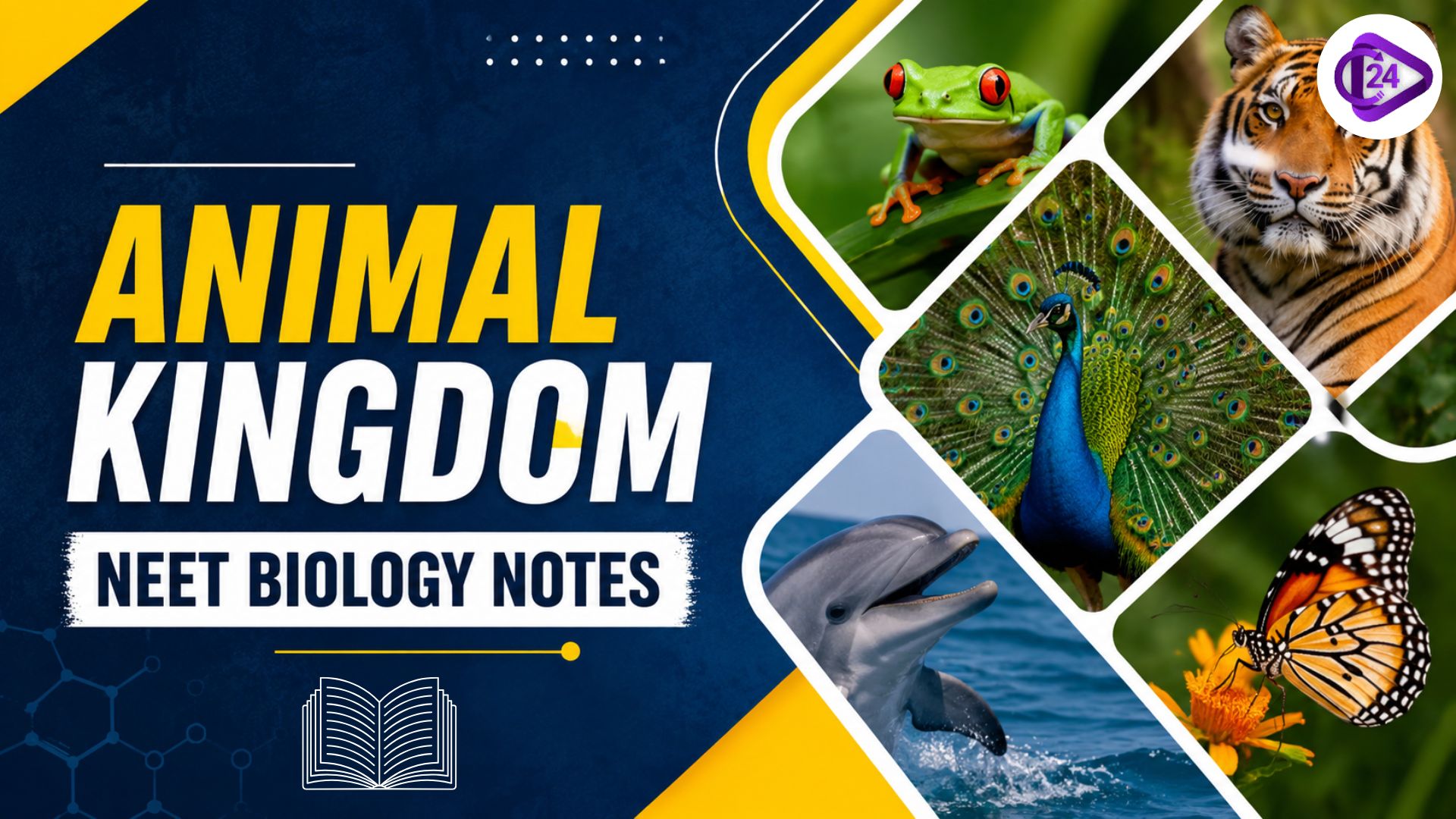
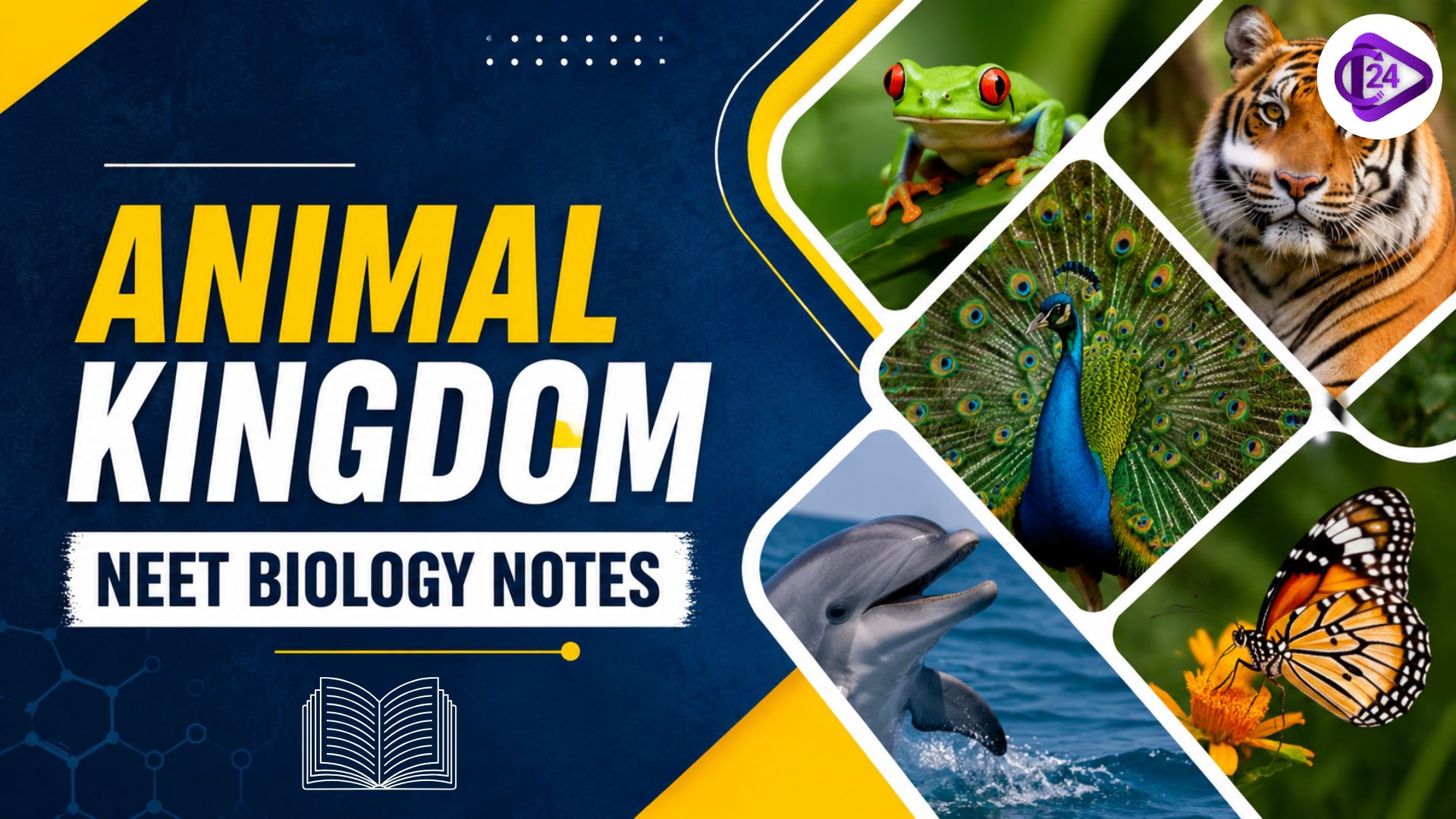
Animal Kingdom is one of the most frequently tested chapters in NEET Biology. On average, 2-4 questions come directly from this chapter every year. Questions are mostly based on characteristic features of each phylum/class, examples of organisms, classification basis, and diagram-based identification. Memorising examples along with their phylum is essential.
1. BASIS OF CLASSIFICATION
Animals are classified based on the following fundamental features. These criteria are extremely important because almost every MCQ in this chapter tests whether you can match an organism to its correct classification basis.
Levels of Organisation
- Cellular level organisation: Cells are arranged as loose aggregates (e.g., sponges/Porifera)
- Tissue-level organisation: Cells performing the same function are arranged into tissues (e.g., Cnidarians like Hydra)
- Organ-level organisation: Tissues group to form organs (e.g., Platyhelminthes/flatworms)
- Organ system level organization: Organs associate to form functional systems; can be of two types:
- Incomplete digestive system - single opening (mouth), e.g., Platyhelminthes
- Complete digestive system - two openings (mouth + anus), e.g., Annelida, Arthropoda, etc.
Symmetry
- Asymmetrical: No body symmetry - e.g., most sponges
- Radial symmetry: Body parts arranged around a central axis (any plane through the axis divides into similar halves) - e.g., Coelenterates, Ctenophores, Echinoderms (adult)
- Bilateral symmetry: Body can be divided into identical left and right halves by a single plane through the axis - e.g., Annelids, Arthropods, Chordates
Diploblastic and Triploblastic Organisation
- Diploblastic: Two embryonic layers - ectoderm and endoderm, with a non-cellular mesoglea in between. E.g., Cnidaria (Coelenterates)
- Triploblastic: Three embryonic layers — ectoderm, mesoderm, and endoderm. E.g., all animals from Platyhelminthes onwards
Coelom (Body Cavity) - VERY IMPORTANT FOR NEET
The space between the body wall and the gut wall, lined by mesoderm, is called coelom.
| Type | Definition | Examples |
|---|---|---|
| Acoelomate | No body cavity present | Platyhelminthes |
| Coelomate (Eucoelomate) | True coelom present, lined by mesoderm on both sides (body wall and gut) | Annelida, Arthropoda (haemocoel - reduced), Mollusca, Echinodermata, Chordata |
| Pseudocoelomate | Body cavity present but NOT lined by mesoderm (mesoderm present only as scattered pouches) | Aschelminthes (Nematoda) |
Segmentation (Metamerism)
External and internal division of the body into segments with serial repetition of organs is called metameric segmentation. Seen in Annelida onwards (Annelida, Arthropoda, Chordata).
Notochord - KEY DIFFERENTIATOR
A mesodermally derived rod-like structure formed on the dorsal side during embryonic development.
- Chordates: Notochord present (at some stage of life)
- Non-chordates: Notochord absent
2. NON-CHORDATES (Invertebrates) - PHYLUM-WISE NOTES
Phylum Porifera (Sponges)
- Cellular level of organisation, mostly asymmetrical
- Possess a unique water canal system (canal system) for circulation of water to bring food and oxygen, and remove waste — Types: Ascon, Sycon, Leucon
- The body has numerous pores called ostia (water enters) and a large opening called osculum (water exits)
- Outer layer: pinacocytes; Inner layer lined by flagellated cells called choanocytes (collar cells)
- Skeleton made of spicules or spongin fibres
- Mostly marine and sessile; all are hermaphrodites
- Reproduction: asexual (budding, gemmules) and sexual; development includes a larval stage
- Examples: Sycon (Scypha), Spongilla (freshwater sponge), Euspongia (bath sponge)
Phylum Cnidaria (Coelenterata)
- Aquatic, mostly marine, sessile or free-swimming
- Diploblastic, radially symmetrical
- Cnidoblasts/cnidocytes (stinging cells) present on tentacles — used for defence and capture of prey
- Two basic body forms: Polyp (sessile, e.g., Hydra) and Medusa (umbrella-shaped, free-swimming, e.g., jellyfish)
- Many cnidarians show polymorphism — both polyp and medusa forms exist (e.g., Obelia)
- Digestion: extracellular and intracellular
- Some Cnidarians, like corals, have a skeleton of calcium carbonate
- Examples: Hydra, Physalia (Portuguese man-of-war), Adamsia, Pennatula, Meandrina (brain coral), Gorgonia
Phylum Ctenophora (Sea walnuts/Comb jellies)
- Exclusively marine, free-swimming
- Diploblastic, biradial symmetry
- The body bears eight external rows of cilia called comb plates, used for locomotion
- Digestion: extracellular and intracellular
- Bioluminescence present (property of emitting light)
- Sexes are not separate (Hermaphrodite/Monoecious). Reproduction is only sexual, with external fertilization and indirect development.
- Reproduction only sexual; external fertilisation, indirect development
- Examples: Ctenoplana, Pleurobrachia
Phylum Platyhelminthes (Flatworms)
- Dorsoventrally flattened body (flat from top to bottom)
- Triploblastic, acoelomate, bilaterally symmetrical
- Mostly endoparasites in animals (some free-living)
- Have specific organs for attachment to host called hooks/suckers in parasitic forms
- Body surface covered with tegument (in parasitic forms) instead of cilia
- Hermaphrodites (sexes are not separate).
- Examples: Fasciola hepatica (liver fluke), Taenia solium (tapeworm), Planaria (free-living - capable of regeneration)
Phylum Aschelminthes (Nematoda - Roundworms)
- Body circular in cross-section, hence the name roundworms
- Triploblastic, pseudocoelomate, bilaterally symmetrical
- Mostly endoparasites causing diseases in humans, plants, and animals
- Alimentary canal complete with a well-developed muscular pharynx
- Excretory substances are removed through the excretory pore
- Sexes are separate (dioecious) - males are generally smaller than females
- Fertilisation internal; development direct or indirect
- Examples: Ascaris (roundworm), Wuchereria (filarial worm, causes elephantiasis), Ancylostoma (hookworm)
Phylum Annelida
- Body metamerically segmented (true segmentation), hence the name (Latin annulus = little ring)
- Triploblastic, coelomate (true coelom present), bilaterally symmetrical
- Found in marine, freshwater, and terrestrial habitats
- Closed circulatory system present
- Excretion through nephridia
- Nervous system: paired ganglia connected by lateral nerves to a central nerve ring
- Examples: Nereis (marine), Pheretima (earthworm), Hirudinaria (blood-sucking leech)
Phylum Arthropoda - LARGEST PHYLUM (in number of species)
- The most species-rich phylum in the Animal Kingdom (over two-thirds of all named species)
- Triploblastic, coelomate (body cavity mainly haemocoel), bilaterally symmetrical.
- Jointed legs (Greek: arthros = joint, podos = foot)
- Body covered by a chitinous exoskeleton
- Body divided into head, thorax, and abdomen
- Respiration: through gills, tracheae, or book lungs
- Open circulatory system; sensory organs include antennae, eyes (compound and simple), statocysts
- Excretion through Malpighian tubules
- Examples: Locusta (locust), Apis (honey bee), Bombyx (silkworm), Laccifer (lac insect), Limulus (king crab — "living fossil"), Palaemon (prawn)
Phylum Mollusca - SECOND LARGEST PHYLUM
- The second-largest animal phylum
- Triploblastic, coelomate, bilaterally symmetrical
- Body covered by a calcareous shell (in most), divisible into head, muscular foot, and visceral hump
- Mantle present, covering soft body; space between mantle and body = mantle cavity
- A rasping/file-like organ for feeding called radula (absent in bivalves)
- Excretion through the kidneys
- Examples: Pila (apple snail), Pinctada (pearl oyster), Sepia (cuttlefish), Loligo (squid), Octopus (devil fish — most advanced mollusc), Aplysia (sea hare), Dentalium (tusk shell), Chaetopleura (chiton)
Phylum Echinodermata
- Exclusively marine animals
- Body unsegmented, triploblastic, coelomate
- Radially symmetrical as adults but bilaterally symmetrical as larvae
- Calcium carbonate spicules/ossicles form an endoskeleton, giving a spiny skin appearance (hence the name)
- Unique water vascular system for locomotion, capture, and transport of food
- Sexes are separate (dioecious); reproduction is sexual, fertilization is external, and development is indirect with a free-swimming larva.
- Examples: Asterias (starfish/sea star), Echinus (sea urchin), Antedon (sea lily), Cucumaria (sea cucumber), Ophiura (brittle star)
Phylum Hemichordata
- Small group of worm-like marine animals, formerly considered a sub-phylum under Chordata, now a separate phylum
- Triploblastic, coelomate, bilaterally symmetrical
- Body divided into proboscis, collar, and trunk
- Circulatory system open type
- Excretion by a single proboscis gland
- Sexes separate; fertilisation external; development indirect
- Examples: Balanoglossus, Saccoglossus
3. PHYLUM CHORDATA
General Characteristics of Chordates (Three Key Features)
- Notochord present (at some stage of life)
- Dorsal, hollow nerve cord present
- Paired pharyngeal gill slits present
Additional features: triploblastic, coelomate, bilaterally symmetrical, possess a post-anal tail and a closed circulatory system.
Classification of Chordata
Chordata is divided into three subphyla: Urochordata, Cephalochordata, and Vertebrata
A. Subphylum Urochordata (Tunicata)
- Notochord present only in larval tail, disappears in adults
- Marine, found as either solitary or in colonies
- Examples: Ascidia, Salpa, Doliolum
B. Subphylum Cephalochordata
- The notochord extends from head to tail region and persists throughout life
- Marine animals
- Example: Branchiostoma (Amphioxus/lancelet)
C. Subphylum Vertebrata
- Notochord is present during the embryonic period and is replaced by a cartilaginous or bony vertebral column in adults
- Also possess a ventral muscular heart with 2, 3, or 4 chambers; kidneys for excretion and osmoregulation
- Divided into two groups: Agnatha (jawless) and Gnathostomata (jawed)
4. CLASSES OF VERTEBRATES (Most Important Section for NEET)
Class Cyclostomata (Agnatha - Jawless fishes)
- All living members are ectoparasitic on some fishes
- Body elongated, bears 6-15 pairs of gill slits for respiration
- No scales, no paired fins
- Cranium and vertebral column cartilaginous
- Circulation: closed type
- Marine, but migrate to freshwater for breeding (anadromous); die after spawning
- Examples: Petromyzon (lamprey), Myxine (hagfish)
Class Chondrichthyes (Cartilaginous fishes)
- Marine animals with a streamlined body
- Endoskeleton entirely cartilaginous
- Mouth located ventrally; notochord persists throughout life
- Gill slits separate and are without an operculum (gill cover)
- Skin has placoid scales; teeth are modified placoid scales, backwardly directed
- Some have electric organs (e.g., Torpedo) or poison sting (e.g., Trygon)
- Sexes separate; fertilisation internal; mostly viviparous
- Examples: Scoliodon (dogfish), Pristis (sawfish), Carcharodon (great white shark), Trygon (sting ray)
Class Osteichthyes (Bony fishes)
- Endoskeleton made of bone, can be marine or freshwater
- Body streamlined; mouth usually terminal
- Gills covered by an operculum on each side
- Skin covered with cycloid/ctenoid scales (some have no scales)
- The heart is 2-chambered (1 atrium + 1 ventricle) air bladder present for buoyancy
- Sexes separate, fertilisation usually external; mostly oviparous; development direct
- Examples: Marine: Exocoetus (flying fish), Hippocampus (seahorse) | Freshwater: Labeo, Catla, Clarias | Aquarium: Betta, Pterophyllum
Class Amphibia
- Found in both aquatic and terrestrial habitats
- Most have two pairs of limbs; the body is divisible into head, trunk and tail (tail present in some)
- Skin moist, without scales; respiration through gills, lungs, or skin
- Heart three-chambered (2 atria, 1 ventricle)
- Sexes separate; fertilisation external; oviparous; development indirect through larval stage
- Examples: Bufo (toad), Rana (frog), Hyla (tree frog), Salamandra (salamander), Ichthyophis (limbless amphibian)
Class Reptilia
- Body covered by dry and keratinized skin, epidermal scales/scutes
- Mostly limbs present, but in some they are absent or reduced (e.g., snakes)
- Respiration only through lungs
- Heart usually three-chambered but four-chambered in crocodiles
- Ectothermic ("cold-blooded") - body temperature varies with environment
- Sexes separate; fertilisation internal; mostly oviparous; development direct
- Examples: Chelone (turtle), Testudo (tortoise), Chameleon (tree lizard), Crocodilus (crocodile), Alligator, Hemidactylus (wall lizard), Naja (cobra), Python
Class Aves (Birds)
- Characteristic feature: presence of feathers; most can fly (except flightless birds like ostriches)
- Forelimbs modified into wings; hind limbs have scales and are used for walking/swimming/grasping
- Endothermic ("warm-blooded") - maintain constant body temperature
- Completely four-chambered
- Skin dry without glands except the oil gland at the base of the tail
- Beak present, no teeth
- Sexes separate; fertilisation internal; oviparous; egg with calcareous shell; development direct
- Examples: Struthio (ostrich - largest living bird), Corvus (crow), Columba (pigeon), Psittacula (parrot), Pavo (peacock), Aptenodytes (penguin)
Class Mammalia
- Most distinguishing feature: presence of mammary glands (for milk production to nourish young)
- Skin has hair, and various types of glands: sebaceous, sweat, and mammary
- Completely four-chambered
- Diaphragm present, which helps in breathing.
- Endothermic; external ear (pinna) present
- Teeth present in sockets of jaws (thecodont); different types - heterodont
- Sexes separate; fertilisation internal; gestation period present (most are viviparous); some are oviparous (egg-laying)
- Three groups based on reproduction:
- Egg-laying mammals (Monotremes): Platypus (Ornithorhynchus), Echidna - no nipples, young lap milk
- Marsupials (pouched mammals): Kangaroo (Macropus), Koala - young born immature and develop in mother's pouch
- Placental mammals (Eutherians): Pteropus (bat), Camelus (camel), Macaca (monkey), Rattus (rat), Canis (dog), Felis (cat), Elephas (elephant), Equus (horse), Delphinus (dolphin), Balaenoptera (blue whale — largest living mammal), Homo sapiens (human)
5. QUICK REVISION TABLE - VERTEBRATE CLASS COMPARISON
| Feature | Cyclostomata | Chondrichthyes | Osteichthyes | Amphibia | Reptilia | Aves | Mammalia |
|---|---|---|---|---|---|---|---|
| Skeleton | Cartilage | Cartilage | Bone | Bone | Bone | Bone | Bone |
| Heart Chambers | 2 | 2 | 2 | 3 | 3 (4 in crocodile) | 4 | 4 |
| Body Temperature | Variable | Variable | Variable | Variable | Variable | Constant | Constant |
| Skin Covering | No scales | Placoid scales | Cycloid/Ctenoid scales | Moist, no scales | Dry, cornified scales | Feathers | Hair |
| Respiration | Gills | Gills | Gills with operculum | Gills/Lungs/Skin | Lungs | Lungs | Lungs |
| Fertilisation | External | Internal | External | External | Internal | Internal | Internal |
6. COMMON CONFUSIONS / TRICKY POINTS FREQUENTLY ASKED IN NEET
- Notochord persistence: Urochordata (only in larval tail) vs Cephalochordata (throughout life) vs Vertebrata (only in embryo, replaced by vertebral column in adult) - this exact distinction is a favourite NEET question.
- Heart chambers: Remember the exception - most reptiles have 3 chambers, but crocodiles have 4 chambers.
- Pseudocoelomate vs Coelomate vs Acoelomate - always check whether mesoderm forms a continuous lining (coelomate), is absent (acoelomate), or present only as scattered pouches (pseudocoelomate).
- Largest phylum = Arthropoda; second largest = Mollusca.
- Living fossil = Limulus (king crab, Arthropoda) and also Sphenodon (Reptilia) and Latimeria (a fish) are commonly referenced "living fossils" - don't confuse the phylum-specific one each time it's asked.
- Egg-laying mammals: Platypus and Echidna - these are mammals despite laying eggs because they possess mammary glands and hair.
- Operculum: present in Osteichthyes (bony fish), absent in Chondrichthyes (cartilaginous fish) - gill slits are separate and exposed in sharks/rays.
- Air bladder: present in bony fish (Osteichthyes) for buoyancy, absent in cartilaginous fish.
- Asexual reproduction structures: Gemmules (Porifera) vs Buds (Hydra, Cnidaria) - don't mix up the terms.
- Hermaphrodite phyla: Porifera, Ctenophora, and Platyhelminthes are hermaphrodites; Aschelminthes, Annelida (some), Arthropoda, Mollusca, Echinodermata, and Chordata generally have separate sexes - but always check the specific example asked.
HIGH-YIELD NEET EXCEPTIONS
| Feature | Exception |
|---|---|
| Reptile with 4-chambered heart | Crocodile |
| Mammal laying eggs | Platypus, Echidna |
| Fish with lungs | Protopterus, Lepidosiren |
| Largest phylum | Arthropoda |
| Second largest phylum | Mollusca |
| Largest bird | Ostrich |
| Largest mammal | Blue Whale |
| Living fossil (Arthropoda) | Limulus |
| Living fossil (Fish) | Latimeria |
| Living fossil (Reptile) | Sphenodon |
7. SHORT ONE-LINE SUMMARY OF DEFINING FEATURE PER PHYLUM (For Quick Last-Minute Revision)
- Porifera → Water canal system, cellular-level organisation
- Cnidaria → Cnidoblasts, polyp/medusa forms
- Ctenophora → Comb plates, bioluminescence
- Platyhelminthes → Flatworms, acoelomate, hermaphrodite
- Aschelminthes → Roundworms, pseudocoelomate
- Annelida → True segmentation (metamerism), nephridia
- Arthropoda → Jointed legs, largest phylum
- Mollusca → Shell, mantle, radula, second-largest phylum
- Echinodermata → Water vascular system, spiny skin
- Hemichordata → Proboscis, collar, trunk
- Chordata → Notochord, dorsal hollow nerve cord, pharyngeal gill slits
Important Links
Conclusion - Animal Kingdom NEET Biology Notes
Animal Kingdom NEET Biology Notes are a powerful resource for quick revision and concept clarity. By focusing on classification criteria, major phyla, chordates, vertebrate classes, important examples, and NEET exceptions, students can strengthen their preparation and improve accuracy in the examination. Regular revision of these Animal Kingdom NEET Biology Notes, along with NCERT examples and comparison tables, can help secure valuable marks in the Biology section of NEET.
FAQs - Animal Kingdom NEET Biology Notes
Our Courses







Post a Comment
Your email address will not be published. Required fields are marked *