

Daily Quizzes
Mock Tests
No tests attempted yet.
Select Category
NEET Important Biology Diagrams 2026: Complete Guide for Class 11 & 12 (Botany + Zoology)
Master all NEET important biology diagrams 2026 for Class 11 & 12. Cell, Heart, Nephron, DNA, Mitosis & more - scoring diagrams directly asked in the NEET exam.


Get in Touch with Class24 for All Your Needs!
NEET important biology diagrams are your fastest route to scoring 40–60 guaranteed marks in NEET 2026. Biology carries 360 marks — the highest weightage in NEET - and 10–15 questions every year are asked directly from NCERT diagrams. This complete guide covers all important Botany and Zoology diagrams from Classes 11 and 12, with must-know labels, exam tips, and memory tricks to help you revise smarter in the final days.
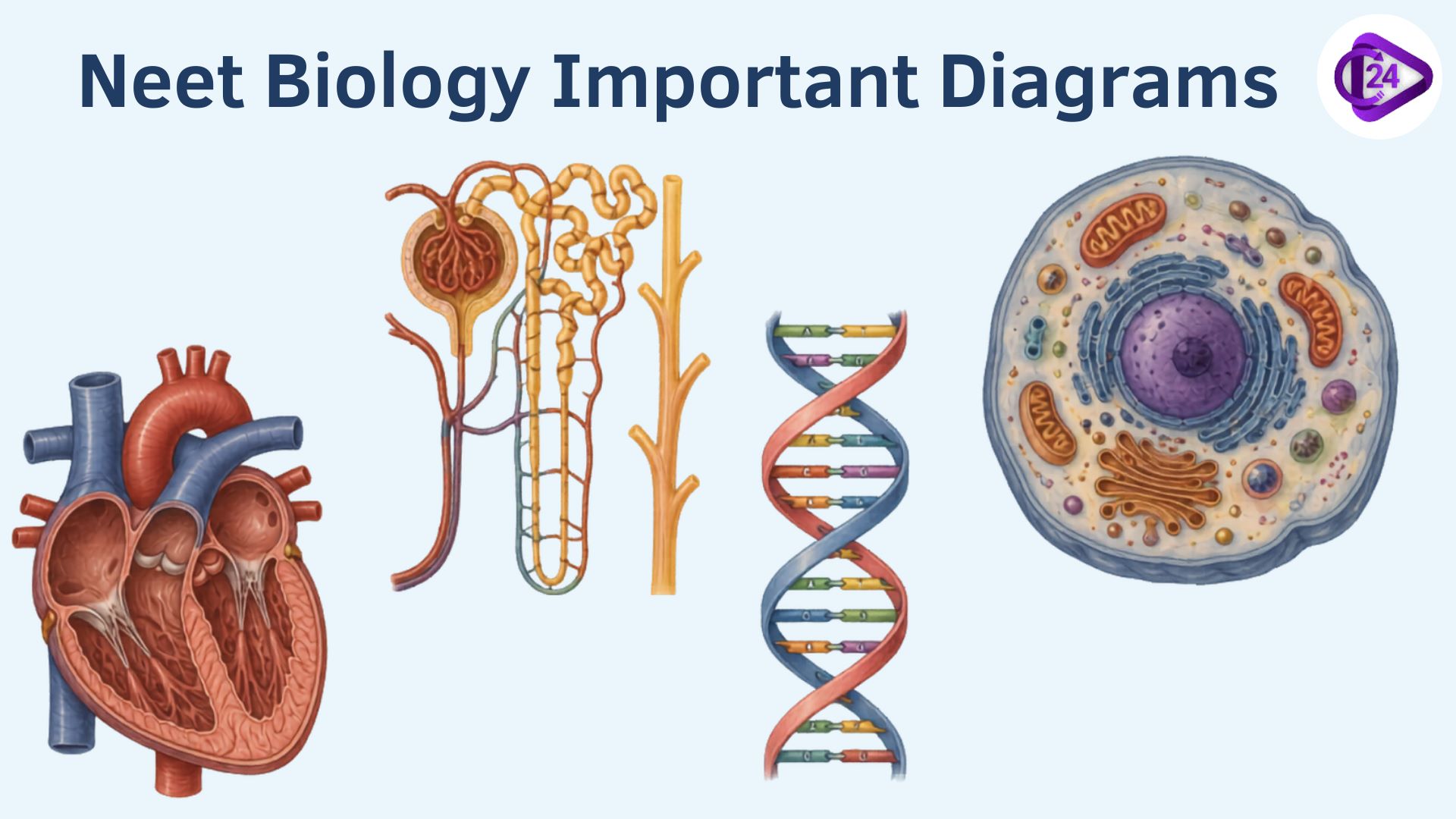
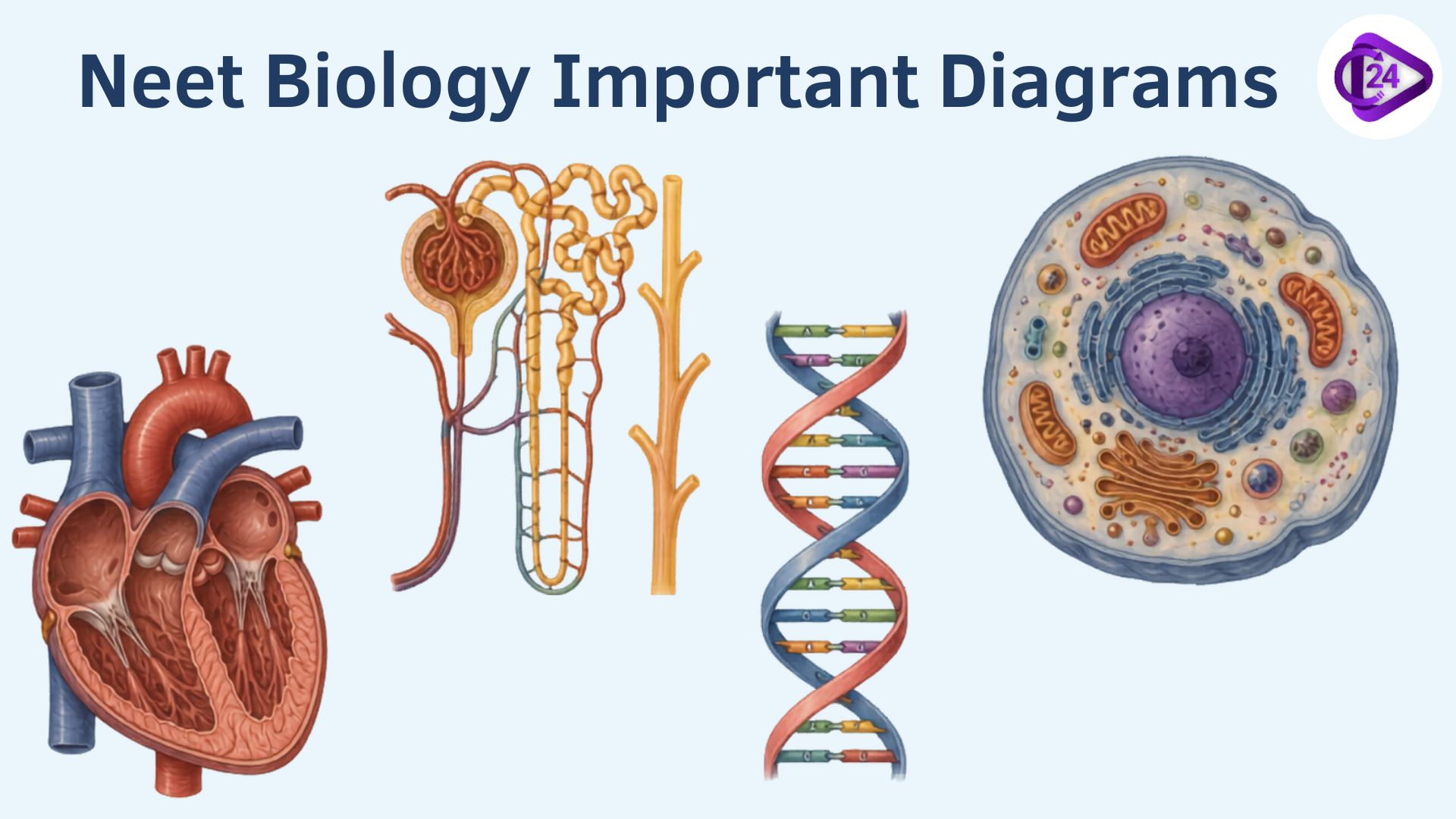
With the Re-NEET UG 2026 exam on 21 June, biology diagrams are your fastest route to scoring marks. Biology carries 360 marks (90 questions) in NEET - the highest of all three subjects - and diagram-based questions are asked directly from NCERT every year.
Studies of previous NEET papers show that 10–15 questions per year are directly diagram-based. That means mastering these diagrams alone can fetch you 40–60 marks - often the difference between getting a government MBBS seat or not.
This article covers all important NEET biology diagrams from Classes 11 and 12, divided into Botany and Zoology, with key labelling points and exam tips for each.
Why Biology Diagrams Are Critical for NEET 2026
- Biology has the highest weightage in NEET (360 marks)
- NCERT diagrams are asked verbatim in the exam
- Diagram labels are frequently tested as MCQs
- Diagrams help in retaining complex processes (like the Krebs cycle, DNA replication)
- In the last 6 days before the exam, revising diagrams is more effective than reading full chapters
Exam Tip: NEET never asks you to draw a diagram. It shows you a diagram with labels missing and asks you to identify them. Always practice labelling, not drawing.
NEET Important Biology Diagrams - Class 11 Botany
1. Plant Cell vs Animal Cell
Why it matters: 2–3 questions every year on organelle function and structure.
Must-know labels:
- Cell wall, cell membrane, nucleus, nucleolus
- Mitochondria (powerhouse), chloroplast (only in plant cells)
- Golgi apparatus, endoplasmic reticulum (smooth & rough)
- Vacuole (large in plant cells), lysosomes (only in animal cells)
- Ribosomes, centrosome (only in animal cells)
Key NEET points:
- Ribosomes are the site of protein synthesis
- Mitochondria have their own DNA (semi-autonomous organelle)
- Lysosomes, called "suicidal bags" - contain hydrolytic enzymes
- Tonoplast = membrane surrounding vacuole
Common Mistake: Students confuse smooth ER (lipid synthesis) with rough ER (protein synthesis due to ribosomes).
2. Mitosis - Stages Diagram
Why it matters: Mitosis and meiosis together get 3–5 questions in NEET every year.
Must-know stages and features:
| Stage | Key Feature to Identify |
|---|---|
| Prophase | Chromatin condenses into chromosomes |
| Metaphase | Chromosomes align at the equatorial plate |
| Anaphase | Sister chromatids separate to the poles |
| Telophase | Nuclear envelope reforms |
| Cytokinesis | The cell divides into 2 identical daughter cells |
Key NEET points:
- Mitosis produces 2 genetically identical diploid cells
- Occurs in somatic (body) cells
- Metaphase is the best stage to study chromosomes (karyotyping is done here)
- A cell plate forms during cytokinesis in plant cells; a cleavage furrow forms in animal cells
3. Meiosis - Stages Diagram
Must-know stages:
- Meiosis I: Homologous chromosomes separate (reduction division)
- Meiosis II: Sister chromatids separate (similar to mitosis)
- Prophase I is the longest phase - has 5 sub-stages: Leptotene, Zygotene, Pachytene, Diplotene, Diakinesis
Key NEET points:
- Meiosis produces 4 genetically different haploid cells
- Crossing over occurs during Pachytene (Prophase I)
- Chiasmata are visible during Diplotene
- Occurs in germ cells (gonads)
Memory Trick - Prophase I sub-stages: Long Zebras Play Dirty Dances = Leptotene → Zygotene → Pachytene → Diplotene → Diakinesis
4. Photosynthesis Diagram - Light and Dark Reactions
Why it matters: One of the most frequently tested topics - 3–4 questions every year.
Light Reactions (In Thylakoid membrane):
- PS I (P700) and PS II (P680)
- Water splitting (photolysis): 2H₂O → 4H⁺ + 4e⁻ + O₂
- ATP and NADPH are produced
- Z-scheme of electron transport
Dark Reactions / Calvin Cycle (In Stroma):
- CO₂ fixation by RuBisCO enzyme
- RuBP (5C) + CO₂ → 2 PGA (3C) — C3 plants
- Produces G3P → Glucose
- 3 CO₂ → 1 G3P requires: 9 ATP + 6 NADPH
Key NEET points:
- First stable product of C3 photosynthesis = 3-PGA
- First stable product of C4 photosynthesis = OAA (Oxaloacetic acid)
- RuBisCO = the most abundant enzyme on Earth
- C4 plants: Maize, Sugarcane, Sorghum (efficient in hot/dry climates)
Memory Trick - C4 plants: Maize, Sugarcane, Sorghum = "MSS plants love the Sun."
5. Krebs Cycle (TCA Cycle) Diagram
Why it matters: Asked every year - know the cycle, not just the diagram.
Key inputs and outputs per cycle (per Acetyl CoA):
- Input: 1 Acetyl CoA (2C) + 1 Oxaloacetate (4C)
- Outputs: 3 NADH + 1 FADH₂ + 1 ATP (GTP) + 2 CO₂
Key NEET points:
- Occurs in the mitochondrial matrix
- Citrate (6C) is the first product
- Complete oxidation of 1 glucose = 2 Acetyl CoA → 2 turns of Krebs cycle
- Net yield from 1 glucose via Krebs: 6 NADH + 2 FADH₂ + 2 ATP
6. Anatomy of Dicot Root, Stem, and Leaf
Must-know labels:
Dicot Root (T.S.):
- Epidermis → Cortex → Endodermis (Casparian strips) → Pericycle → Xylem (X-shaped) → Phloem
Dicot Stem (T.S.):
- Epidermis → Cortex → Endodermis → Pericycle → Vascular bundles (open — cambium present) → Pith
Key NEET points:
- Monocot root: Polyarch xylem (many xylem bundles), no pith
- Monocot stem: Scattered vascular bundles, large pith
- Casparian strips - prevent water movement through cell walls in roots
- A dicot stem has cambium (so secondary growth is possible)
NEET Important Biology Diagrams - Class 12 Botany
7. Sexual Reproduction in Flowering Plants
Must-know diagrams:
- Structure of a mature anther (microsporangium)
- Structure of an ovule (megasporangium)
- Female gametophyte (Embryo sac) — 7 cells, 8 nuclei
Embryo Sac structure:
- 3 Antipodal cells
- 2 Synergid cells + 1 Egg cell (at micropylar end)
- 2 Polar nuclei (Central cell)
Double Fertilization:
- 1 male gamete + Egg cell → Zygote (2n)
- 1 male gamete + 2 Polar nuclei → Primary Endosperm Nucleus (3n)
Key NEET points:
- Tapetum nourishes developing pollen grains
- Exine of pollen is made of sporopollenin (the most resistant organic material)
- Emasculation = removal of stamens before anthers mature
8. DNA Double Helix Structure
Why it matters: 2–3 questions every year on DNA structure.
Must-know features:
- Proposed by Watson and Crick (1953)
- Two antiparallel polynucleotide strands
- Sugar-phosphate backbone on the outside
- Nitrogenous bases inside - joined by hydrogen bonds
Base pairing rules (Chargaff's rule):
- Adenine (A) - Thymine (T): 2 hydrogen bonds
- Guanine (G) - Cytosine (C): 3 hydrogen bonds
Key NEET points:
- Pitch of DNA helix = 3.4 nm
- One complete turn = 10 base pairs
- DNA is right-handed (B-form is most common)
- In RNA, uracil replaces Thymine
Memory Trick: "AT = 2 bonds (AT is weaker), GC = 3 bonds (GC is stronger)" — helpful in melting temperature questions.
9. DNA Replication Diagram
Key enzymes and their roles:
| Enzyme | Function |
|---|---|
| Helicase | Unwinds the double helix |
| Primase | Synthesizes RNA primer |
| DNA Polymerase III | Main enzyme - adds nucleotides (5'→3' only) |
| DNA Polymerase I | Removes RNA primer, fills gaps |
| DNA Ligase | Joins Okazaki fragments on the lagging strand |
Key NEET points:
Replication is semiconservative (proven by the Meselson-Stahl experiment)
Leading strand is synthesized continuously; lagging strand in fragments (Okazaki fragments)
The replication fork opens at the origin of replication
10. Transcription and Translation
Transcription (DNA → mRNA):
- Occurs in the nucleus
- Template strand read 3'→5'; mRNA synthesized 5'→3'
- RNA Polymerase is the enzyme
Translation (mRNA → Protein):
- Occurs on ribosomes (in the cytoplasm)
- tRNA brings amino acids
- Ribosome moves along mRNA in 5'→3' direction
- Start codon: AUG (Methionine)
- Stop codons: UAA, UAG, UGA
Key NEET points:
- Genetic code is: Universal, Non-overlapping, Degenerate (one amino acid by multiple codons), Commaless
- AUG also acts as a start signal
- Wobble position = 3rd base of codon
NEET Important Biology Diagrams - Class 11 Zoology
11. Human Heart Diagram
Why it matters: The human heart is one of the most asked diagrams in NEET - expect 2–3 questions directly.
Must-know labels:
- 4 chambers: Right Atrium, Right Ventricle, Left Atrium, Left Ventricle
- Valves: Tricuspid (right AV), Bicuspid/Mitral (left AV), Pulmonary semilunar, Aortic semilunar
- Blood vessels: Superior/Inferior Vena Cava, Pulmonary Artery, Pulmonary Vein, Aorta
- SA Node (Pacemaker) - in right atrium wall
- AV Node - at AV junction
Blood flow path: Body → Vena Cava → Right Atrium → Tricuspid valve → Right Ventricle → Pulmonary Artery → Lungs → Pulmonary Vein → Left Atrium → Bicuspid valve → Left Ventricle → Aorta → Body
Key NEET points:
- SA node generates an impulse spontaneously - called the natural pacemaker
- Heart rate: 72 beats/minute (resting)
- Stroke volume: ~70 mL | Cardiac output: ~5 L/min
- Lubb-Dubb sounds: Lubb = AV valves closing; Dubb = Semilunar valves closing
Common Mistake: Students confuse Pulmonary Artery (deoxygenated blood) with Pulmonary Vein (oxygenated blood). Remember: Artery = away from heart (regardless of O₂ content).
12. Nephron Structure and Function
Why it matters: Nephrons appear in almost every NEET exam - 2-4 questions.
Structure - Must-know labels:
- Bowman's capsule → Glomerulus (together = Malpighian body)
- Proximal Convoluted Tubule (PCT)
- Loop of Henle (Descending + Ascending limb)
- Distal Convoluted Tubule (DCT)
- Collecting Duct
Functions of each part:
| Part | Function |
|---|---|
| Glomerulus | Filtration (ultrafiltration) |
| PCT | Reabsorption of glucose, amino acids, 70% water, Na⁺ |
| Loop of Henle | Concentrating urine; NaCl reabsorption |
| DCT | Conditional reabsorption; H⁺ and K⁺ secretion |
| Collecting Duct | Final water reabsorption (ADH controlled) |
Key NEET points:
- Glomerular Filtration Rate (GFR) = 125 mL/min = 180 L/day
- Only 1.5 L of urine is formed per day
- Juxtaglomerular apparatus (JGA) regulates GFR
- ADH (Antidiuretic hormone) increases water reabsorption in the collecting duct
- Renin secreted by JGA cells → activates Angiotensin → causes vasoconstriction
13. Human Digestive System
Must-know labels:
- Mouth → Oesophagus → Stomach → Small Intestine (Duodenum, Jejunum, Ileum) → Large Intestine → Rectum → Anus
- Accessory organs: Liver, Pancreas, Salivary glands, Gallbladder
Key enzymes and their sites:
| Enzyme | Site | Action |
|---|---|---|
| Salivary amylase | Mouth | Starch → Maltose |
| Pepsin | Stomach (acidic, pH 2) | Proteins → Peptides |
| Trypsin | Small intestine | Proteins → Peptides |
| Lipase (pancreatic) | Small intestine | Fats → Fatty acids + Glycerol |
| Lactase | Small intestine | Lactose → Glucose + Galactose |
Key NEET points:
- The liver produces bile, stored in the gallbladder, and emulsifies fats
- HCl in the stomach activates pepsinogen → pepsin
- Maximum absorption occurs in the ileum (due to villi and microvilli)
- Brunner's glands in the duodenum secrete alkaline mucus
14. Human Respiratory System
Must-know labels:
- Nasal cavity → Pharynx → Larynx → Trachea → Bronchi → Bronchioles → Alveoli
- Diaphragm, intercostal muscles, pleural membrane
Breathing mechanism:
- Inspiration: Diaphragm contracts (moves down) + Rib cage expands → Pressure decreases → Air enters
- Expiration: Diaphragm relaxes (moves up) + Rib cage contracts → Pressure increases → Air exits
Lung volumes:
| Term | Value |
|---|---|
| Tidal Volume (TV) | 500 mL |
| Inspiratory Reserve Volume (IRV) | 2500 mL |
| Expiratory Reserve Volume (ERV) | 1000 mL |
| Residual Volume (RV) | 1100 mL |
| Vital Capacity (VC) | TV + IRV + ERV = 4000 mL |
Key NEET points:
- Partial pressure of O₂ in alveoli = 104 mmHg; in blood = 40 mmHg → O₂ enters blood
- Haemoglobin carries ~97% of O₂
- CO₂ is mostly transported as bicarbonate ions (70%)
- Chloride shift: HCO₃⁻ moves out of the RBC, Cl⁻ moves in
NEET Important Biology Diagrams - Class 12 Zoology
15. Human Brain - Parts and Functions
Why it matters: Neural coordination is asked about every year - 2–3 questions on brain structure.
Must-know parts:
| Part | Function |
|---|---|
| Cerebrum (largest part) | Thinking, memory, voluntary movement, speech |
| Cerebellum | Balance, coordination, fine motor control |
| Medulla Oblongata | Heart rate, breathing, blood pressure (involuntary) |
| Hypothalamus | Thermoregulation, hunger, thirst, sleep, hormones |
| Thalamus | Relay station — sensory signals to the cerebral cortex |
| Corpus Callosum | Connects the left and right cerebral hemispheres |
Key NEET points:
- Grey matter = neuron cell bodies; White matter = myelinated axons
- Meninges (3 layers): Dura mater, Arachnoid mater, Pia mater
- CSF (Cerebrospinal fluid) - cushions the brain
- Broca's area = speech production (frontal lobe)
- Wernicke's area = speech understanding (temporal lobe)
16. Human Reproductive System
Male Reproductive System labels:
- Testes (in scrotal sac) → Rete testis → Vasa efferentia → Epididymis → Vas deferens → Ejaculatory duct → Urethra
- Accessory glands: Seminal vesicles, Prostate gland, Bulbourethral glands (Cowper's glands)
Female Reproductive System labels:
- Ovaries → Fallopian tubes (Oviducts) → Uterus → Cervix → Vagina
- Parts of the fallopian tube: Infundibulum (finger-like fimbriae) → Ampulla → Isthmus
Key NEET points:
- Fertilization occurs in the ampulla of the fallopian tube
- Implantation occurs in the uterine wall (endometrium) - Day 6–7 after fertilization
- Human chorionic gonadotropin (hCG) - the first sign of pregnancy, maintains the corpus luteum
- Spermatogenesis occurs in seminiferous tubules; Sertoli cells nourish sperm
17. Menstrual Cycle Diagram
Four phases:
- Menstrual phase (Day 1–5): Shedding of the endometrium
- Follicular phase (Day 1–13): FSH → Graafian follicle development → Estrogen rises
- Ovulation (Day 14): LH surge → Egg released from Graafian follicle
- Luteal phase (Day 15–28): Corpus luteum → Progesterone → Prepares endometrium
Key NEET points:
- Cycle length: ~28 days
- LH surge triggers ovulation
- Progesterone maintains the uterine lining during pregnancy
- If no fertilization → Corpus luteum degenerates → Progesterone drops → Menstruation
18. Ecosystem - Food Chain and Food Web
Must-know concepts:
Energy flow:
- Only 10% of energy transfers from one trophic level to the next (10% law by Lindeman)
- Energy flow is unidirectional (never recycled)
Ecological Pyramids:
- The pyramid of energy is always upright
- The pyramid of biomass can be inverted (aquatic ecosystems)
- The pyramid of numbers can be inverted (tree ecosystem)
Key NEET points:
- Producers → Primary consumers → Secondary → Tertiary → Quaternary
- Decomposers (bacteria + fungi) recycle nutrients
- GPP (Gross Primary Productivity) − Respiration = NPP (Net Primary Productivity)
19. Human Health and Disease - Diagrams
Immune System diagrams:
- Innate vs Adaptive Immunity
- Humoral immunity: B lymphocytes → Plasma cells → Antibodies
- Cell-mediated immunity: T lymphocytes (T-helper, T-killer, T-memory)
Key disease facts for NEET:
| Disease | Pathogen | Transmission |
|---|---|---|
| Malaria | Plasmodium (protozoan) | Female Anopheles mosquito |
| Dengue | Dengue virus | Aedes mosquito |
| Typhoid | Salmonella typhi | Contaminated food/water |
| Pneumonia | Streptococcus pneumoniae | Droplets |
| AIDS | HIV (retrovirus) | Blood, sexual contact |
| Ascariasis | Ascaris lumbricoides | Contaminated food |
NEET Biology Diagrams - Revision Checklist
Use this checklist 2–3 days before your NEET exam:
Botany - Class 11:
- Plant cell and animal cell
- Mitosis - all 4 stages
- Meiosis - all stages with Prophase I substages
- Photosynthesis - Z scheme and Calvin cycle
- Krebs cycle
- Dicot and monocot root/stem T.S.
Botany - Class 12:
- Flower structure and double fertilization
- DNA double helix
- DNA replication (replication fork)
- Transcription and translation
Zoology - Class 11:
- Human heart - 4 chambers, valves, blood flow
- Nephron - all parts and functions
- Human digestive system
- Human respiratory system - lung volumes
Zoology - Class 12:
- Human brain - all parts
- Male and female reproductive systems
- Menstrual cycle
- Ecosystem and energy flow pyramids
Important Links
Conclusion - NEET Biology Important Diagrams
Biology diagrams are among the highest-return topics for NEET preparation. With the Re-NEET 2026 exam just days away, focusing on these 19 key diagrams - especially Heart, Nephron, DNA, Mitosis, and Photosynthesis - can significantly boost your score.
Remember: NCERT is your bible. Every label, every diagram, every process described in NCERT Biology Classes 11 and 12 is a potential NEET question.
FAQ - NEET Biology Important Diagrams 2026
Our Courses







Post a Comment
Your email address will not be published. Required fields are marked *