

Daily Quizzes
Mock Tests
No tests attempted yet.
Select Category
JEE Advanced Physics Preparation Tips 2026: Complete Strategy to Crack Physics Paper
Prepare effectively for JEE Advanced Physics 2026 with expert study strategies, chapter-wise weightage, important topics, mock test planning, and smart time management techniques. Focus on Mechanics, Electromagnetism, and Modern Physics while practicing previous year papers regularly to improve conceptual clarity, numerical accuracy, and exam performance.

Get in Touch with Class24 for All Your Needs!
Looking for the best JEE Advanced Physics preparation tips for 2026? This complete guide covers high weightage topics, chapter-wise strategy, best books, and time management techniques to help you ace the Physics paper in JEE Advanced 2026 conducted by IIT Roorkee.
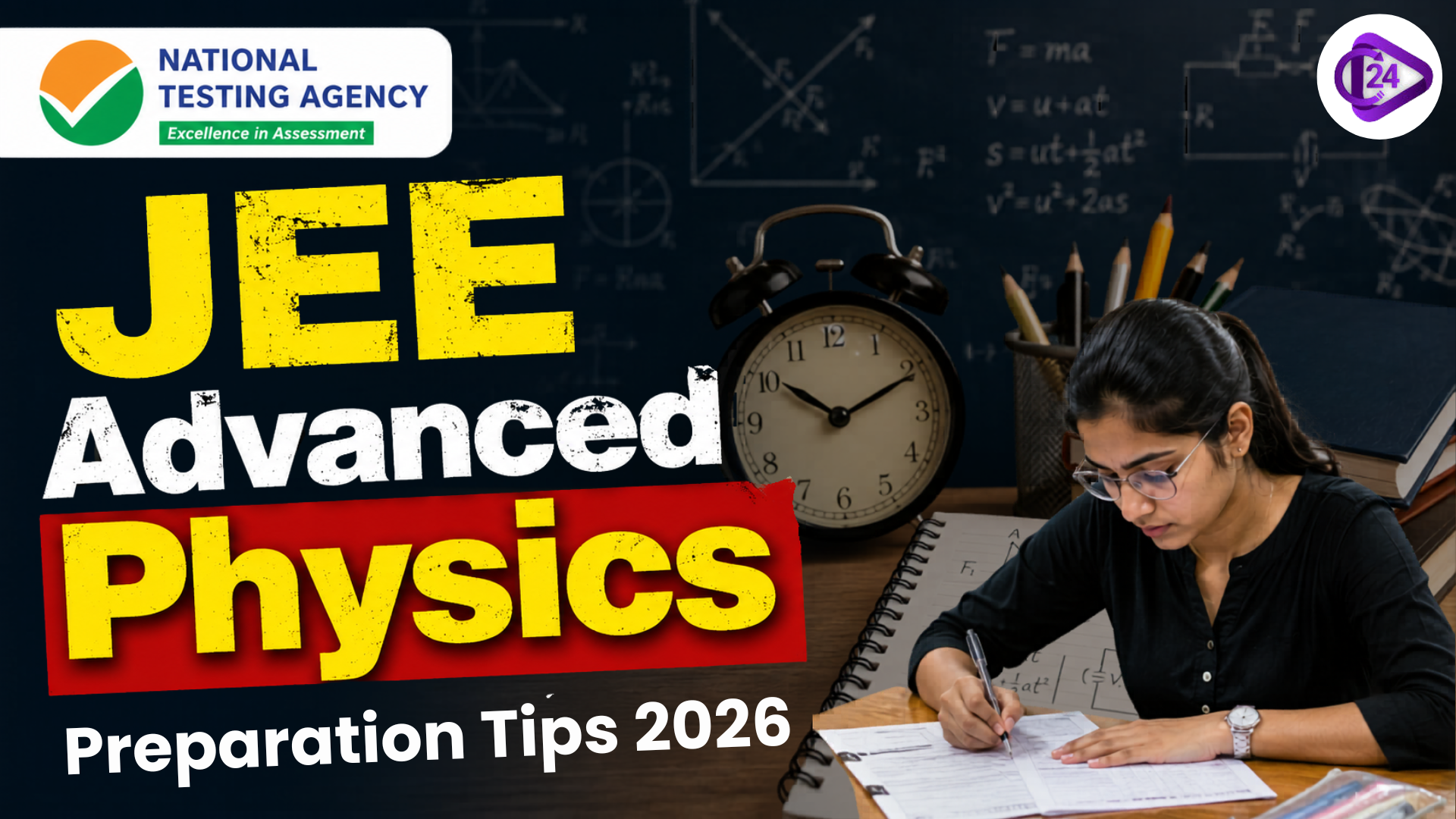
Do you want JEE Advanced physics tips to crack the engineering exam that is the most difficult? Physics is one of the most difficult subjects of JEE Advanced 2026, but with the proper JEE Advanced physics preparation strategy, you can master it. This is a complete reference book for important JEE Advanced Physics topics, time management, the best books, and previous-year analysis.
The JEE Advanced 2026 exam is scheduled for 17th May 2026 at IIT Roorkee. Physics has a weightage of 33.33% in the exam and therefore plays an important role in achieving the top rank. Now, let's get to the best JEE Advanced physics preparation tips for 2026 to help you score your best!
JEE Advanced Physics Exam Pattern 2026
Understanding the JEE Advanced physics exam pattern is the first step toward effective preparation.
Key Exam Details:
| Parameter | Details |
|---|---|
| Exam Mode | Computer-Based Test (CBT) |
| Number of Papers | 2 (Paper 1 & Paper 2) - Both Compulsory |
| Duration per Paper | 3 hours |
| Physics Questions | Varies each year (18-20 questions per paper) |
| Total Marks | Approximately 60-66 marks per paper |
| Question Types | MCQs (Single/Multiple correct), Numerical Value, Matrix Match, Paragraph-based |
| Negative Marking | Yes (varies by question type) |
| Language | English & Hindi |
Important Note: The exact number of questions and marking scheme is revealed only on exam day, making JEE Advanced physics preparation more challenging.
Most Important Topics in JEE Advanced Physics 2026
Based on previous year analysis and weightage distribution, here are the high-priority physics chapters for JEE Advanced:
High Weightage Topics (Must Master)
1. Mechanics (30-35% weightage)
- Rotational Motion
- Newton's Laws of Motion
- Work, Energy & Power
- Center of Mass & Collision
- Simple Harmonic Motion (SHM)
2. Electromagnetism (25-30% weightage)
- Electrostatics
- Current Electricity
- Magnetic Effects of Current
- Electromagnetic Induction
- AC Circuits
3. Modern Physics (15-20% weightage)
- Dual Nature of Matter
- Atoms & Nuclei
- Semiconductor Electronics
- Photoelectric Effect
4. Optics (10-15% weightage)
- Ray Optics & Optical Instruments
- Wave Optics
- Interference & Diffraction
5. Thermodynamics & Heat Transfer (10-12% weightage)
- Laws of Thermodynamics
- Kinetic Theory of Gases
- Heat Transfer
Chapter-wise Weightage Analysis (Last 5 Years)
| Physics Chapter | Average Questions | Weightage % | Difficulty Level |
|---|---|---|---|
| Rotational Mechanics | 3-4 | 12-15% | High |
| Electrostatics | 2-3 | 10-12% | High |
| Current Electricity | 2-3 | 8-10% | Medium |
| Modern Physics | 2-3 | 10-12% | Medium |
| SHM & Waves | 2-3 | 8-10% | High |
| Optics | 2 | 8-10% | Medium |
| Thermodynamics | 2 | 6-8% | Medium |
| Magnetic Effects | 2 | 8-10% | High |
| Electromagnetic Induction | 2-3 | 10-12% | High |
| Fluid Mechanics | 1-2 | 4-6% | Low |
| Gravitation | 1-2 | 4-6% | Medium |
| Heat Transfer | 1 | 3-5% | Low |
Key Insight: Mechanics and Electromagnetism together contribute to 55-65% of total questions. These are your do-or-die chapters for JEE Advanced physics.
Month-wise JEE Advanced Physics Preparation Strategy 2026
| Phase | Timeline | Primary Goal | Study Hours/Day | Expected Output | Key Focus |
|---|---|---|---|---|---|
| Phase 1: Foundation | 12-10 months before | Theory + NCERT + Basic Problems | 3-4 hours | Complete theory understanding, Formula sheets ready, NCERT 100% done | Understanding concepts, Building foundation |
| Phase 2: Strengthening | 10-6 months before | Advanced Problem-solving | 4-5 hours | All HC Verma problems solved, Weak areas identified, Test series joined | Concept clarity, Problem-solving speed |
| Phase 3: Mastery | 6-3 months before | JEE Advanced Level + Speed | 5-6 hours | 20-25 problems daily, Mock tests weekly, Error log maintained | Multi-concept questions, Numerical accuracy |
| Phase 4: Revision | 3-1 month before | Speed + Accuracy + Revision | 4-5 hours | 2-3 mock tests/week, All formulas revised, Speed improved 20-30% | Only revision, No new topics |
| Phase 5: Final Week | Last 7 days | Confidence + Light Revision | 2-3 hours | Stress-free revision, Peak confidence, Healthy routine | Mental preparation, Stay calm |
Smart Study Tips for JEE Advanced Physics
1. Conceptual Understanding Over Memorization
Physics is NOT about memorizing formulas—it's about understanding concepts deeply.
How to Build Concepts:
- Ask "WHY" behind every formula
- Understand derivations (don't just mug up)
- Visualize problems (draw diagrams always)
- Connect topics (SHM with waves, circuits with magnetism)
2. Master Problem-Solving Techniques
JEE Advanced physics tests your application ability, not just theoretical knowledge.
Problem-Solving Strategy:
- Step 1: Read the question carefully (Don't rush)
- Step 2: Identify the physics concept involved
- Step 3: Draw a clear diagram (Very important!)
- Step 4: List given data and what's asked
- Step 5: Choose the right formula/approach
- Step 6: Solve step-by-step (Show work)
- Step 7: Check units and reasonableness of answer
3. Create Visual Notes and Formula Sheets
Visual memory is powerful for Physics.
What to Include in Formula Sheets:
- All important formulas (topic-wise)
- Derivation key steps
- Sign conventions (Very important!)
- Unit conversions
- Common mistakes to avoid
- Shortcuts and tricks
Format: Use colors, boxes, diagrams for better retention.
4. Practice Numerical Accuracy
JEE Advanced has Numerical Answer Type questions where even a 0.01 error = 0 marks.
How to Improve Accuracy:
- Use the calculator regularly during practice
- Be careful with unit conversions
- Check significant figures
- Verify the calculation twice for numerical questions
- Practice mental math for common calculations
5. Focus on High-Weightage Topics First
80-20 Rule: 80% of marks come from 20% of topics.
Priority Order for Preparation:
Tier 1 (Must Master - 60% marks):
- Mechanics (Rotation, NLM, Energy)
- Electrostatics & Capacitors
- Current Electricity & Circuits
- Electromagnetic Induction
- Modern Physics
Tier 2 (Important - 30% marks): 6. Optics (Ray + Wave) 7. Magnetism 8. SHM & Waves 9. Thermodynamics
Tier 3 (Moderate - 10% marks): 10. Gravitation 11. Fluid Mechanics 12. Heat Transfer
Strategy: Master Tier 1 completely before moving to Tier 2.
Time Management Tips for JEE Advanced Physics Paper
Paper-solving Strategy:
| Phase | Time | Activity |
|---|---|---|
| First 15 minutes | 0:00 - 0:15 | Read entire paper, mark easy/medium/hard questions |
| Next 60 minutes | 0:15 - 1:15 | Solve ALL easy questions first (low-hanging fruits) |
| Next 60 minutes | 1:15 - 2:15 | Solve medium difficulty questions |
| Next 40 minutes | 2:15 - 2:55 | Attempt hard questions strategically |
| Last 5 minutes | 2:55 - 3:00 | Mark answers, check OMR/response sheet |
Golden Rules:
- Never spend >4 minutes on a single question
- Attempt questions topic-wise (not serial order)
- Mark confident answers first (avoid negative marking)
- Use the elimination technique in MCQs
- Keep watch on the desk - track time regularly
Important Links
Conclusion - JEE 2026 Physics Preparation Tips
Cracking the Physics paper in JEE Advanced 2026 is absolutely achievable with the right JEE Advanced Physics preparation strategy. Physics may seem overwhelming at first, but a structured approach - focusing on high-weightage topics, mastering concepts deeply, solving previous year papers, and taking regular mock tests - will put you well ahead of the competition.
Remember the three pillars of JEE Advanced Physics preparation tips: concept clarity, numerical accuracy, and smart time management. Do not try to cover everything - prioritize Mechanics and Electromagnetism first, as they together account for over 55% of the Physics paper.
Start early, stay consistent, and trust your preparation. With disciplined practice and the right JEE Advanced Physics preparation strategy 2026, scoring high in Physics is not just possible - it is inevitable


Post a Comment
Your email address will not be published. Required fields are marked *