

Daily Quizzes
Mock Tests
No tests attempted yet.
Select Category
BITSAT vs IIT JEE: Key Differences, Difficulty & Which is Better?
BITSAT vs JEE difference - which exam is harder, what's different in the syllabus, and should you attempt both? Complete comparison with official dates, fees, and preparation strategy.

Get in Touch with Class24 for All Your Needs!
BITSAT vs IIT JEE is the most searched question among engineering aspirants in India - and for good reason. Both exams can shape your entire career, yet they are completely different in how they test you, what they offer, and where they take you.
Every year, over 12 lakh students appear for JEE Main alone. Thousands more attempt BITSAT for a shot at BITS Pilani - one of India's most respected private engineering universities. But very few students actually understand the real differences between these two exams before deciding their preparation strategy.
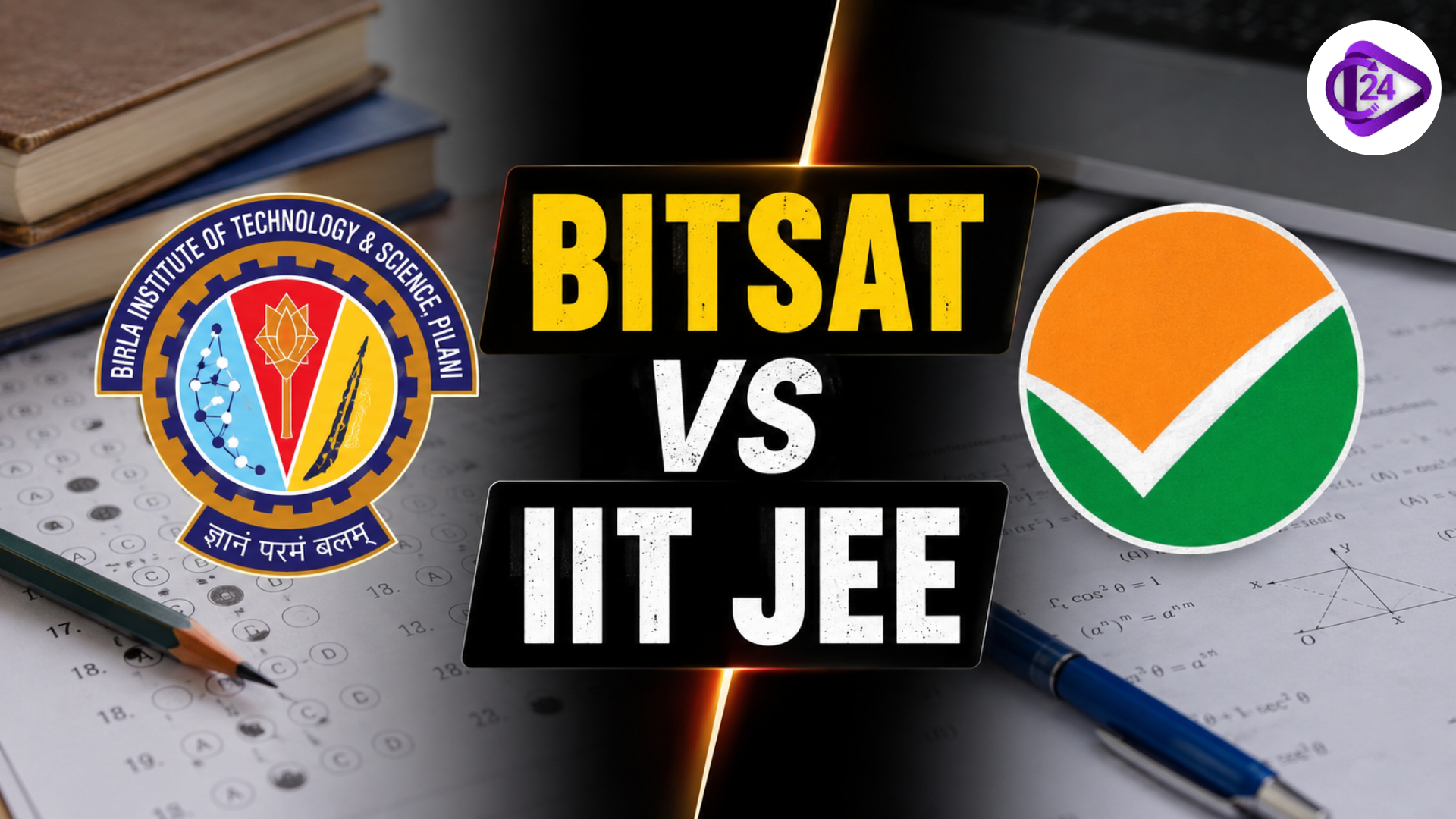
The IIT JEE, administered by the Indian government, serves as the entrance examination for hundreds of higher education institutions across India, including all Indian Institutes of Technology (IITs) and National Institutes of Technology (NITs). The privately run BITSAT, by contrast, is only valid for admission to the three campuses of BITS Pilani. Both exams are highly prestigious, but they follow different assessment logics, so candidates must make their choice based on their own strengths.
In this guide, we break down everything you need to know about the BITSAT vs JEE difference - official exam dates, syllabus comparison, difficulty level, fees, number of seats, and a step-by-step plan to crack both exams in the same preparation cycle. Whether you are targeting IIT, NIT, or BITS Pilani, this article will help you make the right call.
What Are These Exams?
IIT JEE has two stages - JEE Main (conducted by NTA) and JEE Advanced (conducted by IIT Roorkee in 2026). Clearing JEE Main gets you into NITs, IIITs, and GFTIs. Clearing JEE Advanced opens the doors to 23 IITs plus IISc Bengaluru (newly added from 2026). It is the largest engineering entrance exam in India, with over 12 lakh candidates appearing every year.
BITSAT 2026 stands for BITS Admission Test - conducted by BITS Pilani for admissions to its three campuses: Pilani, Goa, and Hyderabad. BITSAT 2026 was held in two sessions: Session 1 (April 15–16, 2026) and Session 2 (May 25–27, 2026). Around 3 lakh candidates appear for this exam every year.
BITSAT vs JEE 2026: Official Exam Dates
| Event | JEE Main 2026 | JEE Advanced 2026 | BITSAT 2026 |
|---|---|---|---|
| Session 1 | Jan 21–30, 2026 | May 17, 2026 | Apr 15–16, 2026 |
| Session 2 | Apr 2–9, 2026 | — | May 25–27, 2026 |
| Result | Feb 12 (S1) · Apr 20 (S2) | June 2026 | June 16 (S1 Result) |
| Conducting Body | NTA | IIT Roorkee | BITS Pilani |
| Official Website | jeemain.nta.nic.in | jeeadv.ac.in | bitsadmission.com |
BITSAT vs JEE: Side-by-Side Comparison
| Parameter | JEE Main / Advanced | BITSAT 2026 |
|---|---|---|
| Conducting Body | NTA (Main) / IIT Roorkee (Advanced) | BITS Pilani (Private University) |
| Exam Mode | Online CBT | Online CBT |
| Duration | Main: 3 hrs · Advanced: 3+3 hrs | 3 hours (fixed) |
| Total Questions | Main: 90 · Advanced: varies | 130 questions |
| Subjects Tested | Physics, Chemistry, Mathematics | PCM/PCB + English Proficiency + Logical Reasoning |
| Marking Scheme | +4/–1 (Main) · Varies (Advanced) | +3 correct / –1 wrong |
| Negative Marking | Yes | Yes |
| Difficulty Level | JEE Advanced = Very High | Moderate (Speed is critical) |
| Class 12 Marks Required | Qualifying criteria only | Minimum 75% in PCM/PCB (60% in each subject) |
| Attempts per Year | Main: 2 · Advanced: 1 | 2 sessions (best score counts) |
| Bonus Questions | Not applicable | 12 extra questions if you finish all 130 early |
| Annual Fees (approx.) | IIT ~₹1L · NIT ~₹1.5L | ~₹2.5–3 lakh per year |
| Colleges | 23 IITs + IISc + NITs + IIITs + GFTIs | BITS Pilani, BITS Goa, BITS Hyderabad |
Key insight: The JEE Main syllabus and BITSAT's PCM syllabus are almost identical - both are based on Class 11–12 NCERT (90–95% overlap as per the official BITSAT 2026 brochure). If you're already preparing for JEE, you only need to separately practice English proficiency and logical reasoning for BITSAT.
Which Exam is Harder - BITSAT or JEE?
The short answer: JEE Advanced is the hardest engineering entrance exam in India. But BITSAT presents a completely different kind of challenge.
JEE Advanced 2026 difficulty: Conducted by IIT Roorkee on May 17, 2026, JEE Advanced features conceptually deep, multi-layered questions - integer-type problems, multiple-correct MCQs, and paragraph-based sets. Only the top 2.5 lakh qualifiers from JEE Main 2026 are even eligible to appear. The exam consists of two 3-hour papers held on the same day.
BITSAT 2026 difficulty Individual questions are comparatively easier, but the real challenge is 130 questions in 3 hours - roughly 1.4 minutes per question. Speed and accuracy are everything. A key differentiator: if you complete all 130 questions before time is up, you unlock 12 bonus questions that can significantly boost your score - but once you move to bonus questions, you cannot go back and change earlier answers.
Difficulty ranking: JEE Advanced > BITSAT > JEE Main
Rule of thumb: A JEE Main percentile of 99+ usually means you can crack BITSAT - but only if you've also practiced English Proficiency and Logical Reasoning, which JEE does not test at all.
Syllabus Difference: What's Common and What's Extra?
Common in both exams (Class 11–12 NCERT base):
- Physics - Mechanics, Thermodynamics, Electrostatics, Magnetism, Optics, Modern Physics, Waves
- Chemistry - Physical Chemistry (Thermodynamics, Equilibrium), Organic Chemistry (GOC, Hydrocarbons, Carbonyls), Inorganic Chemistry (Periodic Table, Coordination Compounds)
- Mathematics - Same core syllabus. JEE Advanced has more application-heavy, multi-step problems.
Only in BITSAT (not in JEE):
- English Proficiency - Grammar, Reading Comprehension, Vocabulary - 15 questions
- Logical Reasoning - Verbal and Non-verbal Reasoning - 10 questions
No change in BITSAT 2026 syllabus compared to 2025, as confirmed by BITS Pilani's official brochure.
BITS Pilani vs IIT - Which College is Better?
Both are genuinely world-class. Here's an honest comparison:
Advantages of IIT Government-funded with significantly lower fees, strong research culture, global brand recognition, 23 campuses across India, IISc Bengaluru now joining JoSAA 2026 counselling as well. Powerful alumni networks in academia, startups, and global corporations.
Advantages of BITS Pilani Highly flexible curriculum with the freedom to choose courses, the renowned Practice School internship program (where you work at top companies as part of your degree), dual degree options, strong startup ecosystem, and exceptional placement records — especially in CS and software roles.
If you're getting a good IIT with your preferred branch, IIT is generally the stronger pick from a fees and brand perspective. However, BITS Pilani's CS program rivals top IITs, and its industry integration through Practice School is genuinely unmatched.
Which Exam Should You Choose?
Choose JEE if you:
- Have strong conceptual and analytical thinking skills
- Are specifically targeting the IIT or IISc brand
- Want a government college with lower annual fees
- Need the flexibility of 2 attempts per year
- Are interested in research, core engineering, or academia
Choose BITSAT if you:
- Excel at speed and accuracy under time pressure
- Want a flexible, industry-oriented curriculum
- Value real-world internship experience through Practice School
- Are comfortable with English and Reasoning tests
- Are open to a private institution with strong placements
Best strategy: Attempt both. JEE preparation covers 80–90% of the BITSAT syllabus automatically. Add English grammar and Logical Reasoning practice starting 2–3 months before the BITSAT date. One structured preparation cycle - two top engineering entrances.
How to Prepare for Both JEE and BITSAT 2026 Together
- Build your PCM foundation on NCERT - Class 11 and 12 NCERT is the base for both exams. Concepts must be crystal clear; both exams reward deep understanding over memorisation.
- Take regular JEE Main mock tests - This builds the speed and exam temperament that BITSAT demands. Timer-based practice is non-negotiable.
- Add English + Reasoning 2–3 months before BITSAT - Use RS Aggarwal for Logical Reasoning and any standard grammar workbook for English Proficiency. 30–45 minutes daily is sufficient.
- Practice BITSAT-specific timed tests - Target completing 130 questions in under 150 minutes to leave buffer time for the 12 bonus questions.
- Don't neglect Class 12 board marks - BITSAT 2026 requires a minimum of 75% in PCM/PCB and at least 60% in each individual subject. Boards cannot be sacrificed for entrance prep.
Quick Summary
- Difficulty ranking: JEE Advanced > BITSAT > JEE Main
- Total seats: JEE (IITs + NITs + IIITs): 47,000+ · BITSAT: ~2,000
- BITSAT extra sections: English Proficiency (15 Qs) + Logical Reasoning (10 Qs)
- BITSAT 2026 marking: +3 correct, –1 wrong, 0 for unattempted
- JEE Advanced 2026 date: May 17, 2026 (IIT Roorkee)
- JEE Main 2026: Session 1 Jan 21–30 · Session 2 Apr 2–9
- BITSAT 2026: Session 1 Apr 15–16 · Session 2 May 25–27
- Best advice: Attempt both — 80–90% syllabus overlap confirmed officially
Important Link
| JEE Advanced Toppers List 2026 | |
Conclusion - BITSAT vs JEE Difference
BITSAT and IIT JEE 2026 are both prestigious engineering entrance exams — but they are fundamentally different in what they test. JEE opens more doors across India and rewards deep conceptual thinking. BITSAT rewards speed, all-round aptitude, and accuracy under pressure.
The smartest move? Prepare for both. Use JEE as your primary foundation, layer in English and logical reasoning for BITSAT, and give yourself the best shot at two completely different top-tier institutions with a single preparation cycle.


Post a Comment
Your email address will not be published. Required fields are marked *