

Daily Quizzes
Mock Tests
No tests attempted yet.
Select Category
JEE Advanced 2026 Marks vs Rank – Official Result, Cutoff & Category-wise Rank List
JEE Advanced 2026 results are out with official marks vs rank, cutoffs, toppers, and JoSAA counselling details released by IIT Roorkee for admission into IITs, NITs, and IIITs.

Get in Touch with Class24 for All Your Needs!
JEE Advanced 2026 Result has been officially declared on June 1, 2026 by IIT Roorkee. Shubham Kumar topped with 330/360 marks. A total of 56,880 candidates qualified. Check official Marks vs Rank for all categories, qualifying cutoffs, and JoSAA 2026 counselling details starting June 2, 2026.
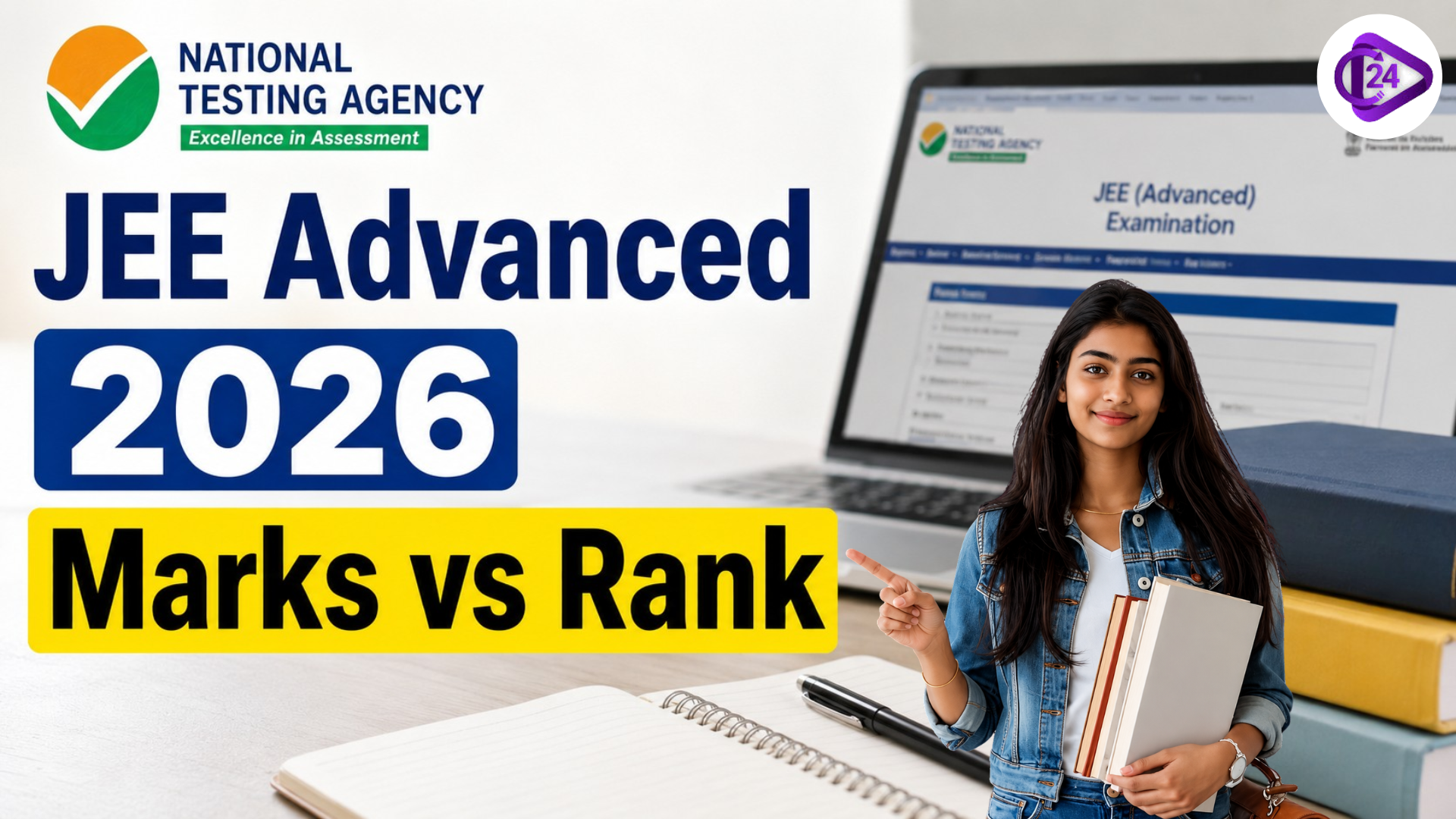
IIT Roorkee has officially declared the JEE Advanced 2026 Result on June 1, 2026. This year, 1,79,694 candidates appeared for both papers and 56,880 students qualified. Shubham Kumar from the IIT Delhi Zone topped the exam with 330 out of 360 marks. The official CRL qualifying cutoff stands at 92 aggregate marks with a minimum of 8 marks per subject.
If you are wondering what rank you will get for your marks and which IIT you can get into, this article covers everything - official Marks vs Rank data for all categories, category-wise cutoffs, IIT branch closing ranks, and a complete JoSAA 2026 counselling guide.

JEE Advanced 2026 – Official Result Highlights
| Detail | Official Data |
|---|---|
| Conducting Body | IIT Roorkee |
| Exam Date | May 17, 2026 |
| Result Declared On | June 1, 2026 |
| Total Marks | 360 (Paper 1: 180 + Paper 2: 180) |
| Total Registered | 1,87,389 |
| Total Appeared (Both Papers) | 1,79,694 |
| Total Qualified | 56,880 |
| Female Qualified | 10,107 |
| AIR 1 | Shubham Kumar – 330/360 (IIT Delhi Zone) |
| AIR 2 | Kabeer Chhillar – 329/360 (IIT Delhi Zone) |
| AIR 3 | Jatin Chahar – 319/360 (IIT Delhi Zone) |
| Top Female (CRL 77) | Arohi Deshpande – 280/360 (IIT Delhi Zone) |
| JoSAA 2026 Counselling | Starts June 2, 2026 |
| Official Website | jeeadv.ac.in |
JEE Advanced 2026 Official Qualifying Cutoff – Category-wise (IIT Roorkee)
IIT Roorkee released the official qualifying cutoff on June 1, 2026 alongside the result. Both conditions - subject-wise minimum AND aggregate minimum - must be met to receive a rank.
| Rank List | Minimum Marks in Each Subject | Minimum Aggregate Marks |
|---|---|---|
| Common Rank List (CRL) | 8 | 92 |
| OBC-NCL Rank List | 7 | 82 |
| GEN-EWS Rank List | 7 | 82 |
| SC Rank List | 4 | 46 |
| ST Rank List | 4 | 46 |
| Common-PwD Rank List (CRL-PwD) | 4 | 46 |
| OBC-NCL-PwD Rank List | 4 | 46 |
| GEN-EWS-PwD Rank List | 4 | 46 |
| SC-PwD Rank List | 4 | 46 |
| ST-PwD Rank List | 4 | 46 |
| Preparatory Course (PC) Rank List | 2 | 23 |
Important: Clearing the qualifying cutoff only means inclusion in the rank list. It does NOT guarantee an IIT seat. Actual IIT admission depends on your AIR rank and JoSAA 2026 counselling choices.
JEE Advanced 2026 Marks vs Rank – General Category (CRL)
Based on the official JEE Advanced 2026 result declared by IIT Roorkee and official IIT JEE reports published by IIT Kanpur for previous years:
| Marks (out of 360) | AIR (CRL) | IIT Admission Prospects |
|---|---|---|
| 330 | 1 | AIR 1 – Shubham Kumar (IIT Delhi Zone) |
| 329 | 2 | AIR 2 – Kabeer Chhillar (IIT Delhi Zone) |
| 319 | 3 | AIR 3 – Jatin Chahar (IIT Delhi Zone) |
| 300 – 318 | 4 – 100 | IIT Bombay, IIT Delhi, IIT Madras – CSE / EE |
| 280 – 299 | 101 – 300 | Top 5 IITs – CSE / EE / Mathematics & Computing |
| 260 – 279 | 301 – 600 | IIT Bombay, Delhi, Kanpur – Core Branches |
| 240 – 259 | 601 – 1,000 | Top IITs – Strong Engineering Branches |
| 225 – 249 | 1,001 – 1,500 | IIT Kharagpur, Roorkee, BHU – Good Branches |
| 200 – 224 | 1,501 – 2,500 | Mid-tier IITs – CSE/EE Possible |
| 175 – 199 | 2,501 – 4,000 | Multiple IITs – Decent Branches Available |
| 150 – 174 | 4,001 – 6,000 | Newer IITs – Limited Branches |
| 125 – 149 | 6,001 – 8,500 | Very Limited IIT Options |
| 100 – 124 | 8,501 – 11,000 | NIT/IIIT May Be a Better Option |
| 92 – 99 | ~11,000+ | Borderline Qualifying Cutoff |
JEE Advanced 2026 Marks vs Rank – Category-wise
OBC-NCL Category (Official Cutoff: 82 marks aggregate, min. 7 per subject)
| Marks (out of 360) | OBC-NCL Rank |
|---|---|
| 200+ | 1 – 500 |
| 175 – 199 | 500 – 1,200 |
| 150 – 174 | 1,200 – 2,500 |
| 125 – 149 | 2,500 – 4,000 |
| 100 – 124 | 4,000 – 6,000 |
| 82 – 99 | 6,000+ |
SC Category (Official Cutoff: 46 marks aggregate, min. 4 per subject)
| Marks (out of 360) | SC Rank |
|---|---|
| 160+ | 1 – 200 |
| 130 – 159 | 200 – 600 |
| 100 – 129 | 600 – 1,200 |
| 70 – 99 | 1,200 – 2,000 |
| 46 – 69 | 2,000 – 3,000 |
ST Category (Official Cutoff: 46 marks aggregate, min. 4 per subject)
| Marks (out of 360) | ST Rank |
|---|---|
| 140+ | 1 – 100 |
| 110 – 139 | 100 – 300 |
| 80 – 109 | 300 – 600 |
| 50 – 79 | 600 – 1,000 |
| 46 – 49 | Borderline |
GEN-EWS Category (Official Cutoff: 82 marks aggregate, min. 7 per subject)
| Marks (out of 360) | EWS Rank |
|---|---|
| 200+ | 1 – 400 |
| 175 – 199 | 400 – 1,000 |
| 150 – 174 | 1,000 – 2,000 |
| 125 – 149 | 2,000 – 3,500 |
| 82 – 124 | 3,500 – 6,000 |
JEE Advanced 2026 Official Topper List – AIR 1 to 3
| AIR | Candidate Name | Marks (out of 360) | IIT Zone |
|---|---|---|---|
| 1 | Shubham Kumar | 330 | IIT Delhi Zone |
| 2 | Kabeer Chhillar | 329 | IIT Delhi Zone |
| 3 | Jatin Chahar | 319 | IIT Delhi Zone |
| Female AIR 1 (CRL 77) | Arohi Deshpande | 280 | IIT Delhi Zone |
All three top ranks in JEE Advanced 2026 were secured by candidates from the IIT Delhi zone.
JEE Advanced 2026 Official Result Statistics
| Statistic | Figure |
|---|---|
| Total Registered Candidates | 1,87,389 |
| Appeared in Both Papers | 1,79,694 |
| Total Qualified | 56,880 |
| Female Candidates Qualified | 10,107 |
| Qualifying Rate | ~31.7% of Appeared Candidates |
JEE Advanced 2026 Official Qualifying Cutoff vs Previous Years
| Year | CRL Cutoff (Aggregate) | Min. per Subject (CRL) | Paper Difficulty |
|---|---|---|---|
| 2026 | 92 marks | 8 marks | Moderate to Difficult |
| 2025 | 74 marks | 7 marks | Difficult |
| 2024 | 109 marks | 10 marks | Moderate/Easy |
| 2023 | 91 marks | 9 marks | Moderate |
| 2022 | 88 marks | 8 marks | Moderate |
| 2021 | 87 marks | 8 marks | Moderate |
| 2020 | 90 marks | 9 marks | Moderate |
What is JEE Advanced Marks vs Rank? – Understanding the System
JEE Advanced Marks vs Rank is the relationship between a candidate's total score (Paper 1 + Paper 2) and their All India Rank (AIR) in the rank list. Here is what you need to know:
No Percentile System: Unlike JEE Main, JEE Advanced uses absolute marks for ranking. There is no normalisation or percentile calculation. Your total score out of 360 directly determines your AIR.
Two Conditions to Get a Rank:
Score minimum marks in each subject (Physics, Chemistry, Mathematics) individually
- Score minimum aggregate marks across all subjects
- Failing either condition means no rank is assigned — regardless of total score.
Rank Varies Year to Year: The same marks can result in different ranks across different years depending on paper difficulty, number of candidates, and overall score distribution.
Subject-wise Minimum Marks – Why Every Subject Counts
The subject-wise minimum marks requirement is one of the most critical — and most overlooked — aspects of JEE Advanced:
- A candidate who scores 300 marks in aggregate but only 5 marks in Physics will receive no rank
- All three subjects — Physics, Chemistry, and Mathematics — must each individually clear the minimum threshold
- In 2026, the CRL threshold is 8 marks per subject and 92 marks aggregate
- For SC/ST/PwD, the threshold is 4 marks per subject and 46 marks aggregate
This is why balanced preparation across all subjects is non-negotiable in JEE Advanced.
JEE Advanced 2026 Tie-breaking Rules (Official)
When two candidates score identical total marks, IIT Roorkee applies these rules in order:
- Higher marks in Mathematics → better rank
- If Mathematics is equal → Higher marks in Physics → better rank
- If Physics is also equal → Candidate with more positive marks (fewer wrong answers) → better rank
- If still tied → both candidates receive the same rank
10 Official Rank Lists Released by IIT Roorkee
IIT Roorkee releases 10 separate rank lists along with the result:
- Common Rank List (CRL)
- OBC-NCL Rank List
- GEN-EWS Rank List
- SC Rank List
- ST Rank List
- Common-PwD (CRL-PwD) Rank List
- OBC-NCL-PwD Rank List
- GEN-EWS-PwD Rank List
- SC-PwD Rank List
- ST-PwD Rank List
- Preparatory Course (PC) Rank List
Candidates with a name in any rank list are eligible for IIT admission through JoSAA 2026 counselling.
JEE Advanced 2026 vs 2025 – Official Marks vs Rank Comparison
| Marks Range | 2026 CRL Rank | 2025 CRL Rank (Reference) |
|---|---|---|
| 325 – 330 | 1 – 10 | 1 – 5 |
| 300 – 324 | 11 – 100 | 10 – 80 |
| 280 – 299 | 101 – 300 | 80 – 250 |
| 250 – 279 | 301 – 800 | 250 – 700 |
| 220 – 249 | 801 – 2,000 | 700 – 1,800 |
| 200 – 219 | 2,001 – 2,500 | 1,800 – 2,400 |
| 175 – 199 | 2,501 – 4,000 | 2,400 – 3,800 |
| 150 – 174 | 4,001 – 6,000 | 3,800 – 5,800 |
| 125 – 149 | 6,001 – 8,500 | 5,800 – 8,000 |
IIT Branch-wise Closing Ranks – JoSAA 2025 Reference (CRL)
These are official JoSAA 2025 closing ranks for reference while planning JoSAA 2026 choices:
| IIT | Branch | JoSAA 2025 Closing Rank (CRL) |
|---|---|---|
| IIT Bombay | Computer Science & Engineering | 63 |
| IIT Delhi | Computer Science & Engineering | 65 |
| IIT Madras | Computer Science & Engineering | 171 |
| IIT Kanpur | Computer Science & Engineering | 226 |
| IIT Kharagpur | Computer Science & Engineering | 283 |
| IIT Roorkee | Computer Science & Engineering | 404 |
| IIT Guwahati | Computer Science & Engineering | 1,163 |
| IIT BHU Varanasi | Computer Science & Engineering | 857 |
| IIT Hyderabad | Computer Science & Engineering | 1,521 |
| IIT Indore | Computer Science & Engineering | 2,078 |
| IIT Bombay | Electrical Engineering | 245 |
| IIT Delhi | Electrical Engineering | 277 |
| IIT Bombay | Mechanical Engineering | 549 |
| IIT Delhi | Mathematics & Computing | 152 |
| IIT Madras | AI & Data Analytics | 306 |
JoSAA 2026 official opening and closing ranks will be released round-by-round during counselling starting June 2, 2026.
What to Do After JEE Advanced 2026 Result – Complete Action Plan
Step 1: Download Your Scorecard (Right Now)
- Go to jeeadv.ac.in
- Click "JEE Advanced exam results" link
- Enter Roll Number, Date of Birth, and registered 10-digit phone number
- Click Submit — your scorecard will display
- Download PDF and take 2–3 colour printouts
- Keep it until the full JoSAA 2026 admission process completes
- If website is slow due to heavy traffic: wait 10–15 minutes and retry
Step 2: Register on JoSAA 2026 (Opens June 2)
- Visit josaa.nic.in from June 2, 2026
- Log in using JEE Advanced 2026 credentials
- JoSAA 2026 will conduct 6 rounds of counselling
- 121 institutes participating including 23 IITs, 31 NITs, and IIITs
Step 3: AAT Registration (Architecture – If Applicable)
- For B.Arch at IIT Kharagpur and IIT Roorkee only
- Registration window: June 1–2, 2026
- AAT Exam date: June 4, 2026
- Only JEE Advanced 2026 qualified candidates are eligible
Step 4: JoSAA Choice Filling
- Use your AIR rank, category rank, and JoSAA 2025 closing ranks as reference
- Fill as many preferences as possible for maximum seat options
- IIT seats are allotted based on JEE Advanced 2026 ranks
- NIT/IIIT/GFTI seats are allotted based on JEE Main 2026 ranks
Step 5: Seat Acceptance & Document Verification
- After each round of allotment, complete document verification
- Pay the seat acceptance fee to lock your allotment
- Multiple rounds will follow — keep checking josaa.nic.in
How to Download JEE Advanced 2026 Scorecard
- Go to the official website: jeeadv.ac.in
- Click on "JEE Advanced exam results" link on the homepage
- Enter your JEE Advanced Roll Number
- Enter your Date of Birth
- Enter your registered 10-digit mobile number
- Check "I'm not a robot" and click Submit
- Your scorecard with marks, AIR, category rank, and qualifying status will appear
- Download the PDF and save it
Your JEE Advanced 2026 scorecard contains:
- Candidate name, roll number, date of birth
- Marks in Physics, Chemistry, Mathematics (Paper 1 and Paper 2 separately)
- Total aggregate marks
- All India Rank (CRL)
- Category-wise All India Rank
- Qualifying status
Important Link
| JEE Advanced Result 2026 | |
Conclusion
JEE Advanced 2026 results are out - now your focus should shift completely to JoSAA 2026 counselling, which begins June 2, 2026, at josaa.nic.in. Use your AIR rank, compare it with JoSAA 2025 closing ranks, and fill as many preferences as possible.
If you are targeting B.Arch, complete your AAT registration before June 2. If your score did not meet expectations, your JEE Main 2026 rank still gives you strong options at NITs and IIITs through the same counselling portal. Make every choice count - your IIT journey is just one step away.


Post a Comment
Your email address will not be published. Required fields are marked *