

Daily Quizzes
Mock Tests
No tests attempted yet.
Select Category
JEE Advanced 2026 Exam Pattern: Papers, Marks & Question Types
Note that the number of questions, marking scheme and total marks of JEE Advanced are not fixed and hence, the exact JEE Advanced pattern is not announced before the exam. The overall structure and pattern of the JEE Advanced paper, however, remain unchanged, such as the number of papers, the total time and question types.

Get in Touch with Class24 for All Your Needs!
The dates for the JEE Advanced 2026 exams are May 17 at IIT Roorkee. The exam will consist of two papers - Paper 1 and Paper 2, both consisting of questions from Physics, Chemistry and Mathematics. It is compulsory to appear in both papers. The combined time of both exams is 6 hours, which will be administered in 2- 3 hour shifts on one exam day. The JEE Advanced question paper will comprise four types of questions - Single Correct MCQ, Multiple Correct MCQ, Matching type and questions with numerical value.
Candidates are able to refer to a detailed description of changes in the exam pattern of JEE Advanced for past years here. Candidates should also go through the JEE Advanced 2026 Syllabus and Exam Pattern before initiating their JEE Advanced preparation.
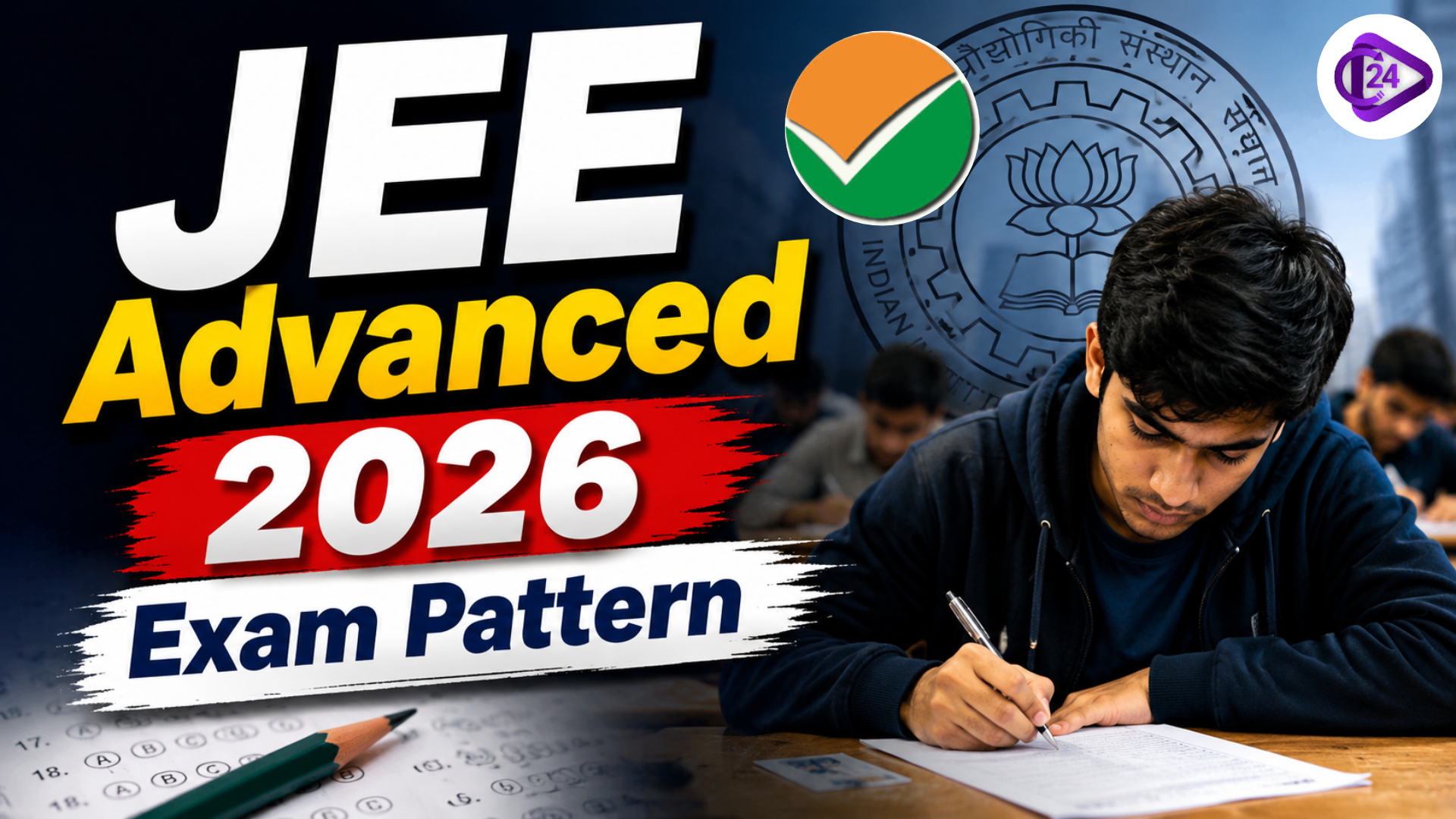
JEE Advanced 2026 Exam Pattern - IIT Roorkee will conduct JEE Advanced 2026 on May 17, 2026, in computer-based test (CBT) mode with two compulsory papers - Paper 1 and Paper 2. Each paper carries 180 marks, combining Physics, Chemistry, and Mathematics sections, totalling 360 marks. Understanding the JEE Advanced paper pattern 2026 is the first and most important step toward cracking this exam. This page covers the complete JEE Advanced 2026 exam pattern, including total questions, marking scheme, question types, subject-wise distribution, and paper-wise structure for both Paper 1 and Paper 2.
JEE Advanced 2026 Exam Pattern Highlights
The exam consists of two papers - Paper 1 and Paper 2 - both of which are mandatory. Both papers have three hours each. Both papers have three sections - Physics, Chemistry, and Mathematics. Questions asked in the JEE Advanced exam include multiple choice questions, questions with more than one answer, numerical value questions, integer digit answers, and matching-type questions.
| Feature | Details |
|---|---|
| Conducting Body | IIT Roorkee |
| Exam Date | May 17, 2026 (Sunday) |
| Mode of Exam | Computer-Based Test (CBT) |
| Number of Papers | 2 (Paper 1 + Paper 2) |
| Duration per Paper | 3 Hours (4 Hours for PwD) |
| Total Duration | 6 Hours |
| Subjects | Physics, Chemistry, Mathematics |
| Total Questions | 102 (51 per paper) |
| Total Marks | 360 (180 per paper) |
| Marks per Subject | 60 per subject per paper |
| Language | English and Hindi |
| Negative Marking | Yes (varies by question type) |
| Pattern Fixed? | No — changes every year |
Important: The exam pattern for JEE Advanced is not fixed and varies each year. The number of questions, types of questions, total marks, and marking scheme are determined by the organizing IIT and are revealed to candidates on the day of the examination through on-screen instructions.
JEE Advanced 2026 Paper 1 Pattern
The JEE Advanced exam pattern for Paper 1 is designed to check conceptual understanding and application skills. There are 51 questions in total, consisting of 17 questions from each of Physics, Chemistry, and Mathematics. This makes the paper balanced as equal weightage is provided to all three subjects.
Paper 1 Schedule: 9:00 AM – 12:00 PM
Each subject in Paper 1 is divided into 4 sections:
| Section | Question Type | Questions | Marks | Negative Marking |
|---|---|---|---|---|
| Section 1 | Single Correct MCQ | 4 | +3 each | -1 for wrong |
| Section 2 | Multiple Correct MCQ | 3 | +4 each (partial) | -2 for wrong |
| Section 3 | Numerical Value Type | 6 | +4 each | None |
| Section 4 | Match the List | 4 | +3 each | -1 for wrong |
Per Subject: 60 marks | Paper 1 Total: 180 marks
JEE Advanced 2026 Paper 2 Pattern
Paper 2 Schedule: 2:30 PM – 5:30 PM
In 2025, a notable change was introduced in the format of Paper 2, where the number of sections was reduced from four to three. It remains uncertain whether this change will be retained in 2026, so candidates should stay updated with official announcements.
| Section | Question Type | Questions | Marks | Negative Marking |
|---|---|---|---|---|
| Section 1 | Single Correct MCQ | 4 | +3 each | -1 for wrong |
| Section 2 | Multiple Correct MCQ | 3 | +4 each (partial) | -2 for wrong |
| Section 3 | Numerical Value Type | 6 | +4 each | None |
Per Subject: 60 marks | Paper 2 Total: 180 marks
Both Paper 1 and Paper 2 are compulsory. Missing either paper means no ranking and no IIT admission.
JEE Advanced 2026 Marking Scheme - Detailed
The JEE Advanced 2026 marking scheme is what makes this exam unique and challenging. Unlike JEE Main, the marking scheme in JEE Advanced differs based on question type.
Single Correct MCQ (Section 1)
- Correct Answer: +3 marks
- Wrong Answer: -1 mark
- Unattempted: 0 marks
Multiple Correct MCQ — Partial Marking (Section 2)
Partial marks are awarded as follows — +3 if all four options are correct but only three correct options are chosen; +2 if three or more options are correct but only two correct options are chosen; +1 if two or more options are correct but only one correct option is chosen.
- All correct options marked: +4 marks
- Any wrong option marked: -2 marks
Numerical Value Type (Section 3)
- Correct Answer: +4 marks
- Wrong Answer: 0 marks (No negative marking)
- Unattempted: 0 marks
Match the List (Section 4 — Paper 1 only)
- Correct Match: +3 marks
- Wrong Match: -1 mark
- Unattempted: 0 marks
JEE Advanced 2026 Total Marks & Subject-wise Distribution
| Subject | Marks per Paper | Total Marks (Both Papers) |
|---|---|---|
| Physics | 60 | 120 |
| Chemistry | 60 | 120 |
| Mathematics | 60 | 120 |
| Total | 180 | 360 |
Question Types in JEE Advanced 2026
The question types are mixed: single-correct MCQs, multi-correct MCQs, numerical value type, and either match-the-list (Paper 1) or paragraph-based (Paper 2).
Understanding each question type is critical for your JEE Advanced preparation strategy:
1. Single Correct MCQ Only one option out of four is correct. Straightforward but tests conceptual clarity. Negative marking of -1 applies.
2. Multiple Correct MCQ (MSQ) One or more options can be correct. Partial marking applies. Strategy: Partial marking benefits you only when you are 100% sure about an option. If 2 out of 3 options look correct and 1 is doubtful, mark only the 2 confirmed options to secure +2. Marking the doubtful one risks -2 if it turns out wrong.
3. Numerical Value Type (NVT) Answer is a numerical value. No negative marking — attempt all NVT questions confidently.
4. Match the List Two lists are given and candidates must match them correctly. Negative marking applies.
JEE Advanced 2026 Exam Mode & Language
The IIT JEE Advanced 2026 exam will be a computer-based test (CBT). Candidates can select or switch their preferred language anytime during the examination between English and Hindi.
Key CBT features:
- Save and Next - saves your answer and moves to next question
- Clear Response - deletes your selected option
- Mark for Review - allows you to revisit a question later
- On-screen rough sheet provided - no external paper allowed
JEE Advanced vs JEE Main - Exam Pattern Comparison
| Feature | JEE Main | JEE Advanced |
|---|---|---|
| Conducting Body | NTA | IIT Roorkee (2026) |
| Mode | CBT | CBT |
| Papers | 1 Paper | 2 Papers (both compulsory) |
| Pattern | Fixed every year | Changes every year |
| Question Types | MCQ + Numerical | MCQ + MSQ + NVT + Match List |
| Negative Marking | Fixed (-1) | Varies by section |
| Total Marks | 300 | 360 (approx) |
| Partial Marking | No | Yes (for MSQs) |
Subject-wise Important Topics for JEE Advanced 2026
Mechanics and Electromagnetism together account for 50%+ of Physics. Organic and Physical Chemistry together account for 65%+ of Chemistry. Calculus and Algebra together account for 50%+ of Mathematics.
Physics: Mechanics, Electromagnetism, Optics, Modern Physics, Thermodynamics
Chemistry: Organic Chemistry, Physical Chemistry, Inorganic Chemistry, Electrochemistry
Mathematics: Calculus, Algebra, Coordinate Geometry, Trigonometry, Vectors & 3D
JEE Advanced 2026 Preparation Tips Based on Exam Pattern
1. Master Partial Marking Strategy Multi-correct MCQs and NVTs carry the highest weight. Never mark a doubtful option in MSQs — partial marking helps only when you are fully sure.
2. Attempt All NVT Questions Numerical value type questions have zero negative marking — never leave them blank.
3. Read On-screen Instructions Carefully Students should note that IIT Roorkee will disclose the exact marking scheme on the exam day in the instructions section. Always read instructions before starting each paper.
4. Practice Previous Year Papers JEE Advanced 2024 and 2025 papers are the best reference for understanding the actual pattern, difficulty level, and question distribution.
5. Manage Time for Both Papers Paper 1 and Paper 2 are on the same day. Use the break between papers to rest - not to review Paper 1.
Important Links
Conclusion
The JEE Advanced 2026 exam pattern is designed to test deep conceptual understanding, analytical ability, and problem-solving skills across Physics, Chemistry, and Mathematics. With 2 compulsory papers, 51 questions each, 360 total marks, and a changing pattern every year, it is critical that every candidate understands the JEE Advanced marking scheme, question types, and partial marking rules before appearing on May 17, 2026. Download the official JEE Advanced 2026 information brochure from jeeadv.ac.in and stay updated with any changes announced by IIT Roorkee.


Post a Comment
Your email address will not be published. Required fields are marked *