

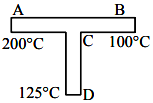
A rod CD of thermal resistance 10.0 W/m×K is joined at the middle of an identical rod AB as shown in figure. The end A, B and D are maintained at 200°C, 100°C and 125°C, respectively. The heat current in CD is P W. The value of P is _______.
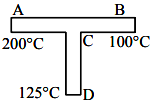
10.0 W/m×K थर्मल रेजिस्टेंस वाली एक रॉड CD को, चित्र में दिखाए अनुसार, एक जैसी रॉड AB के बीच में जोड़ा गया है। सिरों A, B और D का तापमान क्रमशः 200°C, 100°C और 125°C बनाए रखा गया है। CD में हीट करंट P W है। P का मान _______ है।
Three identical spheres each of mass m are placed at the corners of a right angled triangle with mutually perpendicular sides equal to 2m each. Taking point of intersection of these two sides as origin, the magnitude of position vector of the centre of mass of the system is \(\dfrac{4 \sqrt{2}}{x}\) where the value of x is ________.
m द्रव्यमान वाले तीन एक जैसे गोले एक समकोण त्रिभुज के कोनों पर रखे गए हैं, जिसकी एक-दूसरे के लंबवत भुजाओं की लंबाई 2m है। इन दोनों भुजाओं के कटान बिंदु को मूल बिंदु (ऑरिजिन) मानते हुए, सिस्टम के द्रव्यमान केंद्र (सेंटर ऑफ़ मास) के स्थिति सदिश (पोजीशन वेक्टर) का परिमाण \dfrac{4 \sqrt{2}}{x} है, जहाँ x का मान ________ है।
A particle initially at rest starts moving from reference point x = 0 along X-axis, with velocity v that varies as, \(\mathrm{v}=2 \sqrt{\mathrm{x}} \mathrm{~ms}^{-1}\) . The acceleration of the particle is _______ ms ⁻ ².
शुरू में स्थिर एक कण, रेफरेंस पॉइंट x = 0 से X-एक्सिस के साथ v वेग से चलना शुरू करता है, जो इस तरह बदलता है: \(\mathrm{v}=2 \sqrt{\mathrm{x}} \mathrm{~ms}^{-1}\) I कण का त्वरण _______ ms⁻² है।

An alpha-particle of mass m suffers 1- dimensional elastic collision with a nucleus at rest of unknown mass. It is scattered directly backwards losing, 64% of its initial kinetic energy. The mass of the nucleus is ⌷ × m. Then find.
m द्रव्यमान का एक अल्फा-कण, अज्ञात द्रव्यमान वाले और स्थिर न्यूक्लियस के साथ 1-आयामी इलास्टिक टक्कर करता है। यह सीधे पीछे की ओर बिखरता है और अपनी शुरुआती काइनेटिक एनर्जी का 64% खो देता है। न्यूक्लियस का द्रव्यमान ⌷ × m है। तो पता करें।
4 moles of H₂ at 500 K is mixed with 2 moles of He at 400K. The mixture attains a temperature T and volume V. Now the mixture is compressed adiabatically to a volume V' and temperature T'. If \(\dfrac{\mathrm{T}^{\prime}}{\mathrm{T}}=\left(\dfrac{\mathrm{V}}{\mathrm{~V}^{\prime}}\right)^{\mathrm{n}} \), find the value of 26n.
500 K पर H₂ के 4 मोल को 400 K पर He के 2 मोल के साथ मिलाया जाता है। मिश्रण का तापमान T और आयतन V हो जाता है। अब मिश्रण को एडियाबेटिक रूप से V' आयतन और T' तापमान तक कंप्रेस किया जाता है। यदि \(\dfrac{\mathrm{T}^{\prime}}{\mathrm{T}}=\left(\dfrac{\mathrm{V}}{\mathrm{~V}^{\prime}}\right)^{\mathrm{n}}\) है, तो 26n का मान ज्ञात कीजिए।
A sinusoidal voltage V(t) = 50sin (500t) is applied across a pure inductance of L = 0.02H The current through the coil is
L = 0.02H के शुद्ध इंडक्टेंस पर एक साइनसोइडल वोल्टेज V(t) = 50sin (500t) लगाया जाता है। कॉइल से बहने वाली धारा है

When a metal surface is illuminated by light of wavelength λ the stopping potential is 8V. When the same surface is illuminated by light of wavelength 3λ, stopping potential is 2V. The threshold wavelength for this surface is-
जब किसी धातु की सतह पर λ तरंगदैर्घ्य (wavelength) वाला प्रकाश डाला जाता है, तो स्टॉपिंग पोटेंशियल 8V होता है। जब उसी सतह पर 3λ तरंगदैर्घ्य वाला प्रकाश डाला जाता है, तो स्टॉपिंग पोटेंशियल 2V होता है। इस सतह के लिए थ्रेशोल्ड तरंगदैर्घ्य (threshold wavelength) है-
In Young's double slit experiment, light from two identical sources are superimposing on a screen. The path difference between the two lights reaching at a point on the screen is \(\dfrac{3 \lambda}{4}\). The ratio of intensity of fringe at this point with respect to the maximum intensity of the fringe is
यंग के डबल स्लिट प्रयोग में, दो एक जैसे स्रोतों से आने वाली रोशनी एक स्क्रीन पर सुपरइम्पोज़ (एक-दूसरे पर अध्यारोपित) हो रही है। स्क्रीन पर किसी बिंदु पर पहुँचने वाली दोनों प्रकाश तरंगों के बीच पथ का अंतर (path difference) \(\dfrac{3 \lambda}{4}\) है। इस बिंदु पर फ्रिंज की तीव्रता और फ्रिंज की अधिकतम तीव्रता का अनुपात है:
An alternating voltage V(t) = 220 sin 50πt volt is applied to a purely resistive load of 50Ω. The time taken for the current to rise from half of the peak value to the peak value is
50Ω के पूरी तरह से रेजिस्टिव लोड पर एक अल्टरनेटिंग वोल्टेज V(t) = 220 sin 50πt वोल्ट लगाया जाता है। करंट को पीक वैल्यू के आधे से पीक वैल्यू तक बढ़ने में कितना समय लगेगा?

An alternating voltage V(t) = 220 sin 50πt volt is applied to a purely resistive load of 50Ω. The time taken for the current to rise from half of the peak value to the peak value is
50Ω के पूरी तरह से रेजिस्टिव लोड पर एक अल्टरनेटिंग वोल्टेज V(t) = 220 sin 50πt वोल्ट लगाया जाता है। करंट को पीक वैल्यू के आधे से पीक वैल्यू तक बढ़ने में कितना समय लगेगा?
Exam Preparation Simplified
Learn • Practice • Analyse • Improve
Get Started Free