

For a reaction of the type: A + B + C → Product; the following observation are made; doubling the conc. of A keeping the other constant doubles the rate; doubling the concentration of B has no effect on the rate (keeping the other two concentration constant) & tripling the concentration of C (keeping that of the other two constant) increases the rate by a factor of 9. Find overall order of the reaction.
A + B + C → Product जैसी रिएक्शन के लिए, ये बातें देखी गईं: A की कंसंट्रेशन को दोगुना करने पर (बाकी को स्थिर रखते हुए) रेट दोगुना हो जाता है; B की कंसंट्रेशन को दोगुना करने पर रेट पर कोई असर नहीं पड़ता (बाकी दो कंसंट्रेशन को स्थिर रखते हुए) और C की कंसंट्रेशन को तीन गुना करने पर (बाकी दो को स्थिर रखते हुए) रेट 9 गुना बढ़ जाता है। रिएक्शन का कुल ऑर्डर पता करें।
How many of the following are not antiaromatic?

नीचे दिए गए में से कितने एंटी-एरोमैटिक नहीं हैं?

Number of compounds that are colourless in their aqueous solution among the following is
CuSO4, ZnSO4, FeSO4, Cr2(SO4)3, NaCl, KMnO4, K2Cr2O7
नीचे दिए गए यौगिकों में से कितने यौगिक अपने जलीय विलयन में रंगहीन होते हैं?
CuSO4, ZnSO4, FeSO4, Cr2(SO4)3, NaCl, KMnO4, K2Cr2O7

If The enthalpy of formation of KCl(s) = x kcal mol-¹) from the data: Find |10X | ?
\(\text { (i) } \mathrm{KOH}(\mathrm{aq})+\mathrm{HCl}(\mathrm{aq}) \longrightarrow \mathrm{KCl}(\mathrm{aq})+\mathrm{H}_2 \mathrm{O}(\mathrm{l}) ; \Delta \mathrm{H}=-13.7 \mathrm{kcal}\)
\(\text { (ii) } \mathrm{H}_2(\mathrm{~g})+\dfrac{1}{2} \mathrm{O}_2(\mathrm{~g}) \longrightarrow \mathrm{H}_2 \mathrm{O}(\mathrm{l}) ; \Delta \mathrm{H}=-68.4 \mathrm{kcal}\)
\(\text { (iii) } \dfrac{1}{2} \mathrm{H}_2(\mathrm{~g})+\dfrac{1}{2} \mathrm{Cl}_{(\mathrm{g})}+\mathrm{aq} \longrightarrow \mathrm{HCl}(\mathrm{aq}) ; \Delta \mathrm{H}=-39.3 \mathrm{kcal}\)
\(\text { (iv) } \mathrm{K}(\mathrm{~s})+\dfrac{1}{2} \mathrm{O}_2(\mathrm{~g})+\dfrac{1}{2} \mathrm{H}_2(\mathrm{aq})+\mathrm{aq} \longrightarrow \mathrm{KOH}(\mathrm{aq}) ; \Delta \mathrm{H}=-116.5 \mathrm{kcal}\)
\(\text { (v) } \mathrm{KCl}(\mathrm{~s})+\mathrm{aq} \longrightarrow \mathrm{KCl}(\mathrm{aq}) ; \Delta \mathrm{H}=+4.4 \mathrm{kcal}\)
दिए गए डेटा से यदि KCl(s) के निर्माण की एन्थैल्पी = x kcal mol⁻¹ है, तो |10x| का मान ज्ञात कीजिए।
\(\text { (i) } \mathrm{KOH}(\mathrm{aq})+\mathrm{HCl}(\mathrm{aq}) \longrightarrow \mathrm{KCl}(\mathrm{aq})+\mathrm{H}_2 \mathrm{O}(\mathrm{l}) ; \Delta \mathrm{H}=-13.7 \mathrm{kcal}\)
\(\text { (ii) } \mathrm{H}_2(\mathrm{~g})+\dfrac{1}{2} \mathrm{O}_2(\mathrm{~g}) \longrightarrow \mathrm{H}_2 \mathrm{O}(\mathrm{l}) ; \Delta \mathrm{H}=-68.4 \mathrm{kcal}\)
\(\text { (iii) } \dfrac{1}{2} \mathrm{H}_2(\mathrm{~g})+\dfrac{1}{2} \mathrm{Cl}_{(\mathrm{g})}+\mathrm{aq} \longrightarrow \mathrm{HCl}(\mathrm{aq}) ; \Delta \mathrm{H}=-39.3 \mathrm{kcal}\)
\(\text { (iv) } \mathrm{K}(\mathrm{~s})+\dfrac{1}{2} \mathrm{O}_2(\mathrm{~g})+\dfrac{1}{2} \mathrm{H}_2(\mathrm{aq})+\mathrm{aq} \longrightarrow \mathrm{KOH}(\mathrm{aq}) ; \Delta \mathrm{H}=-116.5 \mathrm{kcal}\)
\(\text { (v) } \mathrm{KCl}(\mathrm{~s})+\mathrm{aq} \longrightarrow \mathrm{KCl}(\mathrm{aq}) ; \Delta \mathrm{H}=+4.4 \mathrm{kcal}\)
The number of incorrect statement(s) from the following is -
(i) The successive half-lives of zero-order reactions decrease with time.
(ii) A substance appearing as reactant in the chemical equation may not affect the rate of reaction.
(iii) Order and molecularity of a chemical reaction can be a fractional number.
(iv) The rate-constant units of zero and second-order reactions are mol L¯¹s¯¹ and mol¯¹ Ls¯¹, respectively.
निम्नलिखित में से गलत कथन(s) की संख्या है –
(i) शून्य-कोटि (Zero-order) अभिक्रियाओं के क्रमिक अर्ध-आयु (successive half-lives) समय के साथ घटते जाते हैं।
(ii) रासायनिक समीकरण में अभिकारक (Reactant) के रूप में उपस्थित कोई पदार्थ अभिक्रिया की दर को आवश्यक नहीं कि प्रभावित करे।
(iii) किसी रासायनिक अभिक्रिया का कोटि (Order) तथा आणविकता (Molecularity) दोनों भिन्नात्मक (Fractional) संख्या हो सकते हैं।
(iv) शून्य-कोटि तथा द्वितीय-कोटि (Second-order) अभिक्रियाओं के दर-नियतांक (Rate constant) की इकाइयाँ क्रमशः mol L⁻¹ s⁻¹ तथा mol⁻¹ L s⁻¹ होती हैं।
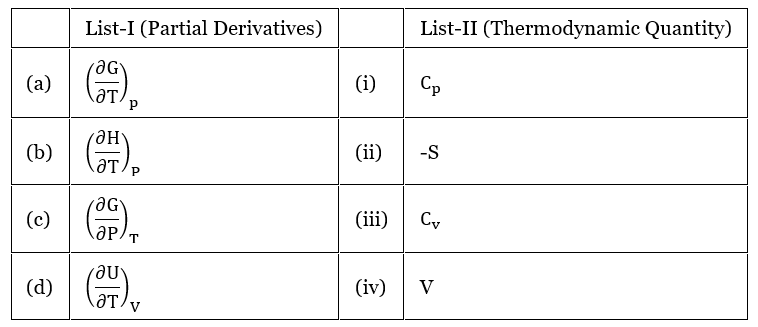
Match List-I with List-II.
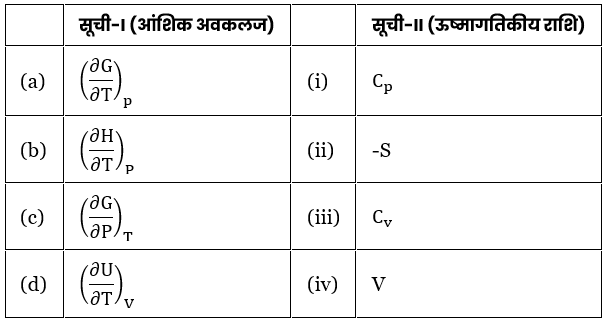
सूची-I का सूची-II से मिलान करें।

The correct order of increasing CFSE is :
CFSE के बढ़ने का सही क्रम है :
CFSEₒ = −1.2Δₒ and increases with ligand field/chelation (en > NH₃).
[Ni(NH₃)₆]²⁺ < [Ni(en)₂(NH₃)₂]²⁺ < [Ni(en)₃]²⁺.
(A) Wrong: square planar [PtCl₄]²⁻, [PdCl₄]²⁻ ≫ tetra [NiCl₄]²⁻.
(B) Wrong: [Fe(H₂O)₆]³⁺ > [FeF₆]³⁻.
(D) Wrong: square planar [Ni(CN)₄]²⁻ ≫ octa [Ni(NH₃)₆]²⁺.
CFSEₒ = −1.2Δₒ and increases with ligand field/chelation (en > NH₃).
[Ni(NH₃)₆]²⁺ < [Ni(en)₂(NH₃)₂]²⁺ < [Ni(en)₃]²⁺.
(A) Wrong: square planar [PtCl₄]²⁻, [PdCl₄]²⁻ ≫ tetra [NiCl₄]²⁻.
(B) Wrong: [Fe(H₂O)₆]³⁺ > [FeF₆]³⁻.
(D) Wrong: square planar [Ni(CN)₄]²⁻ ≫ octa [Ni(NH₃)₆]²⁺.
The products obtained are
\(\text { Glucos } \mathrm{e} \xrightarrow{\mathrm{HIO}_4}\)
The products obtained are
\(\text { Glucos } \mathrm{e} \xrightarrow{\mathrm{HIO}_4}\)
The CORRECT order of first ionization potential among the following is.
निम्नलिखित में से प्रथम आयनन विभव का सही क्रम है:
(A) F⊖ vs Cl⊖ : EA(Cl) > EA(F) ⇒ extra e⊖ is held tighter in Cl⊖, so IE(F⊖) < IE(Cl⊖).
(Statement false)
(B) Group –13 anomaly: due to poor d/f shielding & inert – pair effect, IE(Tl) > IE(Ga). (Statement false)
(C) Group–14: IE rises slightly from Sn to Pb (inert–pair effect) → Sn < Pb. (True)
(D) For anions, EA(S) > EA(O) ⇒ removing e⊖ from S⊖ is harder, so IE(O⊖) < IE(S⊖). (Statement false)
(A) F⊖ vs Cl⊖ : EA(Cl) > EA(F) ⇒ extra e⊖ is held tighter in Cl⊖, so IE(F⊖) < IE(Cl⊖).
(Statement false)
(B) Group –13 anomaly: due to poor d/f shielding & inert – pair effect, IE(Tl) > IE(Ga). (Statement false)
(C) Group–14: IE rises slightly from Sn to Pb (inert–pair effect) → Sn < Pb. (True)
(D) For anions, EA(S) > EA(O) ⇒ removing e⊖ from S⊖ is harder, so IE(O⊖) < IE(S⊖). (Statement false)

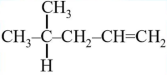
\(\begin{gathered} (\mathrm{X}) \\ \mathrm{C}_6 \mathrm{H}_{12} \end{gathered}\)  (Y)+(Z), (Y) & (Z) both show disproportination with conc. NaOH. Then X will be –
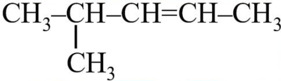
(CH₃)₃C-CH₂-CH=CH₂
(CH₃)₃C-CH=CH₂
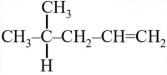
\(\begin{gathered} (\mathrm{X}) \\ \mathrm{C}_6 \mathrm{H}_{12} \end{gathered}\)  (Y)+(Z), (Y) & (Z) both show disproportination with conc. NaOH. Then X will be –
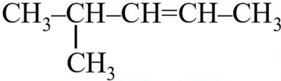
(CH₃)₃C-CH₂-CH=CH₂
(CH₃)₃C-CH=CH₂
Exam Preparation Simplified
Learn • Practice • Analyse • Improve
Get Started Free