

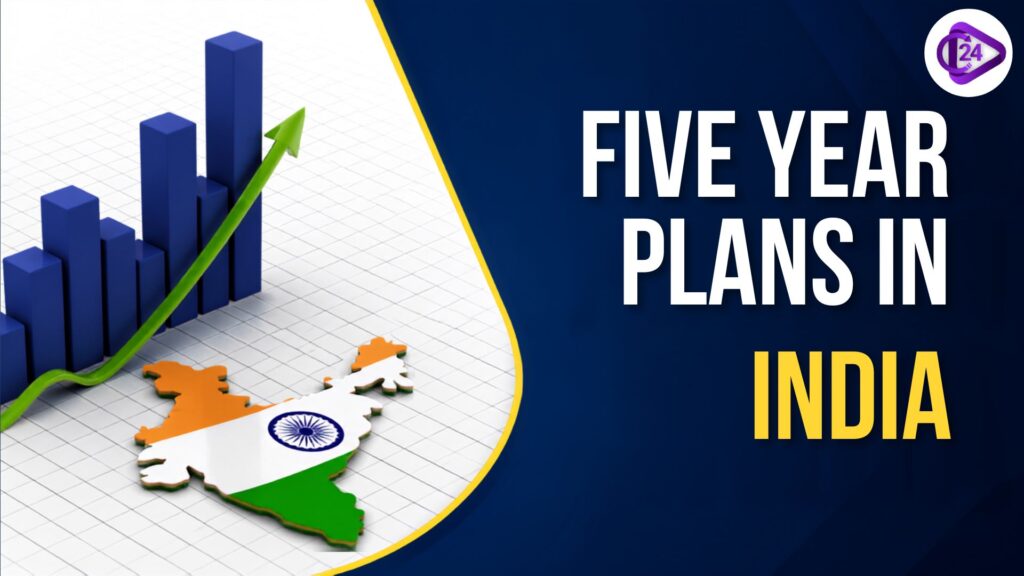
Five-Year Plans in India were an initiative for economic development consisting of a series of Five-Year Plans; the whole process of such planning was further believed to lead towards balanced growth by way of poverty alleviation, Employment Generation, along with Special focus on Social Welfare and Development for Agriculture, industry, and Infrastructure Sectors.
The First Five-Year Plan, which was based on the Soviet model of planned development, was introduced in 1951 under the supervision of the Planning Commission. Introducing twelve Five-Year Plans to meet national priorities from 1951 to 2017, the last Five-Year Plan in India, the Twelfth Five-Year Plan (2012–2017), noted that planning did not require centralised approval, although it urged other ministries to take ownership of plans and policy interventions.
What is Five Year Plans in India?
Five-Year Plans in India were the national economic development programmes administered by the Government of India. The plans, conceived by the Planning Commission (founded in 1950) sought to allocate resources for maximum use for rapid socio-economic growth. The main aims were to increase agricultural and industrial production, provide employment opportunities, eradicate poverty, and improve infrastructure as well as the quality of life. India initiated its First Five-Year Plan in 1951, modelled after the Soviet planning process. 12 Five-Year plans were implemented from 1951 up to 2017.
Origin of Five-Year Plans in India
Five-Year Plans in India began the need for a planned economy just after independence in 1947. Taking a cue from the USSR’s model of centralised planning, policymakers in India embodied a more systemised approach towards economic growth, poverty alleviation and self-sufficiency. The Planning Commission was constituted in 1950 by the Government of India with the Prime Minister as its Chairperson to prepare and formulate plans for development.
The First Five-Year Plan started on 1 April 1951 mainly to emphasise agriculture, irrigation and rural development as a solution for food shortage, followed by restructuring of the economy.
List of Five-Year Plans in India (1951–2017)
To promote planned economic development, 12 Five-Year Plans were implemented in India from 1951 to the year of 2017. Every plan had a national priority like agriculture, industrialisation, poverty reduction, infrastructure, employment, education and sustainable growth. The last of these was the Twelfth Five Year Plan (2012–2017), which was superseded by NITI Aayog’s strategic policy framework.
First Five Year Plan (1951–1956)
- Duration: 1951–1956
- Model: Harrod-Domar Model
- Prime Minister: Jawaharlal Nehru
- Objective: Agriculture, irrigation and rural development
- Growth Target: 2.1%
- Growth Achieved: 3.6%
- Joint ventures: Bhakra-Nangal Dam, Hirakud Dam, Damodar Valley Project
- One of the most important things: Increased food grain production and economic recovery post-independence
Second Five-Year Plans (1956–1961)
- Duration: 1956–1961
- Model: Mahalanobis Model
- Prime Minister: Jawaharlal Nehru
- Specialisation: Fast-developing industries and sectors
- Growth Target: 4.5%
- Growth Achieved: 4.3%
- Key Projects: Expansion of Steel Plants at Bhilai, Durgapur and Rourkela
- Key Milestone: Record of creating Public Sector and Industrial Base in India.
Third Five-Year Plans (1961–1966)
- Duration: 1961–1966
- The result: Prime Minister: Jawaharlal Nehru (initially), Lal Bahadur Shastri.
- Focus: Self-reliance and agriculture
- Growth Target: 5.6%
- Growth Achieved: 2.4%
- Some of the challenges: Indo-China War (1962), Indo-Pak War (1965) and extreme drought
- Type: NGO. Key Accomplishment: Foundation of the Green Revolution.
Plan Holiday (1966–1969)
- Duration: 1966–1969
- Economic crisis, wars and droughts Reason
- Plans: Three Annual Plans implemented
- Focus: Agriculture and economic stability
- Significant Achievement: Laid the foundation of the Green Revolution.
Fourth Five-Year Plans (1969–1974)
- Duration: 1969–1974
- Prime Minister: Indira Gandhi
- Theme: Growing without compromising on stability and being self-reliant
- Growth Target: 5.7%
- Growth Achieved: 3.3%
- Important event: The nationalisation of 14 big commercial banks (1969).
- Major Accomplishment: Improved banking system and agricultural growth.
Fifth Five-Year Plans (1974–1979)
- Duration: 1974–1979
- Prime Minister: Indira Gandhi
- Target: Eliminating poverty (Garibi Hatao) and self-sufficiency
- Growth Target: 4.4%
- Growth Achieved: 5.0%
- Major Programme: Twenty-Point Programme (1975)
- Noteworthy achievement: Focusing on job creation and poverty eradication.
- Note: Terminated one year early in 1978 by the Janata Government
Rolling Plan (1978–1980)
- Duration: 1978–1980
- Introduced By: Janata Party Government
- Idea: Rolling Plan, an Economic strategy by Gunnar Myrdal
- Focus: Flexible annual planning
- Major Accomplishment: Served as a placeholder for the Fifth Plan, and also was shelved in 1980
Sixth Five-Year Plans (1980–1985)
- Duration: 1980–1985
- Prime Minister: Indira Gandhi
- Areas of focus: Poverty alleviation, employment and technology
- Growth Target: 5.2%
- Growth Achieved: 5.7%
- It is The Integrated Rural Development Programme (IRDP).
- Biggest accomplishment: Prioritising modernisation and development of energy
Seventh Five-Year Plans (1985–1990)
- Duration: 1985–1990
- Prime Minister: Rajiv Gandhi
- Focus: Food, employment, and productivity
- Growth Target: 5.0%
- Growth Achieved: 6.0%
- Main Emphasis: Modernisation, IT, & Education
- Key Achievement: Improved telecom and technology sectors.
Annual Plans (1990–1992)
- Duration: 1990–1992
- Reasons: Political instability and Economic crisis
- Plans: Two Annual Plans
- Key Event: Economic Reforms and Liberalisation (1991.
- What We Got: Shift to market-oriented economy
Eighth Five-Year Plans (1992–1997)
- Duration: 1992–1997
- Stage 5: Prime Minister P. V. Narasimha Rao
- Domain: Human development and economic reforms
- Growth Target: 5.6%
- Growth Achieved: 6.8%
- Core Economy: LPG reforms
- Repeat achievement Highlight: Rapid financial improvement and growing private market expansion.
Ninth Five-Year Plans (1997–2002)
- Duration: 1997–2002
- From November 1997–May 1998, Prime Minister: I. K. Gujral, Atal Bihari Vajpayee
- Theme: Growth with social justice and equity
- Growth Target: 6.5%
- Growth Achieved: 5.5%
- Core Areas: Agriculture, rural development and poverty alleviation
- KEY ACHIEVEMENTS: Strengthened social sector programmes
Tenth Five-Year Plans (2002–2007)
- Duration: 2002–2007
- Prime Ministers: Atal Bihari Vajpayee / Manmohan Singh
- Theme: Accelerated, inclusive growth
- Growth Target: 8.0%
- Growth Achieved: 7.6%
- Title of Major Goal: Enhance the living standard and generate jobs
- Accomplishment: Massive enhancement in infrastructure and services
Eleventh Five-Year Plans (2007–2012)
-
- Duration: 2007–2012
- Prime Minister: Manmohan Singh
- Priority: Growth that is Faster and More Inclusive
- Growth Target: 9.0%
- Growth Achieved: 8.0%
- Focus Areas: Education, Health, Skill Development and Infrastructure
- Major Achievement: Realising flagship welfare schemes.
Twelfth Five-Year Plan (2012–2017)
- Duration: 2012–2017
- Prime Minister: Manmohan Singh / Narendra Modi
- Cohesion: Accelerated, Increased Inclusive and Sustainable Growth
- Growth Target: 8.0%
- Growth Achieved: Approximately 7%
- John Ritchie Senior Economist, Development Research
- MAJOR EVENT: Last 5 Year Plan of India under the earlier system, where the Planning Commission was dissolved and replaced by NITI Aayog. Five year plan days were over after the final 5-year strategy report came out in 2017.
Important Links
Objectives of Five-Year Plans in India
- Accelerate Growth: Work to achieve durable, balanced economic growth that spreads across the economy.
- Increasing agricultural production: Increasing irrigation, drafting proper farming methods, boosting rural development and thus securing food security for the nation.
- Foster Heavy Industries: Use state capacity to build heavy industries, manufacturing and public sector enterprises.
- Develop Employment: Creation of jobs, unemployment reduction through the development programme.
- Poverty alleviation: Upgrade the standard of living and provision of support for weaker sections, both social and economic.
- Traffic and Transport: Better Roads, Railways, Power, irrigation, urban facilities
- Ensure Social Justice: Reduce regional and income inequalities, encourage growth.
- Become Self-Sufficient: Decrease reliance on imports and bolster domestic production and export.
- Enhance Human Development: Improve not just education but also healthcare, skill development and social welfare.
- Sustainable Development Challenge: Achieving sustainable development through economic growth while protecting the environment and utilising natural resources efficiently.