
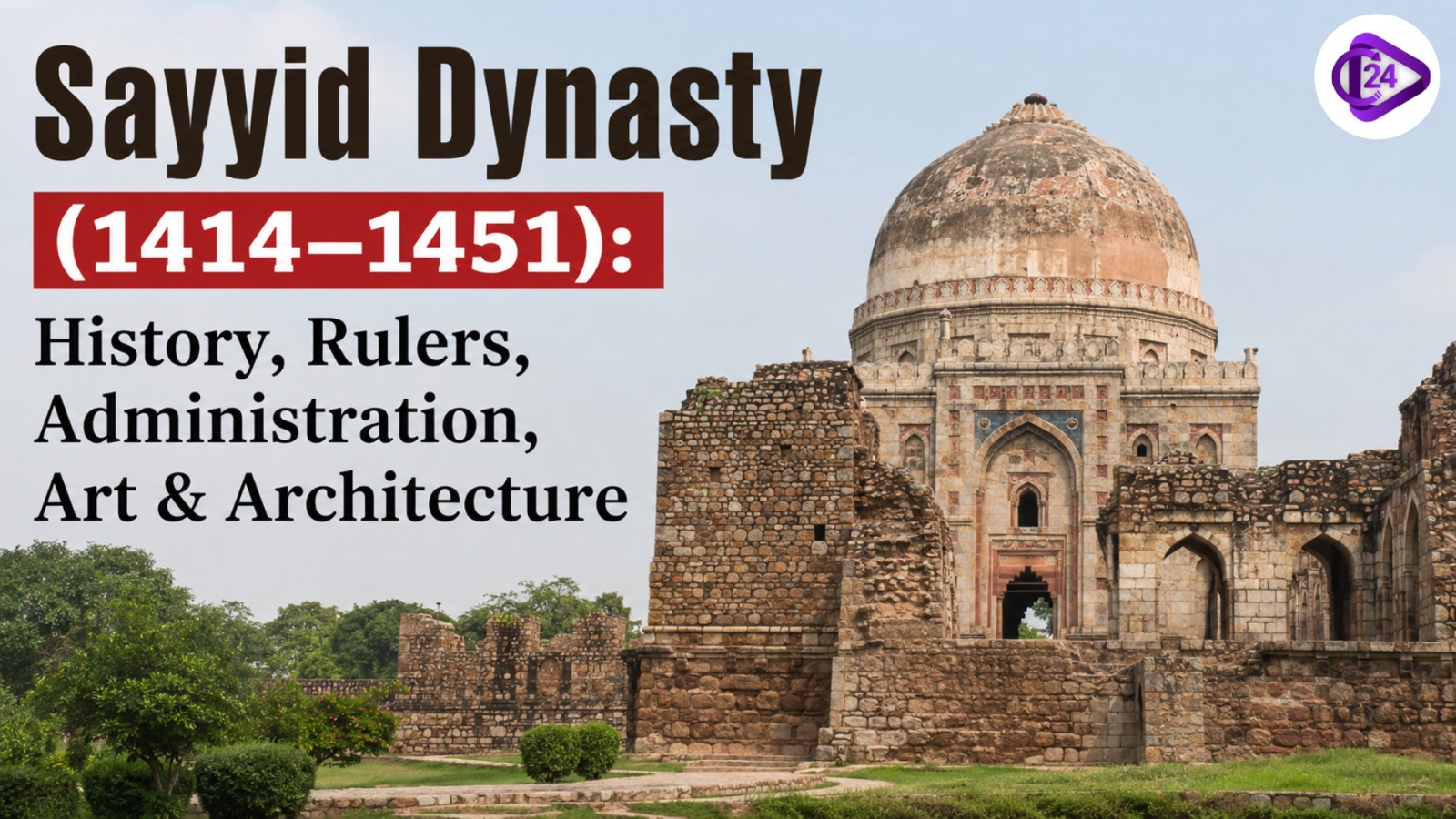
Sayyid Dynasty existed from 1414 to 1451, when a period of upheaval fell into place after the fall of the Tughlaq Dynasty. Khizr Khan, a noble of Turkic background and founder of the Sayyid Dynasty, attempted to bring consolidation to Northern India during political instability. Although it only lasted for 37 years, the Sayyid Dynasty helped to instil regional order and political culture based on territorial control over regions.
At the same time, the Sayyid Dynasty was hampered by powerful nobles who sought control of their territories, along with widespread internal rebellion. The successors conglomerate such as Mubarak Shah and Muhammad Shah, could not stabilise the ongoing crisis, and this paved the way to gradually decline of the dynasty, replaced by another dynasty named the Lodi Dynasty.
Sayyid Dynasty Overview
Sayyid Dynasty the 4th Ruler of the Delhi Sultanate (1414-1451: 37 Years). The Sayyids, who rose to power after the reemerging menace of the fading Tughlaq dynasty, faced a series of problems, both domestic and external in nature.
Foundation: Sayyid dynasty established by Khizr Khan, 1414 (Timurid vassal of Multan). Khizr Khan did not take the title Sultan but rather the title “Rayat-e-ala”.
Specific Identity: The Sayyids, a sect of the theological class in the Delhi Sultanate era, were known as Kulah-Daran (cap-wearers) for their pointed caps rubbed against their crowns — distinct from Dastar-bandan (turban-wearers).
Sayyid Dynasty Origin
Sayyid dynasty – Khizr Khan Sayyid Dynasty is a dynasty that traced its origin from an arab noble who claimed descent from Muhammad. He was the governor of Multan under Sultan Firuz Shah, until he was driven out in 1395. Following Timur’s destruction of Delhi in 1398, he sent Khizr Khan to be his governor at Multan and gained land such as Lahore, Dipalpur & Upper Sindh. He founded the Sayyid dynasty by defeating Mallu Iqbal Khan in 1405 and seized Delhi in 1414.
Sayyid Dynasty Rulers
The Sayyid sultans (1414–1451) were established by Khizr Khan (1414-1421), followed by Mubarak Shah(1421–1434), who struggled against rival regional sultans and internal threats. Muhammad Shah (1434–1445) followed his father on the throne, but his rule was marred by unrest, and the last ruler, Alauddin Alam Shah (1445–1451), lost effective control of his dynasty weakened for good and left unscathed allowing for the eventual rise of the Lodi dynasty.
Sayyid Dynasty Founder Khizr Khan
- Khizr Khan (28 May 1414 – 20 May 1421), the most capable and last ruler of the Sayyid dynasty, came into power after the Tughlaq dynasty’s collapse and Timur’s invasion.
- Title and Authority: Khizr Khan avoided royal styles out of fear of Timur’s invasion, though he had used titles like Rayat-i-Ala (Sublime Banners), Masnad-i-Aali (Most High Post). Nevertheless, Tughlaq rulers still minted coins in their names.
- Military Operations: He crushed the revolts, like the one by Raja of Katehar, Har Singh. His armies captured Bayana and Gwalior in 1416.
- Khizr Khan made Malik-us-Sharq Malik Tuhfa his wazir, who was a key figure as administrator and manager of the state.
- Successors: His son Mujizr-ud-din Mubarak Shah succeeded him after he died in 1421.
Mubarak Shah (Sayyid Dynasty)
Mubarak Shah was the second monarch of Sayyid Dynasty and ruled over Delhi Sultanate from 1421 – 1434 CE. He was a successor to his father Khizr Khan, and helped to strengthen the faltering Sultanate. Mubarak Shah repressed various revolts of the local rajas in Punjab, Doab and beyond, helping to stabilise his regime. He established the city of Mubarakabad near Delhi and ushered in administrative reform. He sat for ten-plus years with the Sayyid authority, beset on all sides by military crisis and attacks from regional powers. Mubarak Shah was murdered in 1434 CE by conspirators, a major blow to the power and stability of the dynasty.
Sayyid Dynasty Muhammad Shah (1434–1445)
- Muhammad Shah was the third monarch of the Sayyid Dynasty and reigned over Delhi Sultanate from 1434 to 1445 CE.
- He took over from his father, Mubarak Shah, who was assassinated.
- Political instability characterised his reign and led to a gradual erosion of royal power.
- This independence of action by many provincial governors and local chiefs diminished the authority of Delhi.
- He spent much of his time squashing rebellions and trying to keep distant provinces in line.
- The administration was chiefly run by wealthy nobles and generals.
- The Delhi Sultanate was, therefore, not what it had been during this time under his rule.
- However, runner has kept control of Delhi and its surrounding areas.
- His rule was an indication of the gradual degeneration of Sayyid power in Northern India.
- He passed away in 1445 CE and was succeeded by Ala-ud-Din Alam Shah.
Alauddin Alam Shah (1445–1451) – Sayyid Dynasty
- Delhi Sultanate: The fourth and the last ruler of the Sayyid dynasty, Ala-ud-Din Alam Shah ruled from 1445 to 1451 CE.
- He came to power right after his father, Muhammad Shah, when the Sultanate had already lost political strength.
- Alam Shah turned out to be an ineffective ruler, who could not restore the fading glory of Delhi.
- Consequently, real power began to slip into the hands of strong Afghan nobles like Bahlul Lodi.
- As the Sultan was not a strong king, his Wazir Hamid Khan did most of the state work.
- In 1448 CE, leaving Delhi get out of the governing together by moving to Badaun.
- He surrendered Delhi to Bahlul Lodi peacefully in 1451 CE, which put an end to the Sayyid sultanate and opened the way for the Lodi Dynasty.
- His abdication ended the Sayyid Dynasty (1414–1451 CE), and ushered in Afghan rule over the Delhi Sultanate.
- Alam Shah lived the rest of his life in Badaun and died in 1478 CE.
- He is remembered as the last monarch of the Sayyid Dynasty.
Sayyid Dynasty Administration (1414–1451)
- There was a Sultan who had the final say over the military, judicial and financial matters in their centralised monarchy under Sayyid rulers.
- In principle, the Sultan had regained much of his former authority, but unruly nobles and governors undermined his rule in practical terms.
- And the empire was divided into Iqtas (provinces), governed by governors responsible for revenue collection, keeping law and order, and military duties.
- The financial department was headed by the Wazir (Prime Minister), who guided the Sultan in governance.
- The Naib was the deputy to the Sultan himself, with considerable powers of administration.
- In the earlier regimes, revenue administration was focused on agrarian taxation, which constituted the major share of the state income.
- These judges operated within an Islamic Sharia law judicial system, but, in general, non-Muslims were permitted to abide by their own religious regulations regarding personal law.
- Qazis (judges) were assigned the responsibility of execution and management of lawsuits.
- Local administration continued largely through customary village institutions and local chiefs.
- Though a different model would supplant the military as the most important police unit, it stayed critical for subduing uprisings and asserting control over more distant areas.
- The administration remained ineffectual, hampered by repeated insurrections, economic problems, and the ascendancy of local rulers.
- Though weak, the Sayyid administration maintained the fundamental structure of government and military of the Delhi Sultanate up to the founding of the Lodi dynasty in 1451 CE.
Sayyid Dynasty Art and Architecture
- Despite political instability and financial constraints, the Sayyid Dynasty had a modest but significant contribution towards Indo-Islamic architecture.
- Their style of architecture served both as a link between the Tughlaq and Lodi styles, with more ornamentation than the Tughlaqs but still simple.
- Delhi became the site of the most remarkable architecture of the period, in terms of creating royal tombs and mausoleums.
- The most significant monument of this dynasty is the Tomb of Mubarak Shah. It is in the shape of an octagon, and should have a large central dome with buttresses and chhatris (domed kiosks).
- The Tomb of Muhammad Shah in Lodhi Gardens is another great example and features perhaps the most symmetry and ornate refinement found in Sayyid architecture.
- The octagonal tomb was a defining feature of Sayyid architecture, which then left its mark on later Lodi and Mughal buildings.
- This included domes, arches, chhatris, lotus finials, plaster decoration such as calligraphic inscriptions and geometric patterns.
- They identified blending of Hindu and Islamic architectural motifs, a feature which enriched the Indo-Islamic style.
- The Sayyids did not have the resources to build fortresses, palaces or cities on the same scale as their own.
- The monuments of the Lodi and Mughal periods were attempted by their more elementary accomplishments.
Tughlaq Dynasty (1320-1414 AD)
Conclusion on the Sayyid Dynasty (1414–1451)
Sayyid Dynasty (1414–1451 CE) preserved the Delhi Sultanate from political confusion after Timur invaded in 1398. The dynasty was founded by Khizr Khan and ruled over a succession of four sultans: Khizr Khan, Mubarak Shah, Muhammad Shah and Alauddin Alam Shah. Despite their weak central control, rebellions in the provinces, and serious financial problems, the Sayyids kept intact the administrative structure of the Sultanate. Architectural contributions, especially octagonal tombs, were their best-known. It ended in 1451 CE when Alam Shah surrendered power to Bahlul Lodi, who began the Lodi Dynasty.