


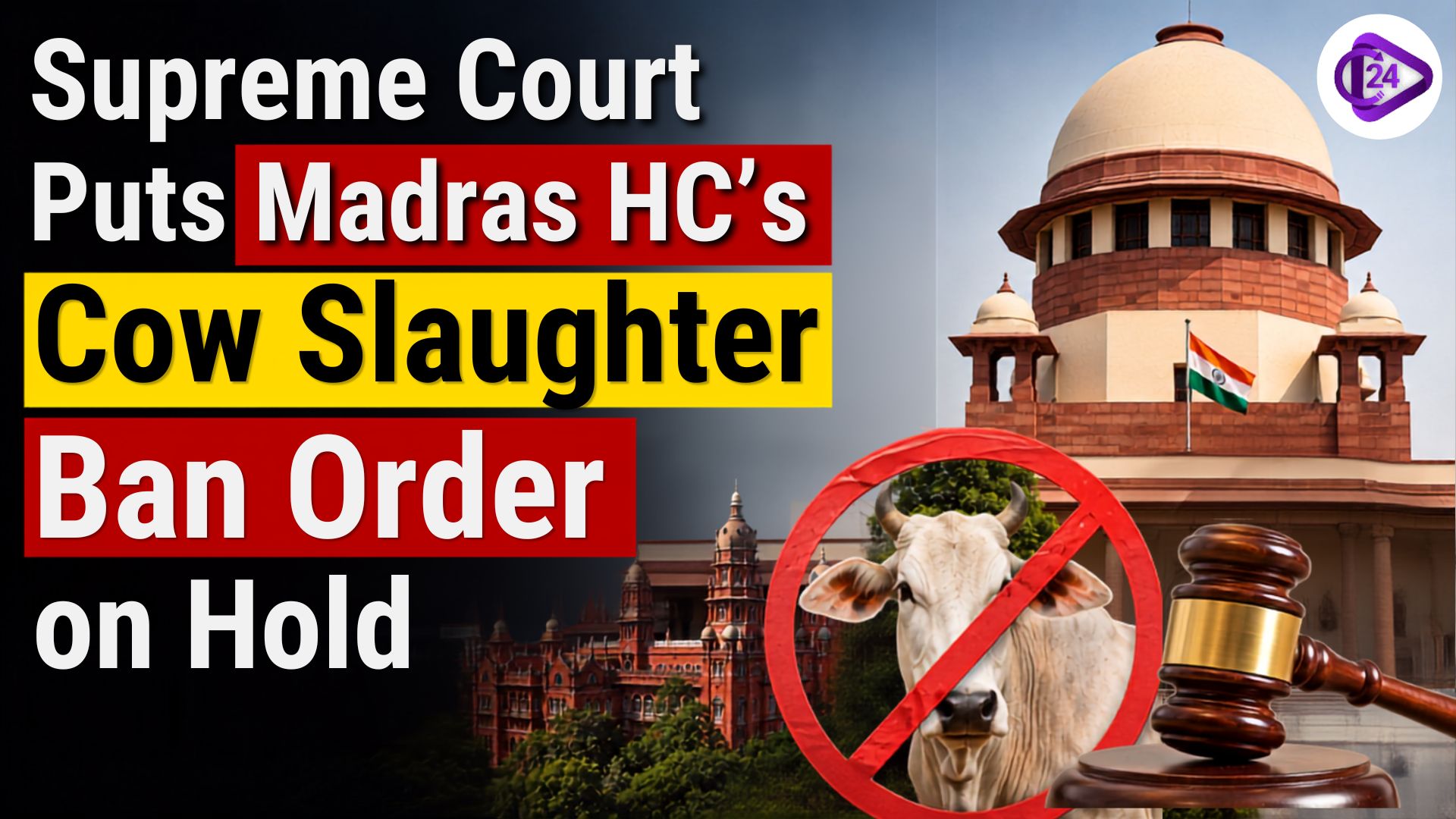
Supreme Court has issued a stay on a Madras High Court directive which ordered measures to be taken about cow slaughter and related activities in Tamil Nadu very strictly. The top court said the High Court’s remark on the direction would need careful examination on two fronts – not only constitutional but also legal – as it raises bigger issues in respect of the judicial powers, legislation and enforcement agencies. Supreme Court has put the High Court’s directions on hold until the matter is heard in detail.
Why is it in the News?
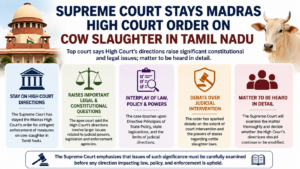
- The Supreme Court has on Thursday placed a stay on the Madras High Court’s directions for stringent enforcement of measures on cow slaughter in the State.
- The High Court directions have raised significant legal and constitutional issues, the apex court said, “Questions of this significance need to be looked into carefully.
- This stay order has raised a debate over what kind of interventions a court can make, over what powers states have, and over what might and should legislate concerning the slaughter of cattle.
- It is important because of its interpretation of the Directive Principles of State Policy, state legislations and limitations of judicial directions.
- The Supreme Court will come into its own to hear the matter in detail and will decide whether the directions given by the High Court continue or are to be modified.
What was the Madras High Court’s Order?
The Madras High Court in India had issued several directions to police authorities to properly implement related legislation related to cow slaughter and cattle transportation in Tamil Nadu. The court recalled the importance of making efforts towards the effective implementation of existing law in order to be able to effectively prevent illegal slaughter and keep cattle safe.
The High Court requested the government to:
- Take strict action against illegal cow slaughter.
- Increase supervision of unauthorised slaughterhouses.
- Prevent illegal transportation of cattle.
- Provide more coordination between animal husbandry and local administration and police.
- Strictly enforce the provisions of the applicable state laws.
What are the reasons behind the Supreme Court quashing the Order?
At this time, the Supreme Court did not rule on the merits of the case. Rather, it denied the motion for an interim order as a result of which:
- The High Court’s orders call for a thorough examination of the Constitution.
- The matter is one of separation of powers and overreaches by the courts.
- Some directions may extend beyond the state administration and law enforcement.
- The Court found that it was fitting to take the order “off the books” until a final hearing.
Constitutional and Legal Provisions Involved
| Provision | Significance |
| Article 48 | Directs the State to prohibit the slaughter of cows, calves, and other milch and draught cattle. |
| Article 226 | Empowers High Courts to issue writs for enforcement of legal and fundamental rights. |
| Article 32 | Allows citizens to approach the Supreme Court for enforcement of Fundamental Rights. |
| Directive Principles of State Policy (DPSPs) | Guide the State in framing laws related to animal husbandry and cattle preservation. |
Previous Year Questions (PYQs)
| Exam | Year | Question | Options | Answer |
| UPSC Prelims | 2020 | Which part of the Constitution contains the Directive Principles of State Policy? | A. Part II
B. Part III C. Part IV D. Part V |
C. Part IV |
| SSC CGL | 2023 | Article 48 of the Constitution deals with: | A. Right to Education
B. Protection of Environment C. Organisation of Agriculture and Animal Husbandry D. Local Self Government |
C. Organisation of Agriculture and Animal Husbandry |
| SSC CHSL | 2022 | Which Article empowers High Courts to issue writs? | A. Article 32
B. Article 226 C. Article 356 D. Article 136 |
B. Article 226 |
| RRB NTPC | 2021 | Directive Principles of State Policy are contained in which Part of the Constitution? | A. Part III
B. Part IV C. Part IVA D. Part V |
B. Part IV |
| UPSC Prelims | 2019 | Which Article empowers the Supreme Court to enforce Fundamental Rights? | A. Article 226
B. Article 356 C. Article 32 D. Article 51A |
C. Article 32 |
India Reports First-Ever Detection of Deadly Parrot Bornavirus (PaBV-4)
Conclusion on Tamil Nadu Cow Slaughter Ban
The Supreme Court’s decision to set aside the Madras High Court’s order is a significant milestone in India’s constitutional jurisprudence. The case will become significant when interpreting existing legislation on protection does not go far enough (to what extent do courts have the authority to administer directions to their interpretation). It is expected from its final verdict to bring more clarity in the balance of judicial, executive and the use of the Directive Principles of State Policy. A case study of this kind is very significant in competitive examinations with respect to some important topics of the Indian Constitution, Judiciary, Fundamental Rights, Directive Principles, Judicial Review, etc.