


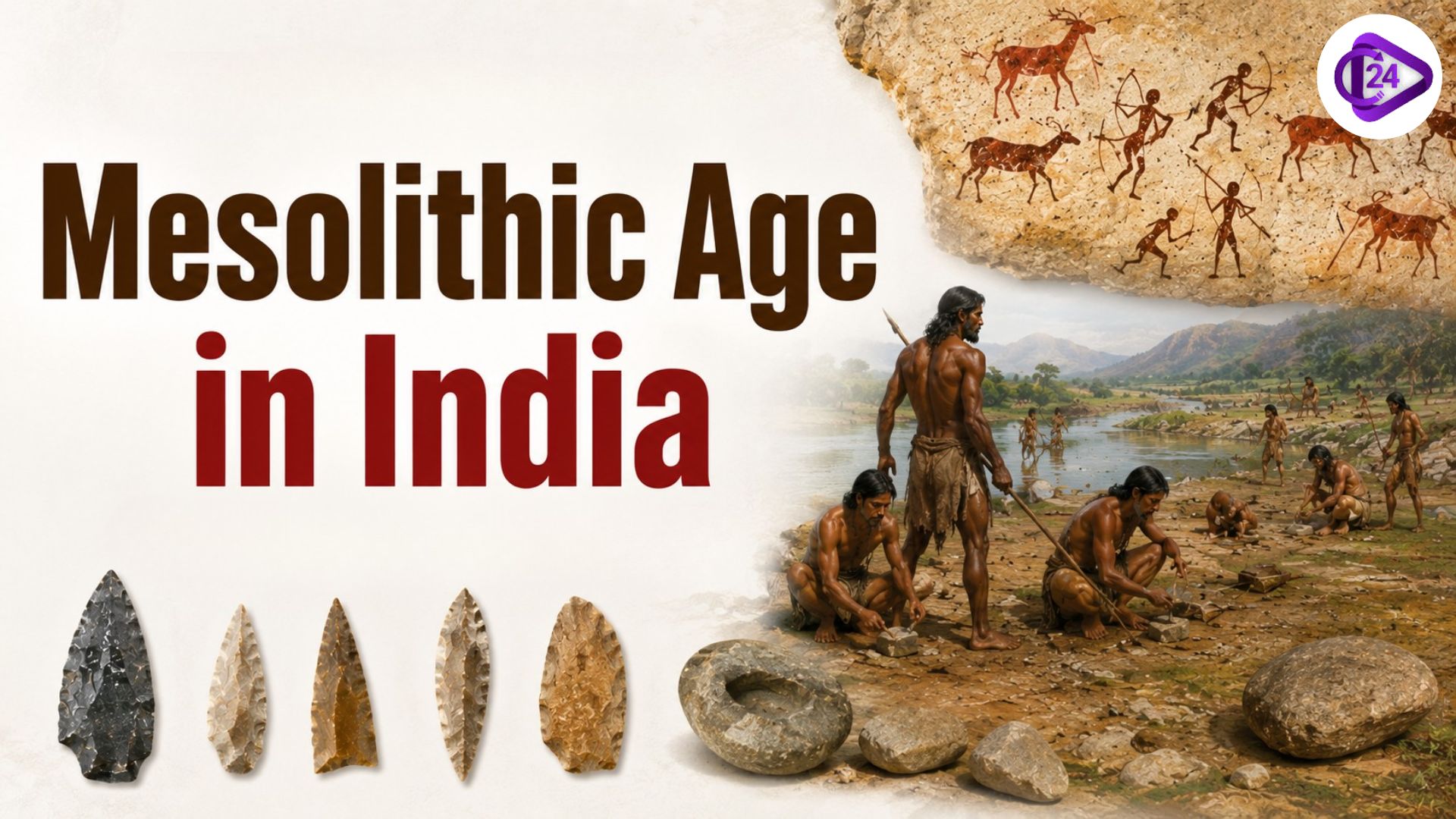
Mesolithic Age : The Mesolithic or Middle Stone Age of India is a transitional period between the Palaeolithic and Neolithic periods, c. 10,000 BCE to 4,000 BCE (regional variations). This time was marked by major changes in the way humans lived: the development of microlithic tools and semi-nomadic settlements where hunting, fishing, gathering and domestication of animals began. Through rock paintings, burial practices, and seasonal camps, we can see this increase in social and cultural complexity. Key Mesolithic sites like Bagor, Langhnaj and Bhimbetka reflect the technological, economic and cultural developments that eventually made possible the Neolithic way of life.
Mesolithic Age Culture
The culture of the Mesolithic Age signifies an important change, and this reflects that man made a significant step from a completely nomadic life to a more sustainable way of living. Evidence from rock art, burial customs, tool-making traditions and the first steps in animal domestication illustrates cultural developments during this time.
Key Features of Mesolithic Culture
- Rock Art: During the Mesolithic period, colourful paintings on cave walls and rock shelters were created to represent hunting scenes, dancing, rituals, trees, and animals in daily life. Bhimbetka contains some of the best-preserved examples of rock art, and is among the most important sites with Mesolithic art in India.
- Interments: The dead were buried in well-prepared graves, and the structure of the body was usually extended. To this distinction were added excavation types in which burials included stone tools, ornaments or animal bones – suggesting a belief in the afterlife and the functioning of rituals.
- Ornaments: Necklaces, beads, pendants and bracelets excavated from the graves of early man made from shells, bones, animal teeth and semi-precious stones indicate a developing aesthetic sense and craftsmanship.
- Social Structure: The groups were family-basedor bands. Social unity developed from hunting, food gathering and foraging around common resources.
- Domestication: Humans domesticated dogs, cattle, sheep, and goats; thereby establishing the groundwork for settled agricultural life in the later Mesolithic.
- Religious beliefs: Evidence of rock painting, burial practices and ritual objects implies the evolution of early spirituality with reverence for nature, plants and animals.
- Artistic Development: Engraved carvings, in addition to rock images and other decorative objects, demonstrate that humans made great improvements in symbolic thought and artistic development.
Mesolithic Age Tools
The Mesolithic Age, identified with the Archaeological Survey of India, is chiefly characterised by an abundance and fairly ubiquitous use of microliths, small, extremely well-worked stone tools that represent one major evolution over the large tools typical for Palaeolithic technology. These were often made of chert, chalcedony, jasper, agate and quartz and were typically 1–5 cm long. Many were attached to wooden or bone handles, forming compound tools that would be used for hunting, fishing, woodworking and food preparation.
Major Types of Mesolithic Age Tools
- Blades: For cutting meat, plants and other materials.
- Scrapers: Used for cleaning the hides of animals and wood
- Points: Served as spearheads and arrowheads.
- Burins: Used for scrimshawing bone, antler, and wood.
- Geometric Microliths: (e.g., triangles, trapezes and lunates [crescent tools]) are used primarily in composite hunting weapons.
- Backed Blades: Had a blunted edge so they were safe to handle and could be cut in more than one way.
Economy of the Mesolithic Age
Mesolithic economy Main articles: Mesolithic and Neolithic economy. The Mesolithic was mostly characterised by a primitive hunter-gatherer society, with communities exploiting various natural resources. People had replaced the Palaeolithic economy with a broad-spectrum one resting on animals, fish, birds, wild fruits and seeds along with roots and other edible plants. People continued to migrate seasonally, following food and water.
The later Mesolithic period (8000 to 3300 B.C.) provides evidence of the earliest stages of animal domestication, including dogs, cattle, sheep and goats. Other communities started to experiment with the domestication of plants, and this is often regarded as an early step towards a Neolithic agrarian economy. People relied more on fishing in areas by rivers, lakes and the coast, while better microlithic implements made hunting other game animals easier.
Also Read
| Revolt of 1857, Complete History | Lodhi Dynasty (1451–1526) |
| Sayyid Dynasty (1414–1451) | Tughlaq Dynasty (1320–1414 AD) |
| Khilji Dynasty (1290-1320 AD): | Mamluk Dynasty (1206 – 1290 AD) |
Characteristics of the Mesolithic Age Economy
- As it was essentially the same, went on living by hunting and gathering.
- Fishing also became an important economic activity in river and coastal areas.
- The diet was supplemented by gathering of wild fruits, nuts, seeds, roots and honey.
- People moved according to seasonality for food and water purposes.
- The relationship between people and animals that is central to pastoralism existed long before the advent of pastoralism itself, beginning with animal domestication.
- Plants were first domesticated in the late Mesolithic to set up a Neolithic-type subsistence economy based on farming.