
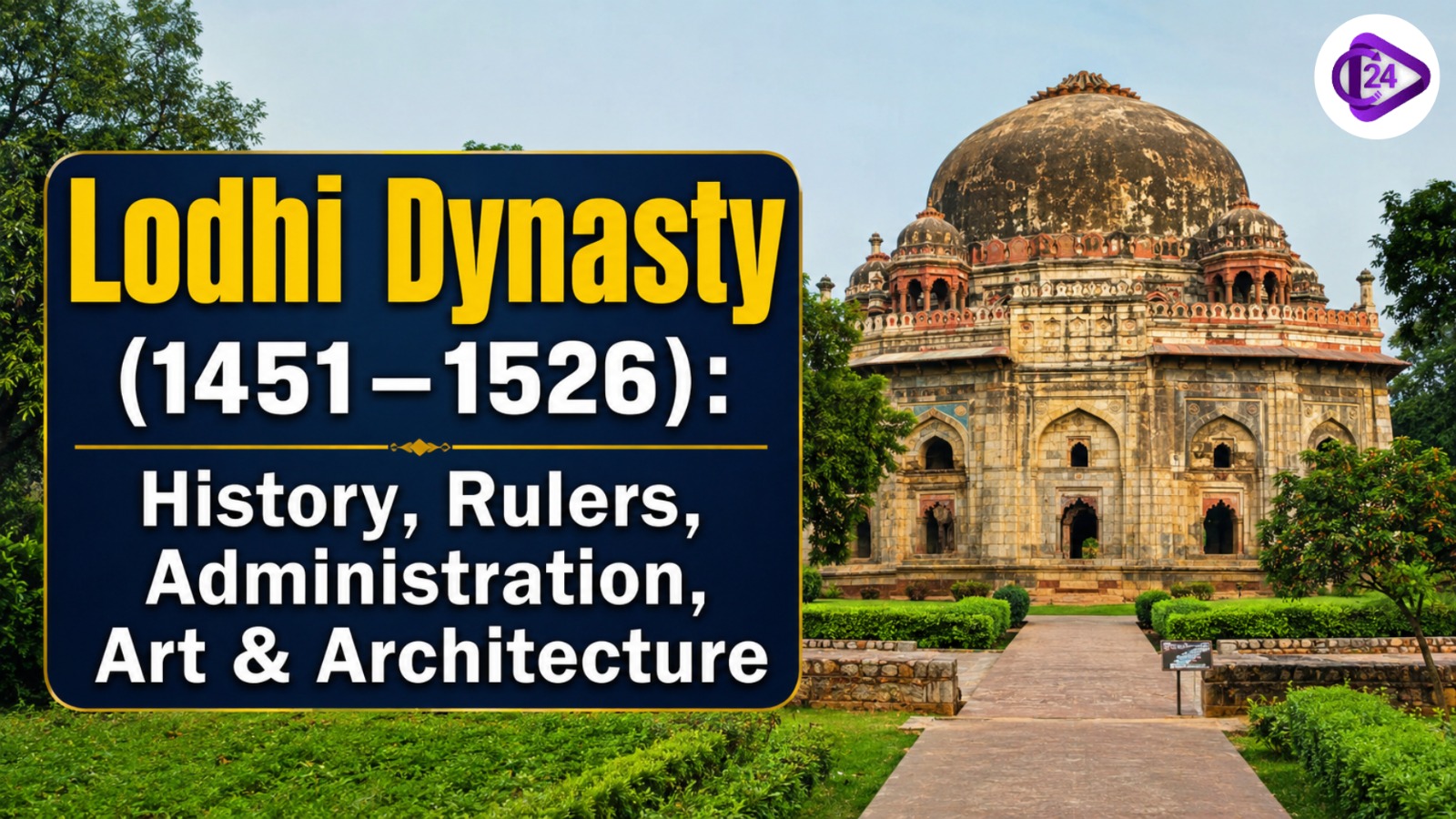
The Lodhi Dynasty (1451–1526 CE) was the last dynasty of Delhi Sultanate, and it was also the first Afghan dynasty to rule at Delhi. Founded by Bahlul Lodi after the end of the Sayyid dynasty in 1451 CE. The Lodhis were members of the Afghan (Pashtun) Lodi tribe that originated in present-day Afghanistan and the northwestern frontier. Bahlul Lodi Suwara: 1451 — 1482 THE MAKER OF HISTORY His progenitor was the chief of one of five great Afghan tribes that ruled Punjab in a declamatory line under Ottoman emperor Mohama, from his rule on behalf of the king at Peshwar until October 2023, where he had previously been governor Sheikh-Panjab. After Ala-ud-Din Alam Shah abdicated his position, Bahlul Lodi took control over Delhi and founded Lodhi Dynasty. The dynasty consolidated Afghan control over most of North India and lasted until 1526 CE, when Ibrahim Lodi was defeated at the First Battle of Panipat by Babur.
Bahlul Lodi (1451–1489 CE)
- Bahlul Lodi started the Lodhi Dynasty and was the ruler of the Delhi Sultanate from 1451 to 1489 CE.
- Being from the Lodi Pashtun (Afghan) clan, he was the first Afghan ruler of Delhi.
- He was formerly Governor of Sirhind, which gave him real power in Punjab before he became Sultan.
- He replaced the last Sayyid ruler, Alauddin Alam Shah, in 1451 CE and founded the Lodi Dynasty.
- Bahlul Lodi attempted to strengthen the Delhi Sultanate and brought it back from its age of decline.
- He recovered the large state of Jaunpur by annexation and further extended his dominion.
- He worked closely with Afghan chiefs and ruled by consensus.
- His administration focused on military might, loyalty and efficient governance.
- Succeeding Bahlul Lodi was known for his humble lifestyle, meritorious charity and practical rulership.
- He passed away in 1489 CE and was succeeded by Sikandar Lodi. Afghan power in North India stems from his reign.
Sikandar Lodi (1489–1517 CE)
- Sikandar Lodhi was the 2nd ruler of Lodhi Dynasty who ruled from 1489 to 1517 A.D.
- He was the son and successor of Bahlul Lodi.
- Sikandar Lodi is often considered the most effective and stable ruler of the Lodhi dynasty.
- He consolidated the rule of the administration and extended the Delhi Sultanate through military campaigns.
- He established the city of Agra in 1504CE, which would go on to become an important political and commercial centre.
- He established complete control over Bihar and brought Northern India under his rule of the Delhi Sultanate.
- To enhance governance and rejuvenate state finances, Sikandar implemented administrative and revenue reforms.
- He promoted agriculture and trade, as well as the construction of roads and markets.
- He wrote poetry under the pen name Gulrukhi and patronised Persian learning and literature.
- Upon the death of Sikandar Lodi in 1517 CE, Ibrahim Lodi acceded.
Ibrahim Lodi (1517–1526 CE)
- Lately, it was Ibrahim Lodi (1517–1526) who became the next and last ruler of the Lodhi Dynasty.
- Upon his death in 1517 CE, Sikandar Lodi was succeeded by his son.
- To make this central authority stronger, Ibrahim Lodi reduced the power of strong Afghan nobles.
- Many nobles and provincial governors opposed his policies, generating a great deal of discontent.
- Qutb al-Din’s rule also saw the rise of several Afghan chieftains, whose very presence further weakened the foundations of the Delhi Sultanate.
- His uncle Alam Khan Lodi and the governor of Punjab, Daulat Khan Lodi, invited Babur to invade India.
- Ibrahim Lodi had a huge army but no military organization and artillery used by Babur.
- He was also defeated and killed by Babur at the First Battle of Panipat on 21 April 1526.
- This defeat brought the Lodhi Dynasty and the Delhi Sultanate to an end.
- This was the natural first step to an empire in India, and by winning, Babur created such a thing – out of this ground zero.
Lodhi Dynasty Administration (1451–1526 CE)
- The Lodhi Dynasty used a centralised administration system with the Sultan highest in command over political, military and justice matters.
- Because the Lodhi rulers were of Afghan origin, they ruled mainly with the support of prominent Afghan noblemen who acted as administrators.
- The empire was segmented into provinces (Iqtas), each governed by governors in charge of revenue collection, law and order, and military service.
- The chief administrator in the case of the empire could also be the Wazir (Prime Minister) who had control over both implementation and financial affairs.
- Land tax was primarily the basis of revenue administration, and it had actually turned out to be the principal source of state income.
- With numerous revenue and administrative reforms to his credit, Sikandar Lodi took essential steps to improve governance and both secure and enhance the treasury.
- The judicial system followed Sharia law, with a Qazi serving as the judge to dispense justice.
- Local chiefs, village headmen and traditional institutions were largely responsible for village administration.
- The administration was supported by the military, and provincial governors had to keep soldiers in service of the Sultan.
- Lodhi rulers promoted agriculture, trade and market development for the economic prosperity of the region.
- However, the Afghan nobles were much more powerful than in earlier dynasties, meaning that the administration was consultative.
- The administration was undermined by internal strife between Afghan nobles at the time of Ibrahim Lodi, which helped weaken the hold of the dynasty.
Lodhi Dynasty Art and Architecture (1451–1526 CE)
- It laid the groundwork for Indo-Islamic architecture and bridged the gap between Sultanate and Mughal architectural elements.
- Lodhi architecture is characterised by simple, strong and well-proportioned forms embellished with domes and arches.
- Instead of mighty palaces and forts, the rulers mainly built tombs, mosques, gardens, bridges and buildings.
- The unique aspect of the Lodhi architecture was its common use of octagonal and square tombs as a key element.
- It is a perfect example of Lodhi architecture and an early example of the Mughal garden tomb type.
- The Bara Gumbad and Shish Gumbad, as well as tombs of some Lodhi rulers within the public park, all showcase impressive architectural style from this era.
- At the same time, builders enhanced structures with grey sandstone interspersed with glazed tiles and adorned them with decorative plasterwork and Quranic inscriptions.
- The architecture used to focus on large domes, pointed arches, Chhatris and geometric design.
- Tomb complexes with gardens, which were characteristic of Persian architecture.
- From the period of Sikandar Lodi onwards, architectural work flourished considerably within the city of Delhi and Agra.
- The foundation for the great architectural style of the Mughal Empire was rooted in Lodhi monuments.
- Dynasty structures are fashioned for their architectural ingenuity, delicacy, and evolution toward the modern Mughal movement.
Conclusion on Lodhi dynasty
The Lodhi dynasty (1451–1526 CE) was the final dynasty of the Delhi Sultanate and first Afghan dynasty to further extend knowledge and rule in the region through conquest. Established by Bahlul Lodi, it attained its zenith of power under Sikandar Lodi, who extended the Empire, built Agra and brought about far-reaching administrative reforms. They patronised agriculture, trade and revenue collection, and made significant contributions to Indo-Islamic architecture during their rule. The tombs and monuments they established would be the groundwork for future Mughal architecture. The dynasty was made weak due to internal conflicts among Afghan nobles, but it was the defeat of Ibrahim Lodi by Babur in 1526 CE that led to the fall of the Delhi Sultanate and the initiation of the Mughal Empire.