


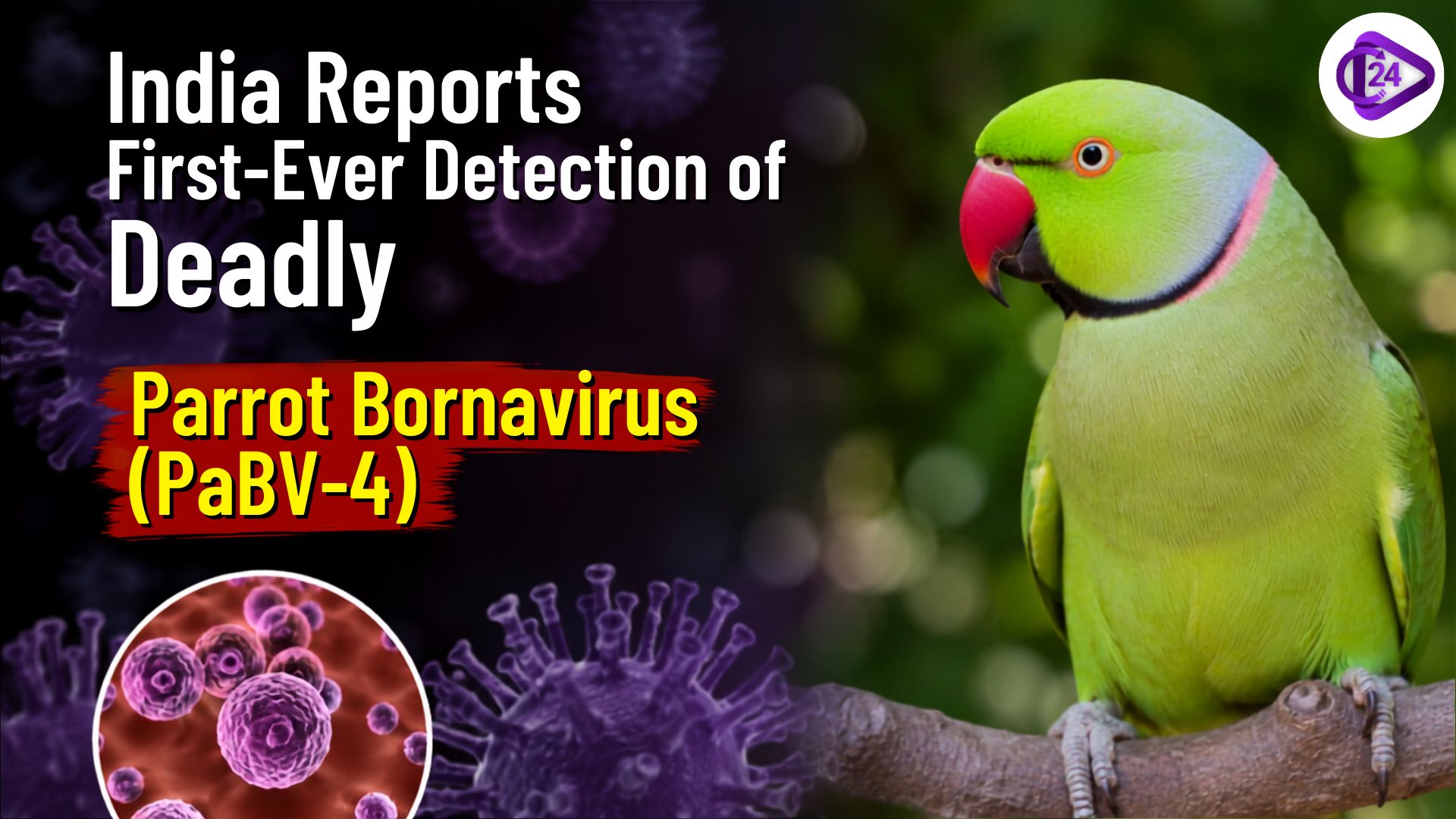
India Reports First-Ever Detection of Deadly Parrot Bornavirus (PaBV-4)

Parrot Bornavirus 4 (PaBV-4) has been first reported in India by researchers as a highly contagious virus that affects parrots and other psittacine birds primarily. A group of Indian scientists has been able to identify and genetically characterise the virus in captive birds and, for the first time, establish that...

India Reports First-Ever Detection of Deadly Parrot Bornavirus (PaBV-4)
Parrot Bornavirus

Parrot Bornavirus 4 (PaBV-4) has been first reported in India by researchers as a highly contagious virus that affects parrots and other psittacine birds primarily. A group of Indian scientists has been able to identify and genetically characterise the virus in captive birds and, for the first time, establish that the virus is circulating in the country. The finding is important because Proventricular Dilatation Disease (PDD) is a serious neurological and digestive disease that is frequently fatal in infected birds, caused by the PaBV-4. The discovery has led to worry among the wildlife conservation community, captive breeding programmes, zoos and the exotic bird trade in India.

Why in the news?

Researchers have identified and genetically characterised the virus in psittacine birds in India, and it is the first detection in the country. The report was based on a multi-institutional scientific study and indicates the importance of improving surveillance of diseases among captive bird populations. PaBV-4 has been described as a major threat to bird conservation and breeding programmes, as infected birds can be asymptomatic and still spread the disease.

India’s First Detection of PaBV-4: Key Highlights

Particular Details
Virus Parrot Bornavirus 4 (PaBV-4)
First Detected in India 2026
Virus Type Single-stranded RNA Virus
Virus Family Bornaviridae
Genus Orthobornavirus
Disease Caused Proventricular Dilatation Disease (PDD)
Affected Birds Parrots, Macaws, Cockatoos, Parakeets, Lovebirds and other Psittacine birds
Major Concern High mortality in captive birds and risk to conservation programmes

World Bank Income Classification 2026

What is Parrot Bornavirus 4 (PaBV-4)?

The Parrot Bornavirus 4 (PaBV-4), is an extremely contagious RNA virus that is part of the Bornaviridae family and Orthobornavirus genus. It primarily affects psittacine birds, such as parrots, macaws, cockatoos, parakeets, conures and lovebirds.

It infects the nervous system and digestive tract, causing one of the most severe diseases of captive parrots throughout the world, called Proventricular Dilatation Disease (PDD). Infected birds can look healthy but still be able to spread the virus to other birds.

What is PVDD?What is Proventricular Dilatation Disease (PDD)?

Proventricular Dilatation Disease (PDD) is a disease that progresses and can be fatal, resulting from the infection of the stomach with PaBV-4. It is harmful to the nerves which govern the digestive system, and sometimes also to the brain and spinal cord.

Symptoms of PDD

  • Progressive weight loss
  • Regurgitation or vomiting
  • The seeds are excreted in the feces without being digested.
  • Swelling of the bird’s glandular stomach (proventriculus)
  • Coordination and balance problems (ataxia)
  • Tremors and paralysis
  • Sudden death in extreme cases

What is the mode of transmission of PaBV-4?

However, the mode of transmission is still under investigation and is thought to be spread via:

  • Contact with infected birds – Direct or Indirect.
  • Saliva and nasal secretions.
  • Bird droppings (faeces)
  • Food and water that are contaminated
  • Feather dust
  • Transmission from infected parents to eggs (possible vertical transmission)
  • The greatest difficulty is that infected birds can exhibit no symptoms and spread the virus constantly.

Why is the First Detection in India Important?

This is significant as India’s captive population of parrots, aviaries, rescue centres, zoos and breeding centres is increasing.

Significance

  • India’s first official evidence of PaBV-4 circulation.
  • Increases wildlife disease monitoring.
  • Conserves endangered parrot species in captivity.
  • Supports the One Health approach through enhanced monitoring of animal diseases.
  • Assists veterinary authorities in creating biosecurity plans for bird conservation.

Prevention and Control Measures – Parrot Bornavirus

No vaccine or antiviral medicine has been approved for use with PaBV-4.

Recommended Measures

  • Health screening of all captive birds regularly.
  • Isolation of suspected and/or infected birds.
  • Ensure a high level of hygiene in aviaries.
  • Take advantage of RT-PCR tests for early diagnosis.
  • Do not interbreed newly imported birds with healthy birds.
  • Improve disease surveillance at zoos and bird breeding centres.
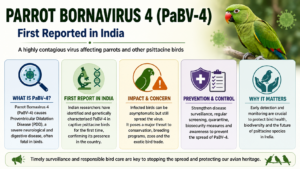
Conclusion on First Detection of Parrot Bornavirus-4

India is the first country to detect Parrot Bornavirus 4 (PaBV-4). This detection was a new important event in wildlife disease surveillance. The virus is known to infect parrots and birds closely related to them, but its identification shows the importance of biosecurity, early disease detection and ongoing monitoring of captive bird populations. This will lead to enhanced surveillance and conservation of threatened bird species, thereby mitigating the risk of future outbreaks in India’s ornamental aviculture sector.


Deadly Parrot Bornavirus (PaBV-4) FAQs

PaBV-4 is a highly contagious RNA virus that infects parrots and other psittacine birds, causing Proventricular Dilatation Disease (PDD).
India-New Zealand Strategic Partnership: Defence, Trade and Security Ties Get Major Boost
India Reports First-Ever Detection of Deadly Parrot Bornavirus (PaBV-4)
ICC Hall of Fame 2026, Sourav Ganguly, Kevin Pietersen and Anjum Chopra Honoured
World’s First Once-Weekly Insulin Launched in India: A Major Diabetes Breakthrough
World Bank Income Classification 2026: India Remains a Lower-Middle-Income Economy
Bhavya Industrial Park Scheme: Objectives, Features, Benefits & Key Highlights

Start Learning Today with Class24

Class24 Mobile Application

Class24 also has a mobile application so that it becomes easily accessible and convenient. This can be downloaded on an Android device. Users have appreciated this app and the content provided as 4.1 out of 5 is its rating in the App Store. People loved it because Class24 is giving content which is extremely rich in every sense. The app comprises a wide variety of features for smooth learning:

  • User-Friendly Interface: The app is categorized into various sections so that students can navigate and access various resources with ease.
  • Offline Access: The study materials can be downloaded and the student can access them even when not connected to the internet.
  • Inbuilt eBook Reader: There is a lightning-fast reader for eBooks within the app, so reading is seamless.
  • Progress Tracking: The app tracks student’s progress in preparation and keeps them organized and focused.

Courses and Subjects Offered

The total syllabus will be covered, and there are in-depth practice materials so as to give deep preparation in the courses designed to each one of them. All the subjects come under the aegis of courses offered by Class24 to meet different needs of various aspirants such as:

Preparation Tips for All Exams

Preparation tips for all exams mentioned below:

  • Previous Year Papers: Try to attempt at least 5-10 years of question papers to know the pattern of questions, how much difficulty one would face while answering, and how many frequently asked topics were in the examination.
  • Take Mock Tests: Attempt Mock Tests regularly in order to time and accuracy. You may analyze the performance and make an improvement for weak areas.
  • Focus on Time Management: Solve questions in the given time to make a habit of having speed and efficiency. Allocate time sensibly between Paper 1 and Paper 2, while appearing in the examination.
  • Current Affairs: For Current Affairs and TET exams, be updated about current affairs, teaching aptitude, and general awareness.
  • Regular Revision: Spend your daily and weekly time for revisions to not forget concepts and formulas. Use flashcards or do self-summary notes for quick revisions.
  • Understand the Exam Pattern and Syllabus: Understand the pattern of your exam paper and syllabus very well. Both Current Affairs and CSIR NET examinations are two-tier ones and involve both Paper 1, which consists of general aptitude and Paper 2 that involves specific aptitude subjects.
  • Make a Study Plan: Divide the preparation time into three phases of concept building, revision, and mock tests. Allocate more time to weaker areas while maintaining equilibrium with stronger sections.
  • Online Coaching or Study Groups: Enroll in online coaching programs like Class24 to get proper guidance and a structured approach to the study. Study groups will be useful to discuss doubts and share resources.
  • Stay Consistent and Motivated: Maintain a steady study schedule. Stay motivated by making small achievable goals.
  • Use Quality Study Materials: Suggested study material refers to a textbook, a set of previously published question papers, and web sources such as Class24.

Conclusion

Class24 is a one stop solution for aspirants preparing for Current Affairs, CSIR NET, SET, UP PGT English, UP TGT PGT, UPHESC Assistant Professor, TET, IGNOU B.Ed and other competitive exams. There are structured courses, live classes, mock tests along with the guidance of experts to assist candidates in achieving success in their respective fields.

Get success in your hand. Start study anytime anywhere.

The journey becomes simple and enjoyable when you start taking interest in it. And through our app “Class24”, we will be your trusted partners in developing that interest.

Daily Quizzes
Mock Tests
Ongoing

No ongoing tests right now.