

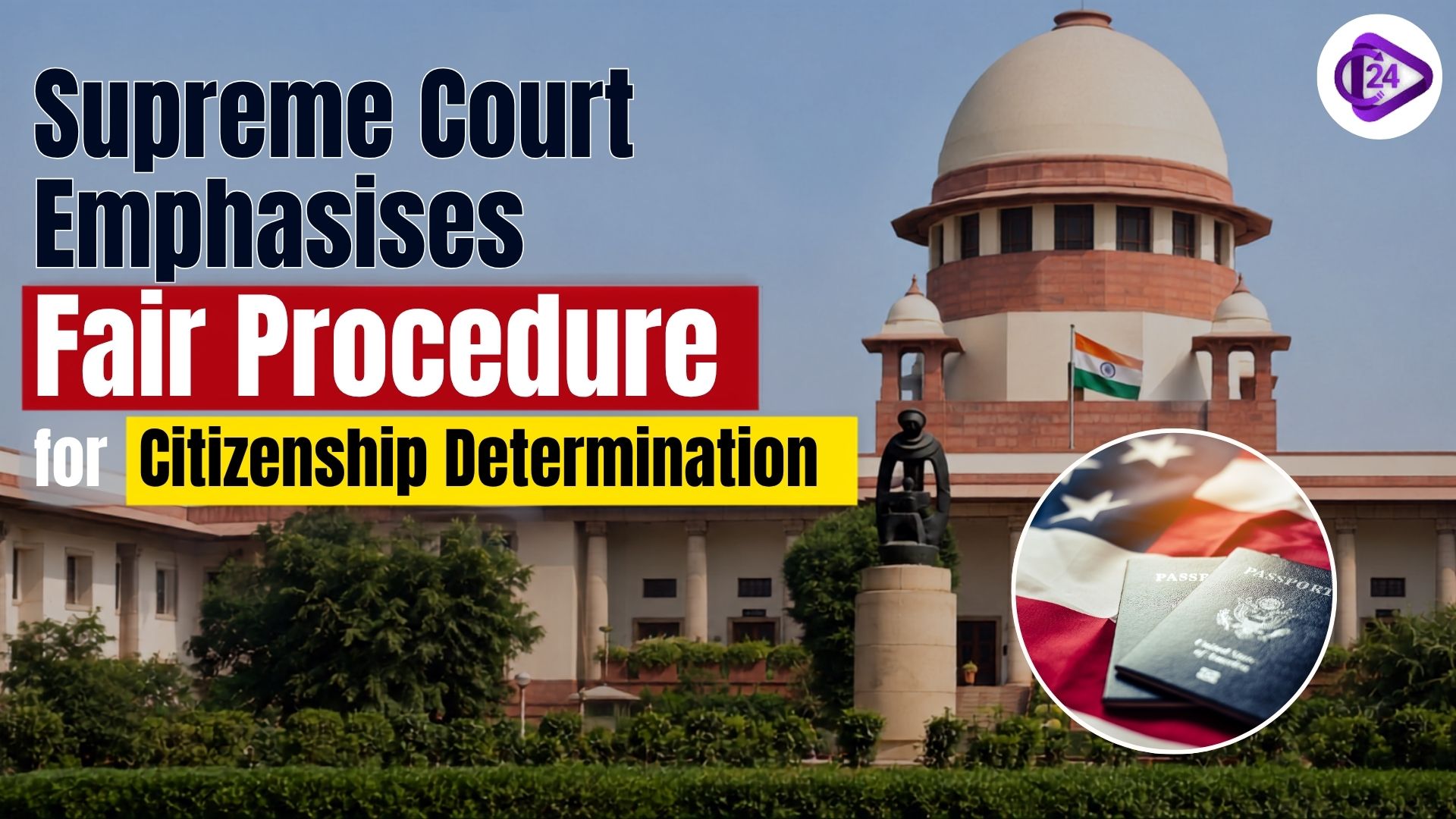
SC Upholds Principles of Fair Procedure: The Supreme Court of India has again stated that loss of citizenship does not happen merely by a fair, transparent and legally laid-down process. The Supreme Court, in passing a citizenship determination case, urged that each person be afforded the right to due process in the court and be provided enough notice, a hearing and evidence to hear before making any decision about citizenship. The judgment bolsters the constitutional ideas of equality before the law, protection of individual rights, and natural justice.
Why is it in the News? – Fair Procedure
- The Supreme Court emphasised that the provisions on citizenship qualification be handled in accordance with the principles of natural justice.
- The Court said that foreignness cannot be declared and loss of citizenship can only occur if there is a Fair Procedure legal process.
- It emphasised the need for proper notice, for affording people an opportunity to come before the authorities and for passing reasoned orders after hearing a person’s case.
- The decision reinforces the rights of the people in the Constitution in relation to the protection of their rights against arbitrary administrative action.
- This decision has ramifications for citizenship challenges, Foreigners Tribunals and constitutional rights cases.
Background of the Citizenship Dispute – Fair Procedure
- The petition was filed by an individual who contested the procedure followed in ascertaining his citizenship before a Foreigners Tribunal.
- According to the petitioner, he was labelled a foreigner without being given a proper opportunity to cite evidence and support his case.
- The core of this point is that the judicial determination of citizenship has a direct day-to-day impact on all aspects of an individual’s legal identity, including voting and access to certain constitutional rights.
- Citing the Citizenship Act, 1955; Foreigners Act, 1946 and constitutional guarantees under Articles 14 and 21, it said authorities must comply with established legal procedure.
- The Court reiterated that everyone is entitled to receive proper notice, adequate time to procure documents, representation wherever necessary and a reasoned order for an adverse order.
- The judgment reiterates the principles of natural justice, holding that disputes regarding citizenship must be adjudicated in a duly established and transparent process that follows constitutional due process requirements instead of arbitrary administrative action.
What is the Principle of Natural Justice? – Fair Procedure
- Natural Justice is an encompassing and overriding principle of law that guarantees a Fair Procedure trial, due process, equality before the law, etc. in judicial as well as administrative proceedings.
- No person, whether citizen or illegal, shall be deprived of rights or legal status without due process of law.
- It is recognised by Indian Courts under the constitutional guarantee embodied in Articles 14 and 21 entitling all individuals to equal protection before law, as well as to life and personal liberty.
- The two main principles are Audi Alteram Partem (hear the other side) and Nemo Judex in Causa Sua (no one should be a judge in their own cause).
- We need a good amount of notice; we need some sort of evidence to present at the hearing (a quasi-judicial setting); we also need an unbiased hearing; and we have to receive our speaking (reasoned) order before any negative action can be taken against us by authorities.
- A decision which violates the principles of natural justice would be regarded as arbitrary and liable to be set aside, unless such a plea has been expressly excluded by law
Citizenship & Supreme Court Related (PYQs) – Fair Procedure
| Exam | Year | Question | Options | Answer |
| UPSC Prelims | 2021 | Which Articles of the Constitution deal with citizenship? | A. Articles 1–4
B. Articles 5–11 C. Articles 12–18 D. Articles 19–22 |
B. Articles 5–11 |
| SSC CGL | 2023 | Which Article of the Constitution guarantees equality before the law? | A. Article 19
B. Article 21 C. Article 14 D. Article 32 |
C. Article 14 |
| SSC CHSL | 2022 | Which Article empowers the Supreme Court to enforce Fundamental Rights? | A. Article 32
B. Article 226 C. Article 356 D. Article 368 |
A. Article 32 |
| RRB NTPC | 2021 | The Citizenship Act in India was enacted in which year? | A. 1950
B. 1952 C. 1955 D. 1960 |
C. 1955 |
| UPSC Prelims | 2019 | Which Fundamental Right is known as the ‘Heart and Soul of the Constitution’ by Dr. B.R. Ambedkar? | A. Right to Equality
B. Right to Freedom C. Right to Constitutional Remedies D. Right against Exploitation |
C. Right to Constitutional Remedies |
| SSC MTS | 2023 | Who is the guardian and final interpreter of the Constitution of India? | A. Parliament
B. President C. Supreme Court D. Election Commission |
C. Supreme Court |
| SSC CPO | 2022 | Under which Article can the Supreme Court issue writs for the enforcement of Fundamental Rights? | A. Article 32
B. Article 226 C. Article 136 D. Article 143 |
A. Article 32 |
| UPSC Prelims | 2020 | Citizenship provisions in the Constitution are contained in which Part? | A. Part I
B. Part II C. Part III D. Part IV |
B. Part II |
| RRB Group D | 2022 | Which authority has the power to interpret the Constitution of India? | A. Prime Minister
B. Parliament C. Supreme Court D. Attorney General |
C. Supreme Court |
| SSC GD | 2024 | The Supreme Court of India was established on: | A. 15 August 1947
B. 26 January 1950 C. 28 January 1950 D. 26 November 1949 |
C. 28 January 1950 |

Conclusion on SC Upholds Principles of Fair Procedure for Citizenship
The Supreme Court emphasised that citizenship is an essential legal status which cannot be modified by arbitrary executive action. The Court has fortified constitutional guarantees against violation of individual rights, reaffirming the need for fair procedure, natural justice and due process. This landmark verdict serves as a reminder that the rule of law and procedural fairness are intrinsic to every citizenship determination, which thus forms an important theme for both constitutional governance as well as competitive exams.