


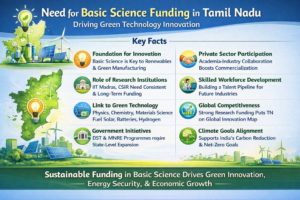
Tamil Nadu is emerging as a key hub for innovation and sustainable development in India, but experts emphasise that greater investment in basic science research is essential to accelerate the transition toward green technology. While the state has made notable progress in sectors like renewable energy, electric mobility, and climate innovation, the foundation of such advancements lies in strong scientific research. Institutions such as the Indian Institute of Technology Madras and the Council of Scientific and Industrial Research have highlighted the need for long-term funding to support fundamental studies in physics, chemistry, and environmental sciences. Strengthening this base will enable breakthroughs in clean energy, sustainable materials, and climate resilience technologies. Increased public and private investment can position Tamil Nadu as a leader in green innovation, contributing to India’s broader goals of sustainability, energy security, and carbon reduction.
Key Facts – Need for Basic Science Funding in Tamil Nadu
- Foundation for Innovation: Basic science research forms the backbone of applied technologies, including renewable energy and green manufacturing.
- Role of Research Institutions: Institutes like the Indian Institute of Technology Madras are actively working on sustainable technologies, but require consistent funding support.
- Link to Green Technology: Advances in physics, chemistry, and materials science directly contribute to innovations in solar panels, batteries, and hydrogen energy.
- Government Initiatives: Programmes under the Department of Science and Technology and the Ministry of New and Renewable Energy aim to promote clean energy research, but need expansion at the state level.
- Private Sector Participation: Increased collaboration between academia and industry can accelerate the commercialisation of green solutions.
- Skilled Workforce Development: Investment in basic science helps build a strong talent pipeline for future green industries.
- Global Competitiveness: Strong research funding enables Tamil Nadu to compete with global innovation hubs in sustainable technology.
- Climate Goals Alignment: Enhanced funding supports India’s commitments to reduce carbon emissions and achieve net-zero targets.
Asked the previous year’s Question and Answers
1. UPSC Prelims 2017
With reference to South Indian history, which of the following statements is/are correct regarding Chola administration in Tamil Nadu?
Options:
A) Village assemblies were called Sabha and Ur
B) Land revenue was the main source of income
C) Both A and B
D) Neither A nor B
Answer: C) Both A and B
Explanation: Cholas had a well-developed local self-government system (Sabha & Ur), and land revenue was the primary source of income.
2. UPSC Prelims 2016
Which classical dance form originated in Tamil Nadu?
Options:
A) Kathak
B) Bharatanatyam
C) Odissi
D) Manipuri
Answer: B) Bharatanatyam
Explanation: Bharatanatyam is one of the oldest classical dance forms, originating in Tamil Nadu temples.
3. SSC CGL 2020
The Brihadeeswara Temple, a UNESCO World Heritage Site, is located in which state?
Options:
A) Karnataka
B) Tamil Nadu
C) Andhra Pradesh
D) Kerala
Answer: B) Tamil Nadu
Explanation: Brihadeeswara Temple at Thanjavur was built by Rajaraja Chola I and is a masterpiece of Dravidian architecture.
4. RRB NTPC 2019
The Kaveri River primarily flows through which of the following states?
Options:
A) Tamil Nadu and Karnataka
B) Kerala and Andhra Pradesh
C) Maharashtra and Gujarat
D) Odisha and West Bengal
Answer: A) Tamil Nadu and Karnataka
Explanation: The Kaveri originates in Karnataka and flows into Tamil Nadu before draining into the Bay of Bengal.
5. SSC CHSL 2018
Which Tamil Nadu city is known as the “Gateway of South India”?
Options:
A) Madurai
B) Chennai
C) Coimbatore
D) Tiruchirappalli
Answer: B) Chennai
Explanation: Chennai is a major cultural, economic, and transport hub in South India.
6. RRB Group D 2018
Which river forms the Hogenakkal Falls in Tamil Nadu?
Options:
A) Krishna
B) Godavari
C) Kaveri
D) Mahanadi
Answer: C) Kaveri
Explanation: Hogenakkal Falls, often called the “Niagara of India,” is formed by the Kaveri River.
7. UPSC Prelims 2014
Which of the following temples is associated with the Dravidian style of architecture?
Options:
A) Sun Temple, Konark
B) Meenakshi Temple, Madurai
C) Khajuraho Temples
D) Sanchi Stupa
Answer: B) Meenakshi Temple, Madurai
Explanation: The Meenakshi Temple is a prime example of Dravidian architecture found in Tamil Nadu.
8. SSC MTS 2019
Which river is known as the “Ganga of the South” in Tamil Nadu?
Options:
A) Godavari
B) Krishna
C) Kaveri
D) Narmada
Answer: C) Kaveri
Explanation: The Kaveri River is considered sacred and is often called the “Ganga of the South.”
9. RRB NTPC 2021
Where does the Kaveri River finally drain?
Options:
A) Arabian Sea
B) Bay of Bengal
C) Indian Ocean
D) Persian Gulf
Answer: B) Bay of Bengal
Explanation: The river forms a delta in Tamil Nadu and drains into the Bay of Bengal.
10. SSC CGL 2017
Mamallapuram (Mahabalipuram), famous for rock-cut temples, is located in which state?
Options:
A) Odisha
B) Tamil Nadu
C) Kerala
D) Andhra Pradesh
Answer: B) Tamil Nadu
Explanation: Mamallapuram, a UNESCO site, was developed during the Pallava dynasty in Tamil Nadu.
Pi Day 2026: Interesting Facts and Historical Background
Conclusion
Strengthening basic science funding in Tamil Nadu is crucial for advancing green technology and sustainable development. A strong research base will drive innovation in clean energy, climate solutions, and eco-friendly industries. By investing in fundamental sciences, the state can enhance global competitiveness, support India’s sustainability goals, and build a resilient, future-ready economy.