
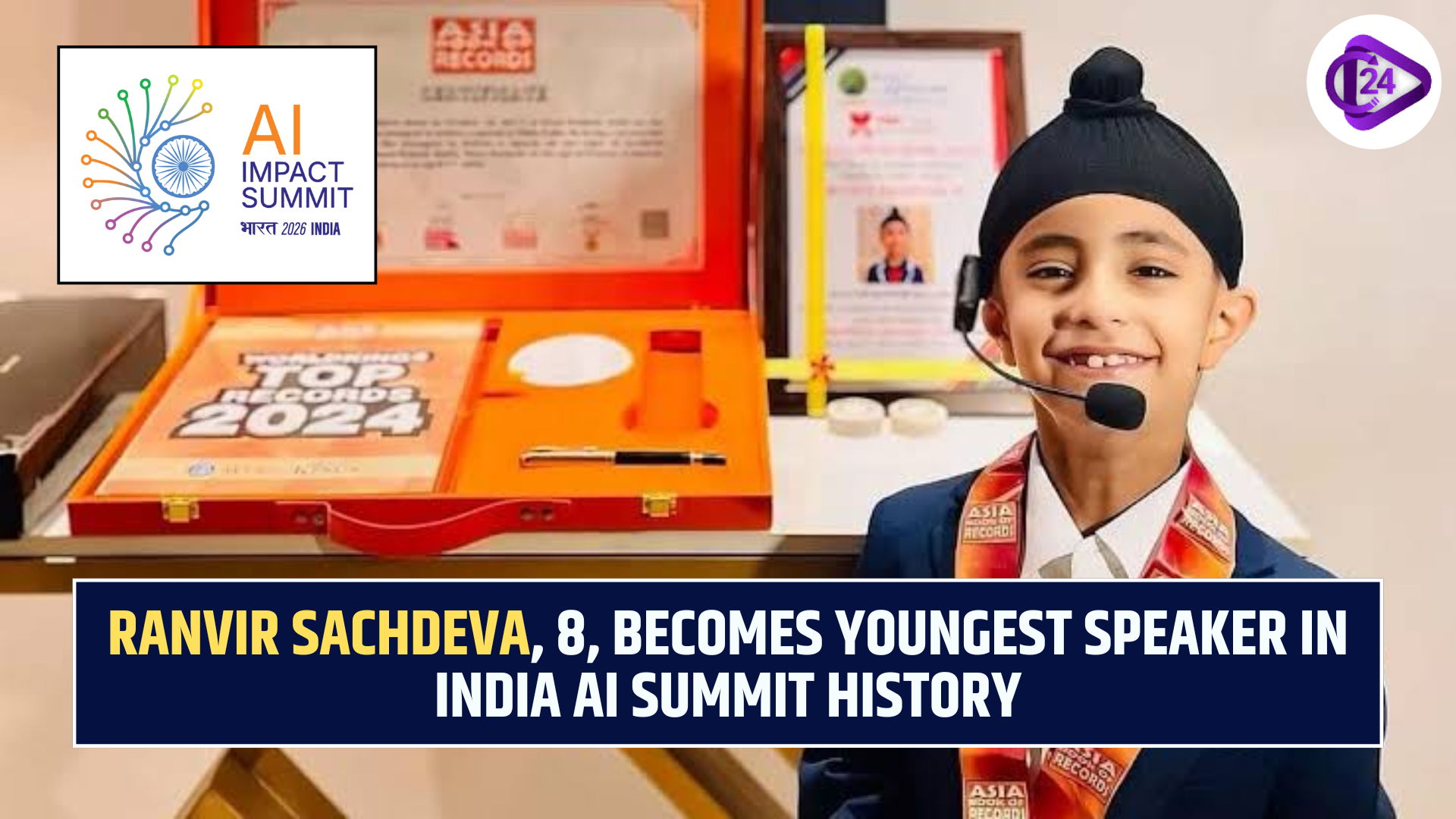
Ranveer Sachdeva made history as the youngest speaker ever to address the India AI Summit 2026. Speaking alongside global tech leaders and industry experts, he delivered a confident and thoughtful perspective on artificial intelligence and its growing role in education and innovation. His appearance was not a symbolic gesture but a reflection of genuine curiosity and deep interest in emerging technologies. The audience responded with admiration as he articulated ideas well beyond his years. Ranveer’s milestone moment highlights a new generation stepping forward, ready to participate in shaping India’s evolving AI and digital future.
Who is Ranvir Sachdeva?
-
Ranvir Sachdeva is an 8-year-old technology enthusiast who gained national attention as the youngest speaker at the India AI Impact Summit 2026 in New Delhi.
-
He is known for his early interest in coding, artificial intelligence, and emerging technologies.
-
At the summit, he shared thoughtful insights on AI’s future and its relevance to education and innovation in India.
-
His participation placed him alongside global technology leaders and policymakers.
-
Ranvir has interacted with prominent tech CEOs during major industry events.
-
He represents a new generation of young innovators actively engaging with advanced technology conversations.
Object of India AI Summit 2026
-
The India AI Summit 2026 was held from 16 to 20 February 2026 at Bharat Mandapam, New Delhi.
-
The summit was organised to establish India as a leading global force in artificial intelligence innovation and governance.
-
It brought together policymakers, global technology leaders, startups, researchers, and industry experts on a unified platform.
-
A key objective was to promote responsible, ethical, and transparent AI development aligned with societal needs.
-
The event focused on how AI can accelerate inclusive economic growth and digital transformation across India.
-
Major discussions covered AI applications in healthcare, agriculture, education, public services, and smart infrastructure.
-
The summit aimed to strengthen collaboration between government bodies and private enterprises to scale AI solutions.
-
It encouraged international partnerships and investment to expand India’s AI ecosystem.
-
Skill development and workforce readiness for an AI-driven economy were central themes.
-
The platform also reinforced India’s commitment to shaping global AI policy discussions, particularly from the perspective of emerging economies.
Best MCQs-Based Question on AI
Q. Who is known as the Father of Artificial Intelligence?
A) Alan Turing
B) John McCarthy
C) Charles Babbage
D) Marvin Minsky
Answer: B) John McCarthy
Explanation: John McCarthy coined the term “Artificial Intelligence” in 1956.
Q. In which year was the term 'artificial intelligence' first introduced?
A) 1945
B) 1950
C) 1956
D) 1962
Answer: C) 1956
Explanation: The term was introduced at the Dartmouth Conference in 1956.
Q. The Turing Test is used to measure:
A) Computer speed
B) Storage capacity
C) Human-like intelligence in machines
D) Internet connectivity
Answer: C) Human-like intelligence in machines
Explanation: It checks whether a machine can imitate human responses.
Q. Machine learning is a subset of:
A) Robotics
B) Artificial Intelligence
C) Blockchain
D) Cybersecurity
Answer: B) Artificial Intelligence
Explanation: Machine learning is a branch of AI that enables systems to learn from data.
Q. What does NLP stand for?
A) Neural Logic Processing
B) Natural Language Processing
C) Network Learning Protocol
D) Natural Learning Program
Answer: B) Natural Language Processing
Explanation: NLP helps machines understand and process human language.
Q. Sophia is an example of:
A) Supercomputer
B) Humanoid Robot
C) Search Engine
D) Operating System
Answer: B) Humanoid Robot
Explanation: Sophia is an AI-powered humanoid robot.
Q. Deep learning is based on:
A) Flowcharts
B) Neural Networks
C) Data Entry
D) Sorting Algorithms
Answer: B) Neural Networks
Explanation: Deep learning uses artificial neural networks to process data.
Q. Which type of AI is designed to perform a specific task?
A) General AI
B) Super AI
C) Narrow AI
D) Strong AI
Answer: C) Narrow AI
Explanation: Narrow AI is built for one particular task, such as voice recognition.
Q. Robotics mainly deals with:
A) Website design
B) Intelligent machine design
C) Data storage
D) Networking
Answer: B) Intelligent machine design
Explanation: Robotics focuses on designing and building intelligent machines.
Q. India The AI mission aims to:
A) Promote space research
B) Develop AI ecosystem in India
C) Improve banking systems
D) Expand tourism
Answer: B) Develop an AI ecosystem in India
Explanation: It focuses on strengthening AI innovation and development in India.
Conclusion (Ranvir Sachdeva Becomes Youngest Speaker in India AI Summit)
Ranvir Sachdeva’s milestone at the India AI Summit marks a powerful moment for young innovators across the country. At just eight, he proved that age is no barrier to meaningful ideas. His achievement reflects the growing curiosity, confidence, and capability of India’s next generation in shaping the future of artificial intelligence.