


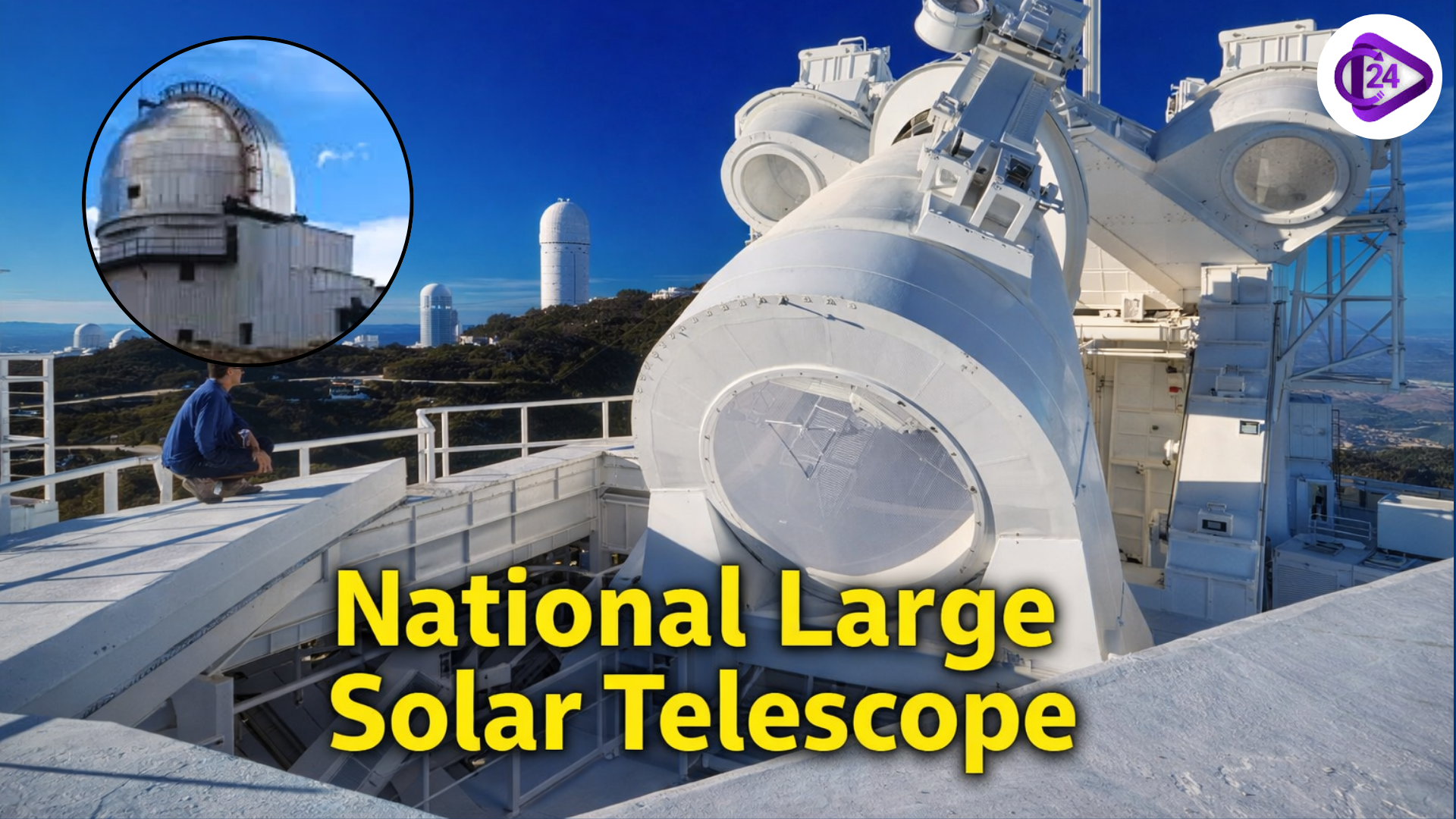
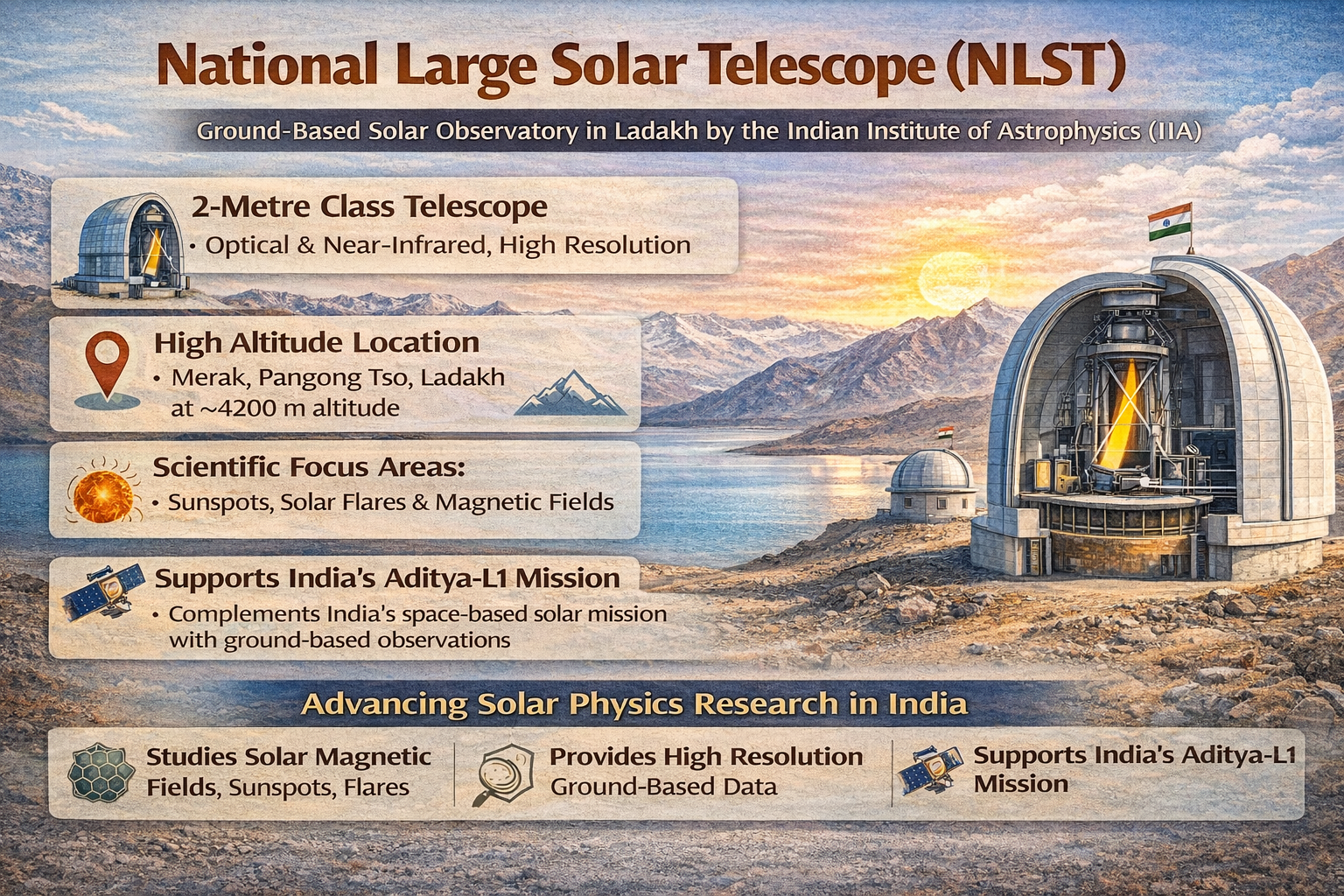
National Large Solar Telescope (NLST) A state of the art ground based solar observatory that is being developed by the Indian Institute of Astrophysics (IIA). NLST will be a 2-metre class optical and near-infrared telescope that will allow high-resolution research on the magnetic fields and dynamic processes of the Sun and other energetic events like solar flares and sunspots. It will be situated in Merak on the Pangong Tso in the Ladakh region at a height of approximately 4,200 m, which has favourable weather conditions to view the solar activities. NLST will supplement the space-based solar mission Aditya-L1 of India, as well as strengthen solar physics research efforts in the country.
What is the National Large Solar Telescope?
-
The National Large Solar Telescope (NLST) is a proposed 2-metre class, earth based solar observatory of high resolution applications in the study of the atmosphere of the Sun.
-
The Indian Institute of Astrophysics (IIA) is working on it to answer major questions on the same subject of the solar magnetic fields and dynamics.
-
This telescope will be visible in the near-infrared and allow the telescope to be used for fine-scaled observations of the sunspots, flares, and other solar features.
-
The location will be located close to the Pangong Tso in Merak, Ladakh, at an altitude of approximately 4200 m to provide good observing conditions.
-
NLST will be an addition to the space-based solar mission Aditya-L1 of India, with the ground-based data.
Key Facts about the National Large Optical-Near Infrared Telescope
-
The National Large Optical-Near Infrared Telescope (NLOT) is a proposed astronomical telescope of 13.7 metres (aperture) and will be located on the ground near Hanle, Ladakh, India.
-
It will consist of a segmented primary mirror made of numerous mirror segments of hexagonal shape, and that will act as a single large mirror.
-
NLOT will monitor celestial objects in the optical and near-infrared spectra, and this will allow deep-sky observations.
-
The location on the Hanle gives a high altitude with dry air and clear skies and low light pollution, and this location is ideal for making precision observations.
-
The telescope will facilitate investigation into exoplanets, galaxy formation, stellar evolution, supernovae, and cosmology.
Recently Asked PYQs on Telescope
| Exam | Year | Question | Options | Answer |
|---|---|---|---|---|
| SSC CGL | 2017 | In an astronomical telescope, the objective lens has a large aperture to: | (A) Increase magnification (B) Increase resolving power (C) Reduce focal length (D) Invert image |
(B) |
| NDA | 2019 | The magnifying power of an astronomical telescope in normal adjustment is: | (A) fo/fe (B) fe/fo (C) fo + fe (D) fo – fe |
(A) |
| NEET | 2016 | The length of an astronomical telescope in normal adjustment is: | (A) fo – fe (B) fo + fe (C) fe/fo (D) fo/fe |
(B) |
| JEE Main | 2020 | If fo = 100 cm and fe = 5 cm, magnifying power is: | (A) 5 (B) 10 (C) 20 (D) 25 |
(C) |
| UPSC CDS | 2018 | Reflecting telescope uses which mirror? | (A) Convex (B) Concave (C) Plane (D) Parabolic lens |
(B) |
| RRB NTPC | 2021 | The main advantage of a reflecting telescope is: | (A) High cost (B) No chromatic aberration (C) Small size (D) Low magnification |
(B) |
| SSC CHSL | 2015 | Which telescope uses lenses as the objective? | (A) Reflecting (B) Refracting (C) Radio (D) Cassegrain |
(B) |
| JEE Advanced | 2014 | The resolving power of a telescope depends on: | (A) Focal length (B) Aperture of objective (C) Eyepiece focal length (D) Length of tube |
(B) |
| NEET | 2017 | Resolving power is proportional to: | (A) 1/D (B) D (C) f (D) λ |
(B) |
| SSC MTS | 2022 | Large aperture helps the telescope to: | (A) Reduce weight (B) Collect more light (C) Reduce length (D) Invert image |
(B) |
Conclusion (National Large Solar Telescope)
The National Large Solar Telescope (NLST) will greatly contribute to the research capacity of India in the solar fields by allowing an observation of the magnetic fields and dynamic processes happening in the Sun with high resolution. It will produce an offshoot of the Aditya-L1 mission planned in Ladakh and give India an edge in the field of advanced solar physics and ground-based astronomical research around the world.