


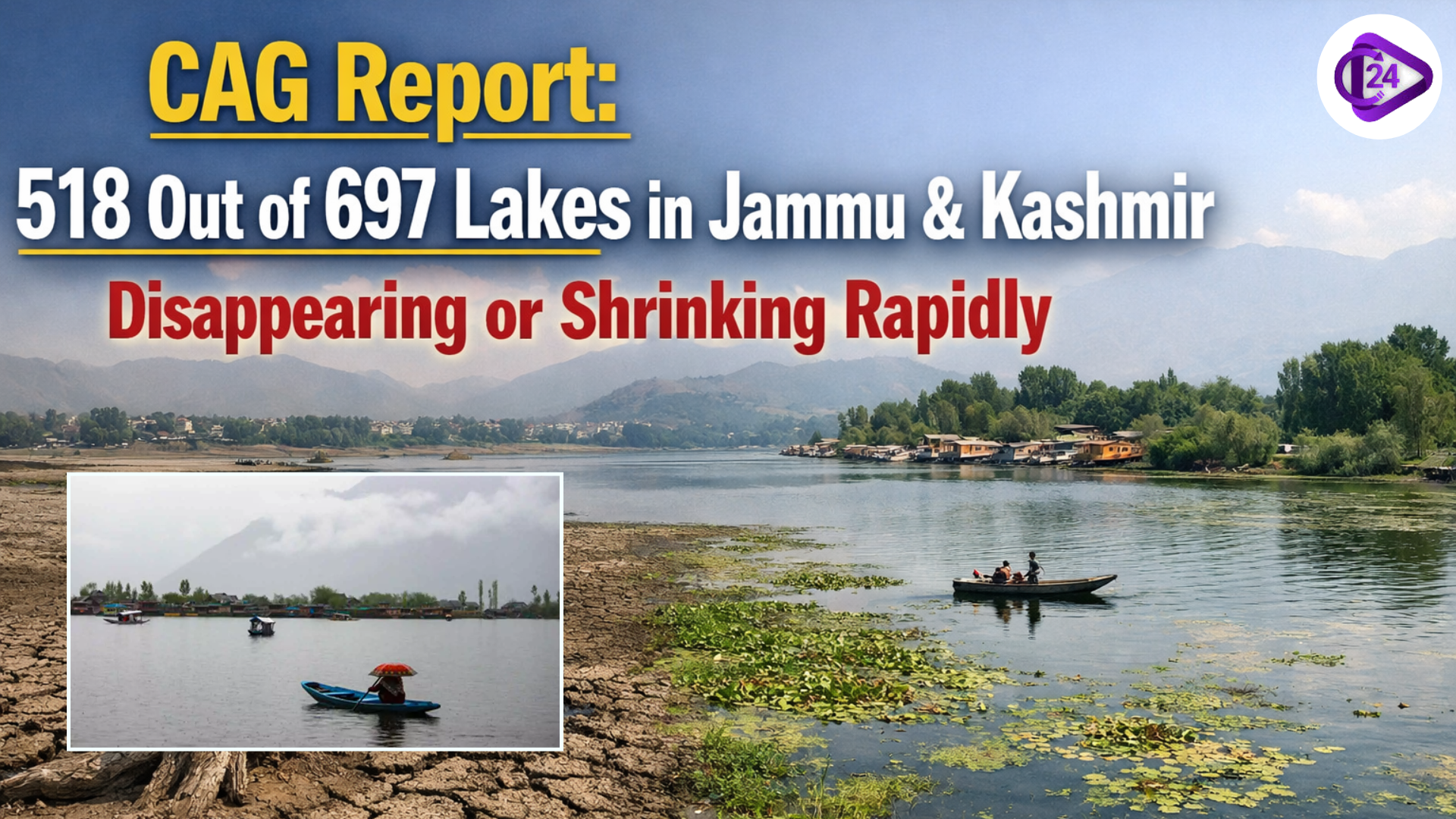
The Comptroller and Auditor General of India has conducted a recent audit that has demonstrated that there is a severe ecological crisis in Jammu and Kashmir. The report on lake conservation and management (tabled in 2026) indicates that 518 out of 697 lakes have disappeared or been greatly reduced over the years. The audit points out that 315 lakes have totally disappeared and many others have deteriorated as a result of encroachment, urbanisation, and changes in land-use. It also cites poor governance, inadequate conservation planning, and insufficient funding as key factors contributing to the decline, and this is a cause of concern regarding the loss of biodiversity and greater vulnerability to climate change.
Why Are 518 Lakes in J&K Disappearing? Key Findings of CAG Report
- According to the report of the Comptroller and Auditor General of India, it has been found that 518 out of 697 lakes in Jammu and Kashmir have either vanished or diminished, and this is a big ecological crisis.
- There is a total of 315 lakes that have been totally lost since 1967, and these have been lost primarily through encroachment, urban growth, and changes in land use within catchment areas and lakes.
- One of the largest human-induced factors that leads to the degradation of lakes is the conversion of wetlands to agricultural, residential, and commercial land.
- The total area covered by the lake has declined by more than 2,851 hectares, indicating a downward trend in the water resources over the decades.
- Fragmented governance in various departments (Forest, Revenue, Agriculture, Urban Development, and Tourism) caused a lack of effective coordination and lake management.
- Conservation focused only on 6 main lakes, while more than 690 lakes received poor management or protection.
- Problems such as sewage being untreated, inability to conserve, and absence of surveillance aggravated the state of major lakes such as Dal and Wular.
- Low budget allocation (approximately 1%) and poor scientific planning further undermined restoration efforts.
- The drying up of lakes has led to loss of biodiversity, water scarcity, and the probability of floods, such as the 2014 floods in Kashmir.
- The CAG suggests the establishment of a central body to have experts to guarantee effective conservation, restoration, and sustainable management of lakes.
PYQs on Jammu & Kashmir (Geography and art & culture)
| Exam | Year | Question | Options | Answer |
| UPSC Prelims | 2019 | Which of the following lakes is located in Jammu & Kashmir? | (A) Sambhar Lake (B) Dal Lake (C) Chilika Lake (D) Pulicat Lake | B) Dal Lake |
| UPSC Prelims | 2016 | The Indus River originates from which region? | (A) Himachal Pradesh (B) Tibet near Mansarovar (C) J&K Valley (D) Nepal | B) Tibet near Mansarovar |
| SSC CGL | 2020 | Wular Lake, one of the largest freshwater lakes in India, is located in which state/UT? | (A) Punjab (B) Rajasthan (C) Jammu & Kashmir (D) Uttarakhand | C) Jammu & Kashmir |
| SSC CHSL | 2018 | Which dance form is associated with Jammu & Kashmir? | (A) Bhangra (B) Rouf (C) Garba (D) Lavani | B) Rouf |
| RRB NTPC | 2021 | In which city do the famous Mughal Gardens, like Shalimar Bagh, lie? | (A) Jammu (B) Leh (C) Srinagar (D) Kargil | C) Srinagar |
| UPSC Prelims | 2015 | Which pass connects Srinagar to Leh? | (A) Nathu La (B) Zoji La (C) Shipki La (D) Bomdi La | B) Zoji La |
| SSC CPO | 2019 | Saffron cultivation in India is mainly done in which region? | (A) Kerala (B) Gujarat (C) Jammu & Kashmir (D) Assam | C) Jammu & Kashmir |
| RRB Group D | 2022 | Which river flows through Srinagar? | (A) Ravi (B) Chenab (C) Jhelum (D) Beas | C) Jhelum |
| UPSC Prelims | 2017 | Dachigam National Park is located in which region? | (A) Himachal Pradesh (B) Uttarakhand (C) Jammu & Kashmir (D) Sikkim | C) Jammu & Kashmir |
| SSC GD | 2021 | The pashmina shawl is traditionally associated with which region? | (A) Punjab (B) Jammu & Kashmir (C) Rajasthan (D) Gujarat | B) Jammu & Kashmir |
ESA’s First Celeste Satellites Launched
Conclusion – 518 Lakes in J&K Disappearing
The 518 lakes in Jammu and Kashmir, as pointed out by the Comptroller and Auditor General of India, are evidence of a terrible environmental crisis that has to be addressed urgently. Rapid urbanisation, encroachment, and poor governance have severely affected these ecosystems. To ensure biodiversity, water security, and climate balance, it is important to protect and restore lakes. It would be important to reverse this concerning trend by having sound policy implementation, scientific management, and making people aware, so as to guarantee sustainable environmental conservation in the region.