

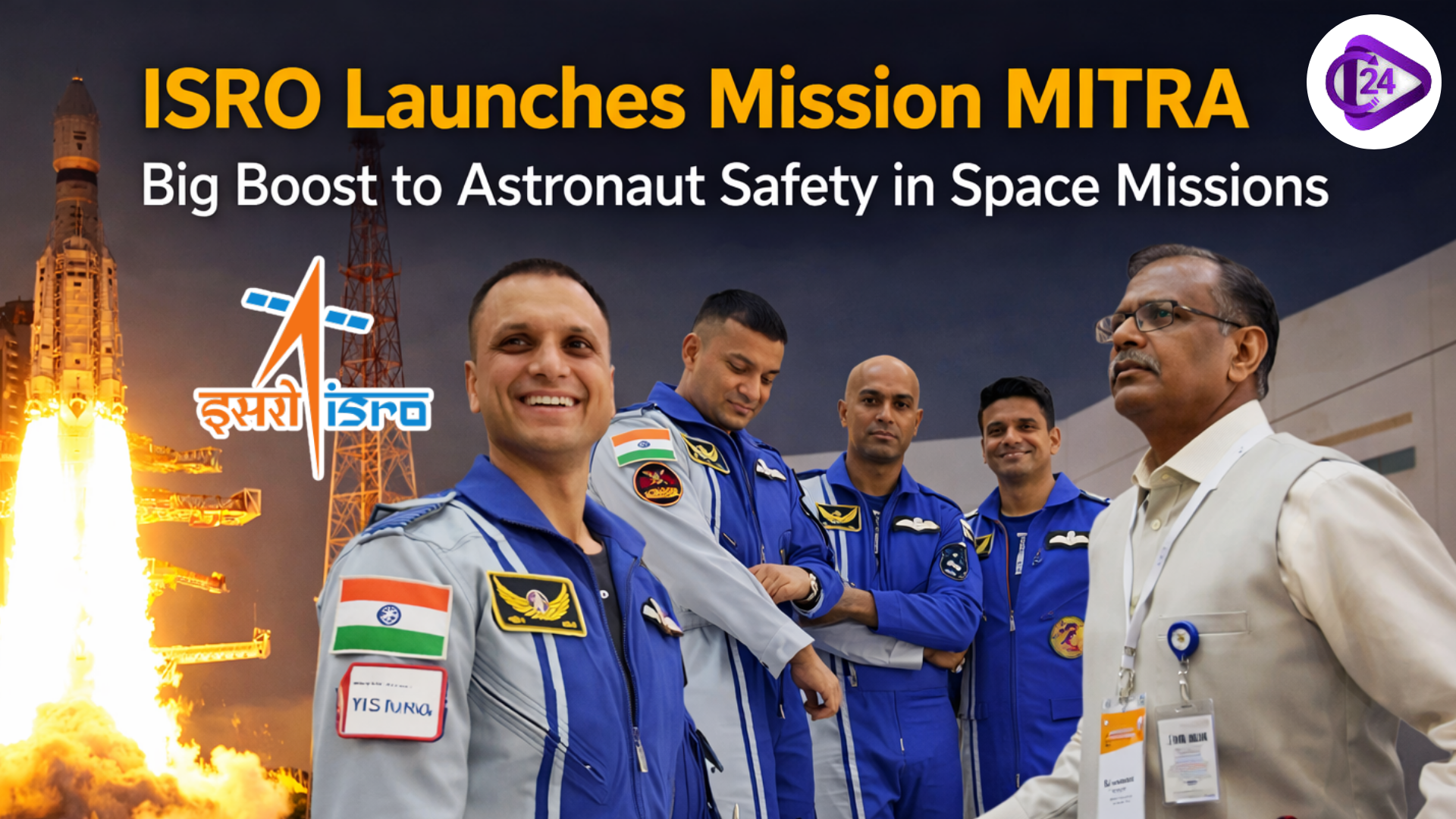
The Mission MITRA by the Indian Space Research Organisation has been a big step in providing astronaut safety in India. This program would improve the safety and health of the crew participants of human spaceflight programs, particularly in the ambitious Gaganyaan Mission. Mission MITRA focuses on sophisticated surveillance systems, emergency response, and real-time assistance technologies. It shows India’s commitment to building reliable, secure space exploration systems and enhancing its reputation as a leading spacefaring nation.
Key Features and Importance of Mission MITRA
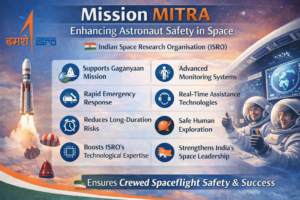
- Mission MITRA is a specific project, and its goal is to enhance the safety of astronauts in human spaceflight missions.
- The Indian Space Research Organisation has developed it to assist crew members in harsh space conditions.
- The mission is crucial in improving the safety structure of the Gaganyaan Mission.
- It also has sophisticated monitoring devices that can monitor the health and vital parameters of astronauts.
- The programme aims to provide rapid emergency response systems in unanticipated events within space.
- Its goal is to reduce the risks of long-duration space missions and hostile space conditions.
- Mission MITRA incorporates the usage of modern technologies in communication, navigation, and life support systems.
- It enhances readiness for exploring human space and future missions to other planets.
- The mission helps enhance the reliability and success rates of crewed space flights.
- It indicates India’s increasing technological potential and safe space missions.
Recently Asked Questions on ISRO
1. Consider the following statements about Chandrayaan missions:
- Chandrayaan-1 carried NASA’s Moon Mineralogy Mapper.
- Chandrayaan-2 orbiter is still operational.
- Chandrayaan-3 had an orbiter module.
Which of the statements given above is/are correct?
A) 1 and 2 only
B) 2 and 3 only
C) 1 only
D) 1, 2 and 3
Answer: A) 1 and 2 only
Explanation: Chandrayaan-3 did not have an orbiter; it used Chandrayaan-2 orbiter for communication.
2. With reference to Aditya-L1, consider the following statements:
- It will be placed in a halo orbit around Lagrange Point L1.
- It is India’s first solar mission.
- It studies only the photosphere of the Sun.
Which of the statements given above is/are correct?
A) 1 and 2 only
B) 2 only
C) 1, 2 and 3
D) 1 only
Answer: A) 1 and 2 only
Explanation: Aditya-L1 studies multiple layers, like corona, chromosphere, not just photosphere.
3. Consider the following pairs (Mission : Objective):
- Astrosat: Multi-wavelength astronomy
- NavIC: Global navigation system
- RISAT: Radar imaging Earth observation
Which of the pairs given above is/are correctly matched?
A) 1 and 3 only
B) 1 only
C) 2 and 3 only
D) 1, 2 and 3
Answer: A) 1 and 3 only
Explanation: NavIC is regional, not global.
4. Consider the following statements about Gaganyaan Mission:
- It aims to send humans to Low Earth Orbit.
- It uses GSLV Mk II launch vehicle.
- It includes both crewed and uncrewed test flights.
Which of the statements given above is/are correct?
A) 1 and 3 only
B) 1 only
C) 2 and 3 only
D) 1, 2 and 3
Answer: A) 1 and 3 only
Explanation: Gaganyaan Mission uses LVM3 (GSLV Mk III), not Mk II.
5. Assertion (A) and Reason (R):
Assertion (A): PSLV is considered one of the most reliable launch vehicles of ISRO.
Reason (R): PSLV is mainly used for geostationary satellite launches.
- A) Both A and R are true, and R is correct explanation of A
B) Both A and R are true, but R is not correct explanation
C) A is true, R is false
D) A is false, R is true
Answer: C) A is true, R is false
Explanation: The PSLV is reliable but mainly used for polar orbits, not geostationary.
6. Consider the following statements about XPoSat:
- It studies X-ray polarisation.
- It is India’s first mission dedicated to studying black holes.
- It helps understand high-energy cosmic sources.
Which of the statements given above is/are correct?
A) 1 and 3 only
B) 2 only
C) 1, 2 and 3
D) 1 only
Answer: A) 1 and 3 only
Explanation: XP OSat studies X-ray sources, not exclusively black holes.
7. With reference to launch vehicles, consider the following:
- PSLV – Polar orbit missions
- GSLV Mk III – Heavy payload missions
- SSLV – Small satellite launches
Which of the above is/are correctly matched?
A) 1 and 2 only
B) 2 and 3 only
C) 1, 2 and 3
D) 1 only
Answer: C) 1, 2 and 3
Explanation: All launch vehicles are correctly matched with their roles.
Conclusion – ISRO Launches Mission MITRA
Mission MITRA represents an important step towards making the Indian Space Research Organisation safe and reliable in terms of astronauts and missions. It enhances the readiness of India for the exploration of space through supporting activities such as the Gaganyaan Mission. Mission MITRA will increase the safety of the crew in severe space environments by incorporating high-tech monitoring and emergency response mechanisms, which will further strengthen India as a responsible and competent spacefaring country, with high safety and innovation priorities.