


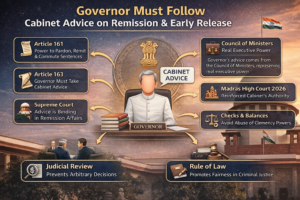
The power of the governor in remission and premature release, according to the true constitutional clauses and the recent decisions of the courts, is not independent. Article 161 of the Constitution of India provides clemency powers, but these should be exercised in accordance with Article 163, which provides that the clemency should be performed with the aid and advice of the Council of Ministers. The Supreme Court of India has made it quite clear that the advice of the state cabinet was binding on the governor as far as remission issues were concerned. This provides democratic accountability and avoids arbitrary decisions in sensitive criminal justice matters.
Governor Must Follow Cabinet Advice on Remission & Early Release
-
The Constitution of India, in Article 161, gives the Governor the power to pardon, remit, or commute sentences.
-
Article 163, however, provides that the governor must take action upon the assistance and counsel of the Council of Ministers.
-
The Supreme Court of India has made it clear that Cabinet advice is binding in remission affairs.
-
The court also made it clear that the governor cannot submit cabinet recommendations to the president with no constitutional support.
-
The Madras High Court (2026), in recent events, reiterated that the governor is obligated to act on the advice of the Cabinet, whether he likes it or not.
-
The governor is not an independent decision-maker but a constitutional or formal head.
-
The state government (council of ministers) is the real executive power.
-
The state policies, conduct of the prisoner, and interest of the people are the basis through which decisions on remission are made.
-
Where judicial review is possible, the judiciary permits judicial review in case decisions on remission are arbitrary or unconstitutional.
-
The scheme of the constitution provides checks and balances concerning clemency powers.
-
It does not allow the abuse of power due to political or personal motives.
-
The governor has the responsibility of sanctioning decisions made by the Cabinet.
-
This is an indication of the collective responsibility of governance.
-
It enhances the rule of law and promotes the fairness of criminal justice.
-
Altogether, a legitimate interpretation of the law proves that the governor is subject to the State Cabinet’s advice in remission and premature release cases.
Legal Basis: Why the Governor Is Bound by Cabinet Advice in Remission Cases
The Constitution of India, Article 161
The governor may shorten or remit a sentence (such as a pardon, remission, or commutation). Nevertheless, this authority is not subjective, and it should be carried out in a due manner.
Article 163 Constitution of India
In most cases, including the decision of remission, the governor has to act based on the recommendation of the State Council of Ministers.
Shamsher Singh vs State of Punjab (1974)
The Supreme Court made it clear that the governor is merely a formal head, and he cannot make any decision independently; decisions are made on the advice of the cabinet.
Union of India vs Maru Ram (1980)
The Court held that the power of remission should be applied according to the recommendation of the state government, but not according to the opinion of the governor.
Union of India vs V. Sriharan (2015)
The Court established strict guidelines on remission and stated that the decisions should be made in accordance with legal procedures and government policy.
Joginder Singh vs State of Punjab (1990)
It was believed that clemency has restraints and should be exercised within the confines of the constitution and laws.
Assam to Launch Satellites for Flood, Border Surveillance
Conclusion
The right of the governor to remission or premature release is a constitutional check and is also democratic. According to the Constitution of India and the judgements of the Supreme Court of India, the Governor has to act as the State Cabinet advises. This makes sure the decisions are legitimate, stable, and responsible. It also discourages abuse of power and the rule of law, which strengthens the fact that it is the elected government that holds the real executive power and not the governor.