

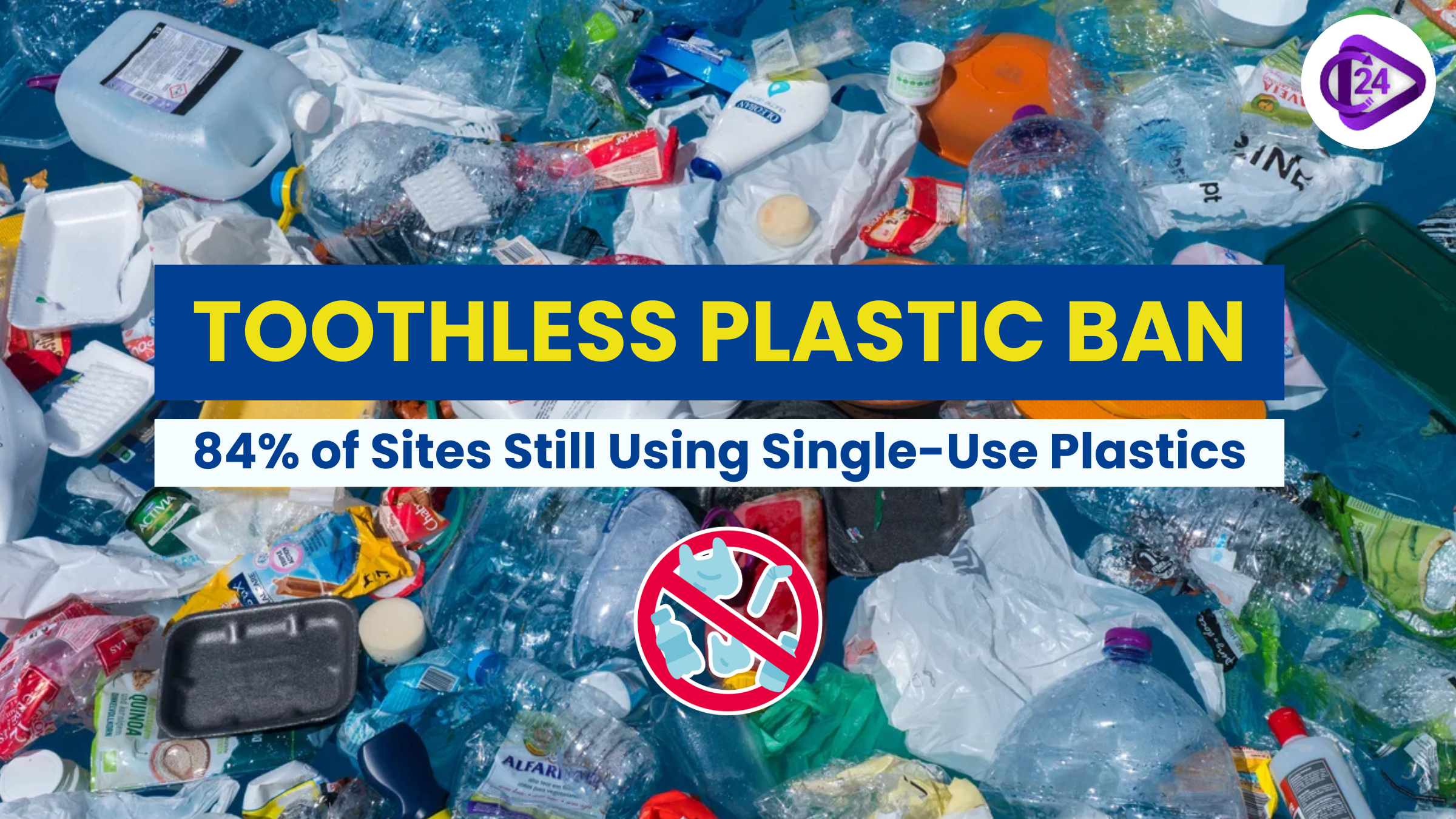
As a significant move to protect the environment and develop sustainably, India’s introduction of a ban on single-use plastics was one of the first steps. But as recent observations indicate, the situation is even worse, with almost 84 per cent of the surveyed locations in four cities continuing to use the outlawed plastic products. This also points to implementation loopholes, ignorance, and on-the-ground implementation problems. Even with the obvious regulations and laws, the problem of using single-use plastic still devastates ecosystems, contaminates waters, and adds to the urban garbage issues, which casts significant doubts on the efficiency of the ban.
Single-Use Plastic Ban in India: Challenges, Violations & Ground Reality
- The ban on single-use plastic was poorly enforced, with nearly 84% of the sites surveyed identified as violating the rule.
- It is because of convenience and affordability that many businesses are still using plastic bags, cutlery, and packaging.
- The absence of stringent monitoring systems leads to high non-adherence in the cities.
- Small vendors and local businesses are not that aware.
- Substitutes such as paper or biodegradable products are usually costly.
- This varies in the application of different states and cities, which influences effectiveness.
- Cities produce volumes of plastic waste every day, worsening the situation.
- The fear of violations is lessened due to insignificant punishment and lack of subsequent action.
- Consumers are also playing their part by remaining in demand for plastic products.
- The infrastructure in most of the regions is undeveloped in terms of recycling.
- The informal waste management systems find it difficult to deal with plastic waste material.
- Rivers, soil, and the marine ecosystem are the worst affected by plastic pollution.
- Wildlife is also becoming victims in consuming the plastic waste.
- There are government efforts that are not well-grounded.
- The manpower and resources are usually limited in the enforcement agencies.
- Essentially, bulk producers and manufacturers are not deemed responsible at all times.
- The behavioural change and community engagement are still among the pressing issues.
- There is a need for more stringent penalties and policy implementation.
- Sustainable alternative promotion should have increased support and encouragement.
- In general, the statistics indicate the necessity to enhance the enforcement of the plastic ban in India.
PYQs on Plastic and Pollution
| Exam | Year | Question | Options | Answer |
|---|---|---|---|---|
| UPSC Prelims | 2019 | Which of the following are the sources of microplastics? | (A) Cosmetic products (B) Synthetic textiles (C) Plastic debris (D) All of the above | D) All of the above |
| UPSC Prelims | 2020 | Which of the following can be harmful due to microplastics? | (A) Marine life (B) Human health (C) Soil quality (D) All of the above | D) All of the above |
| UPSC Prelims | 2021 | What is the main objective of banning single-use plastics? | (A) Reduce pollution (B) Increase production (C) Boost plastic industry (D) None | A) Reduce pollution |
| UPSC Prelims | 2022 | Which of the following is biodegradable? | (A) Plastic (B) Glass (C) Paper (D) Metal | C) Paper |
| SSC CGL | 2018 | Which type of plastic cannot be recycled easily? | (A) Thermoplastics (B) Thermosetting plastics (C) PVC (D) Nylon | B) Thermosetting plastics |
| SSC CGL | 2019 | Which gas is released when plastic is burned? | (A) Oxygen (B) Carbon Monoxide (C) Nitrogen (D) Helium | B) Carbon Monoxide |
| SSC CHSL | 2020 | Which of the following is a major environmental issue caused by plastic? | (A) Soil erosion (B) Water pollution (C) Air pressure (D) Ozone formation | B) Water pollution |
| SSC CHSL | 2021 | Polythene is made from which substance? | (A) Ethylene (B) Methane (C) Propane (D) Butane | A) Ethylene |
| RPSC RAS Prelims | 2017 | Which of the following is the major cause of plastic pollution in Rajasthan? | (A) Industrial waste (B) Domestic waste (C) Agricultural waste (D) Mining | B) Domestic waste |
| RPSC RAS Prelims | 2020 | Which initiative is related to plastic waste management? | (A) Swachh Bharat Mission (B) Make in India (C) Digital India (D) Skill India | A) Swachh Bharat Mission |
| UPSC Prelims | 2018 | Which of the following materials takes the longest time to decompose? | (A) Paper (B) Plastic (C) Cotton (D) Wood | B) Plastic |
| SSC CGL | 2022 | Which of the following is a biodegradable waste? | (A) Plastic bottle (B) Polythene (C) Vegetable waste (D) Glass | C) Vegetable waste |
Conclusion – Toothless Plastic Ban
The plastic toothless ban points out a serious lack of policy implementation in India. The violation has been high because of weak enforcement, ignorance, and limited options despite high police regulations. The ban requires better implementation by monitoring, increasing penalties, and infrastructure in case of sustainable alternatives. There will also be the involvement of the population and behaviour change. Enhancing accountability on all levels can turn the plastic ban into an image rather than a mere policy into a solution that would make a significant difference in environmental policies.