
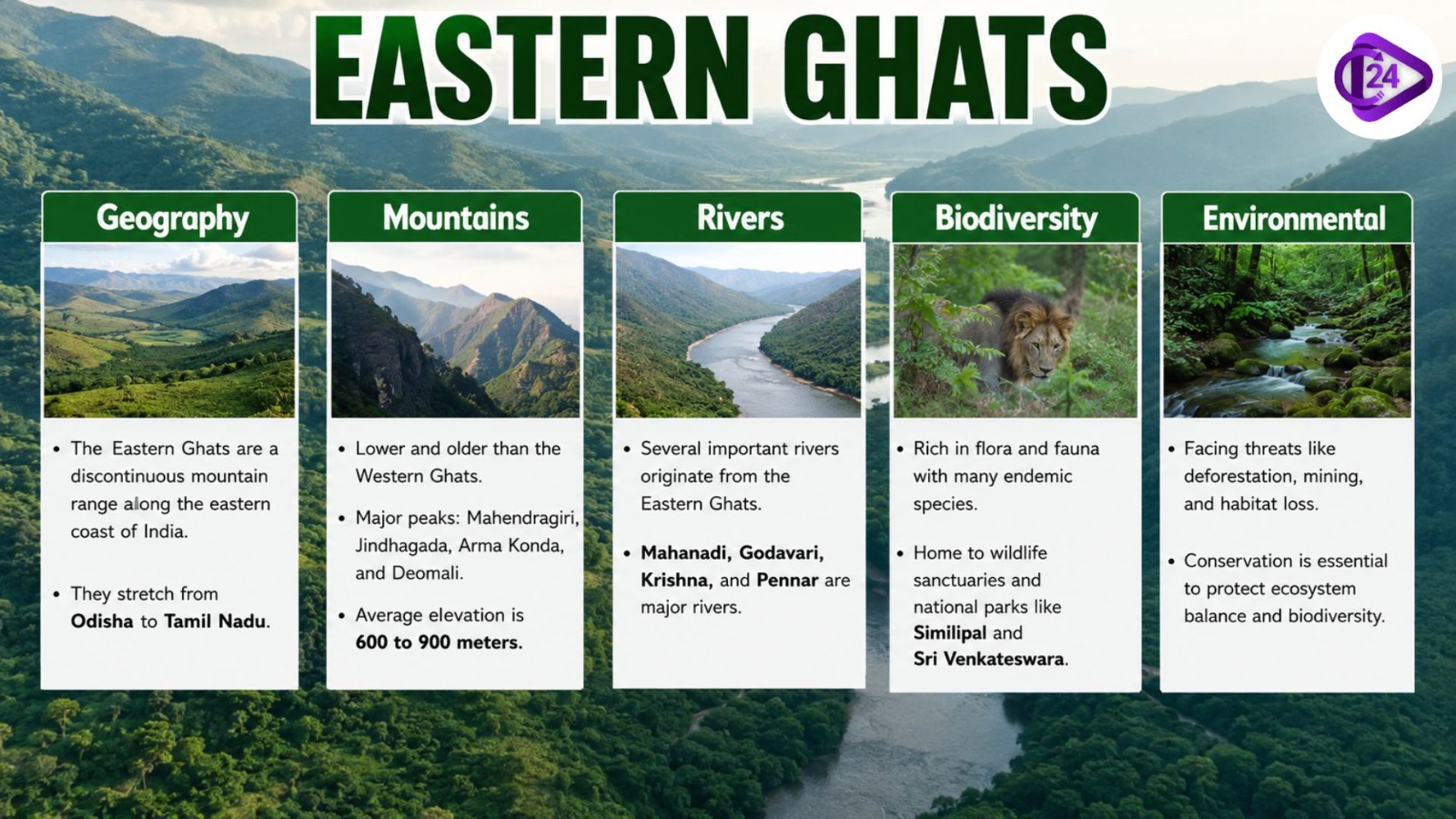
Eastern Ghats are a significant discontinuous range system of mountains along the eastern edge of Peninsular India. The geology of the Eastern Ghats consists of a series of broken hill ranges, plateaus and basins as well as river valleys interspersed with old-growth forests. The Eastern Ghats mountains mostly extend through Odisha, Andhra Pradesh, Telangana, Tamil Nadu and the northern parts of Karnataka.
These ranges are intersected by the major rivers Mahanadi, Godavari, Krishna and Kaveri. It also represents the diverse Eastern Ghats biodiversity, forests, wildlife and eco-resources of the region. For example, the Eastern Ghats are vital for the environment as they help maintain ecosystems, natural habitats and soil conservation; as well as being a recharge point for regional water sources.
About Eastern Ghats
The Eastern Ghats extend for about 1,750 km along the eastern margin of Peninsular India, broadly from the Mahanadi region in Odisha to the Vaigai basin in Tamil Nadu. The belt traverses through Odisha, Telangana, Andhra Pradesh, Karnataka and Tamil Nadu. Eastern Ghats geography is marked by a discontinuous and fragmented pattern in the form of individual hill ranges separated from one another by large river valleys.
As they flow towards the Bay of Bengal, rivers such as Mahanadi, Godavari, Krishna and Kaveri cut right through these mountains. Eastern Ghats tend to be lower and less regular in elevation than the Western Ghats, but their forests and diversity of terrain are important for the biodiversity and environmental characteristics of the region.
Eastern Ghats Geography
- Location: The Eastern Ghats are located on the eastern side of Peninsular India, broadly parallel to the Bay of Bengal coast.
- Region: They extend from the Mahanadi region of Odisha to the Vaigai basin (Tamil Nadu).
- States: The range goes through Odisha, Andhra Pradesh, Telangana, Karnataka and Tamil Nadu in chronological order.
- Structure: The geography of the Eastern Ghats is discontinuous and fragmented.
- Topography: Eastern Ghats mountains are made of hills, plateaus, valleys and isolated ranges.
- Tallest Peak: Arma Konda (Jindhagada Peak) with an elevation of 5,826 ft in Andhra Pradesh.
- Orientation: The eastern side slopes to the Bay of Bengal & western side merges with the Deccan Plateau.
- Biodiversity: The Eastern Ghats are a biodiversity hotspot with forests and diverse topography.
- Environmental Function: Preserves soil and water resources, mainly wildlife habitat, when applied in combination with other measures to curb soil erosion and maintain ecological integrity.
Eastern Ghats Mountain Ranges
The Eastern Ghats are a discontinuous range of mountains located in the eastern portion of Peninsular India. The Eastern Ghats consist of a series of regional hill systems having an interspersion of major rivers separating them, each displaying individuality in geographical and ecological characteristics.
- Nallamala Hills: Located primarily in Andhra Pradesh and Telangana, these are the most significant of the Eastern Ghats ranges, characterised by dense forests and wildlife.
- Palkonda Hills: Mostly in Andhra Pradesh, it is a part of the fragmented hill system of the Eastern Ghats.
- Seshachalam Hills: Close to Tirupati in Andhra Pradesh, the Seshachalam hills are home to a variety of forests and biodiversity.
- Javadi Hills: Located in northern Tamil Nadu, these hills are marked by forests, valleys and plateaus.
- Shevaroy Hills: One of the principal highland regions of the southern Eastern Ghats.
- Kolli Hills: Located in Tamil Nadu, these hills are famed for their forests, agriculture and biodiversity.
- Mahendragiri Hills: Part of the northern Eastern Ghats, this hill station situated in Odisha is a vital habitat for wildlife.
- Similipal Hills: They are connected to large forests and an important wildlife region in the state of Odisha.
- Gandhamardan Hills: These hills are located in the state of Odisha and have rich forest ecosystems as well as various types of medicinal plants.
Eastern Ghats Rivers
Eastern Ghats rivers are one of the main components of Eastern Ghats geography and are also a large part of the eastern Peninsular India drainage system. In contrast to the Western Ghats, Eastern Ghats mountain ranges are broken and traversed by many large rivers. All of the major rivers related to the Eastern Ghats river system flow towards the east to the Bay of Bengal. These rivers are equally important for agriculture and irrigation, water resources, forests and the Eastern Ghats ecosystem.
- Mahanadi: Through Odisha and traversing the northern Eastern Ghats, moves off towards the Bay of Bengal.
- Godavari: Flows above the Eastern Ghats in AP and outfalls into the Bay of Bengal.
- Krishna: It moves eastwards across the Deccan Plateau and passes through the Eastern Ghats.
- Kaveri (Cauvery): Passes through Karnataka and Tamil Nadu, crosses the Eastern Ghats river the Bay of Bengal
- Vamsadhara: Ranges from Odisha with a trek east to the eastern where it joins Bay of Bengal.
- Nagavati: It travels from Odisha to Andhra Pradesh and then ends at the Bay of Bengal
- Palar: Originates from Karnataka, runs through Andhra Pradesh and Tamil Nadu to the Bay of Bengal.
- Subarnarekha: Runs through the eastern part of India and drains into Bay of Bengal.
Eastern Ghats Biodiversity
The biodiversity of the Eastern Ghats consists predominantly of a diverse range of forests, grasslands, wildlife habitats and plant species distributed in fragmented mountain ranges. Eastern Ghat Biodiversity Conservation is essential for ecological stability, safeguarding watersheds, and livelihood sustenance of rural populations. Eastern Ghats are an interrupted range but have some distinct landscapes with rich floral and faunal characteristics important for the ecosystem.
- Forest Types: In different parts of the Eastern Ghat tropic dry deciduous, moist deciduous, semi-evergreen and dry evergreen forests.
- Flora: This region consists of teak, sal, sandalwood, bamboo, and medicinal plants along with many endemic plant species.
- Wildlife: The Eastern Ghat ecosystem supports a variety of wildlife species, including elephants, tigers, leopards, sloth bears, and gaur deer; wild boar also occurs in this region.
- Bird Diversity: As forests, wetlands, and hill ecosystems attract several resident and migratory birds, they are home to bird diversity.
- Reptiles: Snakes, lizards, turtles and other reptiles form part of the diversity in your area.
- Protected Areas: Simlipal, Papikonda, Sri Venkateswara and other protected areas contribute to the conservation of the Eastern Ghat.
- Tribal Communities: Traditional livelihood and culture of a few local communities are based on forest resources and biodiversity.
- Environmental Functions: Forests prevent soil erosion, regulate water flow, sequester and store carbon and contribute to watershed health.
- Main Threats: Deforestation, Mining, habitat fragmentation, forest fire, infrastructure development and invasive species.
Challenges Facing Eastern Ghats
Increasing human activities have resulted in habitat degradation, and climate change is exerting severe pressures on the Eastern Ghats biome, which can be described as a biodiversity hotspot of high sensitivity to environmental challenges. All of these challenges disrupt Eastern Ghat biodiversity, forests and wildlife, rivers and the whole Eastern Ghat ecosystem.
- Deforestation: Forest area cleared for agriculture, settlements or development reduces natural vegetation.
- Mining Operations: Extraction of minerals and other resources leads to habitat destruction and landscape degradation.
- Fragmentation of Habitat: Forests are isolated by roads, industries, dams and other infrastructure.
- Forest Fires: Forest fires are uncontrolled fires that burn vegetation and wildlife.
- Biodiversity loss: Many native and endemic species are at risk from habitat degradation.
- Forest Degradation: The unlawful removal of forest resources that causes degradation.
- Agricultural Expansion: The expansion of agriculture into forested areas leads to the loss of natural habitats.
- Human-Wildlife Conflict: As habitats shrink, so do interactions of people and wild animals
- Invasive species: Invasive plants pose a threat to native vegetation and tend to disturb the Eastern Ghat ecosystem.
- Climate Change: Forests, rivers and wildlife can be impacted by rainfall patterns, temperatures and occurrences of extreme events.
- Water Stress: Changes in land use and watershed degradation practices can improve, reduce or eliminate the availability of local water resources.
- Unplanned Tourism: Bad tourism may produce waste, noise, habitat disturbance and exert pressure on natural resources.
Also Read
Conservation of Eastern Ghats
Conservation of the Eastern Ghats is very important in terms of preserving the forests, flora and fauna, rivers and special ecosystems. The protection of habitat and connectivity is especially crucial because of the fragmented nature of Mountain ranges in the Eastern Ghats. It can be conserved through effective conservation, which will preserve Eastern Ghat biodiversity, water resources and environmental degradation.
- Defence from human impact: There are several types of protected areas—national parks, wildlife sanctuaries, glacier areas, tiger reserves, biosphere reserves.
- Wildlife Protection: Anything against hunting or illegal wildlife trade leads to conservation of endangered species.
- Habitat Connectivity: To allow safe movement across fragmented forest habitat corridors for wildlife
- Mining and Sustainable Mining: Regulating mining activities helps to prevent destruction in forests, hills and finally the natural habitat.
- Watershed Management: Protecting river catchments and restoring of degraded watersheds contributes to the conservation of water resources.
- Community Participation: Local and tribal community involvement in sustainable forest and biodiversity management.
- Forest Fire Management: Use fire lines, community monitoring and early-warning systems to minimise damage from forest fires.
- Educating Local Farmers About Invasive Plants: Educating farmers about the detrimental effects of invasive plants helps to protect both native plants and other critical ecosystems within the Eastern Ghat region, such as agricultural lands.
- Sustainable Development: Striking a balance between infrastructure, tourism, agriculture and conservation can alleviate pressure on resources.
- Climate-Resilient Conservation: The protection of natural habitats and restoration of native forests can increase the resilience of ecosystems to climate change.