


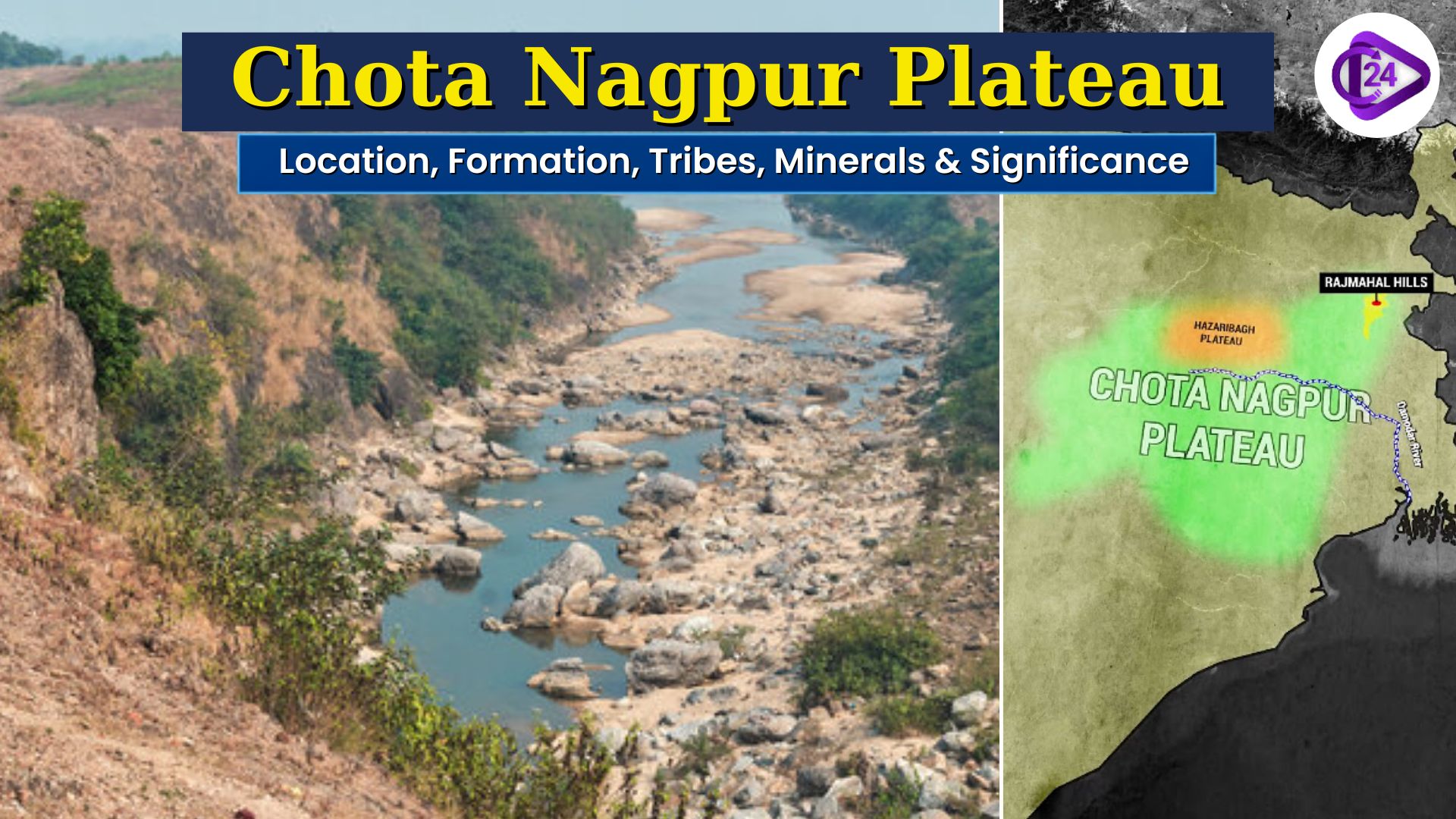
The Chota Nagpur Plateau is one of the most important plateau regions in India, known for mineral wealth, ancient geological origin and colourful tribal culture. It spans Jharkhand and parts of Odisha, Chhattisgarh, West Bengal and Bihar; it is the northeastern projection of the Peninsular Plateau. The region is known as the “Mineral Heartland of India” with deposits of coal, iron ore, bauxite, mica, uranium and copper and has industries such as steel and power generation. The region is home to several indigenous communities such as the Santhal, Munda, Oraon and Ho tribes; It has immense ecological, economic-ecology significance, which makes it a frequent topic of geography and competitive exams.
Chota Nagpur Plateau
Chota Nagpur Plateau, geologically and culturally, is an important region of eastern India. Primarily situated in Jharkhand, it also spans parts of Odisha, West Bengal, Bihar and Chhattisgarh. The main features of the Chota Nagpur Plateau include:
- Size: The plateau covers an area of approximately 65,000 km2.
- Terrain and Topography: The area is identified by its rugged terrain, dense forests, hills, and valleys, along with gneissic formations.
- There are a few subplateaus like the Ranchi Plateau and the Hazaribagh Plateau.
- The area consists of a stream-dissected peneplain interspersed with isolated peaks in the form of erosion.
- The Ganga and Son river basins in the north and the Mahanadi river basin in the south (Features)
- The plateau has an average height of 700 m, with the highest point at Parasnath Hill (1,164 m).
- Composition: Different types of Precambrian rocks, largely granite and gneiss. This material formed more than 540 million years ago as a result of tectonic uplift at the end of the Cenozoic era.
- Weather: The plateau has a tropical climate with alternating wet and dry seasons; average annual rainfall of 1,400 mm is largely received in the monsoon
Chota Nagpur Plateau States
The Chota Nagpur Plateau is primarily located in Jharkhand and extends into four neighbouring states of eastern India. Its geographical distribution is as follows:
| State | Major Regions Covered |
| Jharkhand | Covers most of the state, including Ranchi, Hazaribagh, Dhanbad, Bokaro, Singhbhum, Palamu, and Koderma. |
| Odisha | Extends into the northern districts such as Sundargarh, Mayurbhanj, Keonjhar, and Sambalpur. |
| West Bengal | Covers the western districts, including Purulia, Bankura, and parts of Paschim Bardhaman. |
| Bihar | Includes the southern districts, particularly Gaya, Nawada, and Jamui. |
| Chhattisgarh | Extends into the northern districts, including Surguja, Jashpur, and Korea. |
Chota Nagpur Plateau Formation
- Chota Nagpur Plateau is one of the oldest geological features in India, developed during a period known as the Precambrian (more than 540 million years ago).
- formed as a result of tectonic uplift of the old Peninsular Shield, which had been subjected to millions of years of weathering and erosion.
- Its plateau mainly consists of igneous and metamorphic rocks — granite, gneiss, schist, quartzite, and basalt rich in useful minerals.
- The present topography of plateaus, valleys, hills and waterfalls is the result of continuous erosion by rivers such as Damodar, Subarnarekha and Koel.
- In fact, Ranchi, Hazaribagh, Koderma and Palamu plateaus were formed through geological processes, and collectively they form the fertile Chota Nagpur Plateau region.
- The region is the richest mineral belt in India and contains many deposits of coal, iron ore, mica, bauxite, copper (28.2 million tons as of May 2013), uranium and limestone in ancient rock formations.
- Because of its stable geological structure and enormous mineral resources, the plateau is nicknamed “the Ruhr of India”, and is considered the backbone for mining and heavy industries in India.
Chota Nagpur Plateau Tribal Communities
- Chota Nagpur Plateau is one of the main tribal regions of India, containing a dynamic cultural heritage and indigenous knowledge by many Scheduled Tribes (ST) and native professionals.
- Some of the key tribes include Santhal, Munda, Oraon (Kurukh), Ho, Bhumij, Kharia, Birhor and Asur, as well as Korwa and Lohra
- In other words, there are sizeable pockets of these communities in the states — Jharkhand, Odisha, West Bengal, Chhattisgarh and Bihar.
- The main sources of livelihood are in agriculture, forest produce collection, animal husbandry, and working in handicrafts and other traditional occupations.
- Tribes celebrate Sarhul, Karam, Sohrai, Mage Parab and Tusu Parab, which emphasise their intimate relationship with nature.
- Most Native American tribes have traditional governments and have their own languages, ceremonial customs, songs, dances and art traditions.
- This area is protected under the Fifth Schedule of the Constitution. The Ministry of Tribal Affairs runs numerous welfare programmes for their socio-economic development.
- The role of the tribal communities in preserving forests, biodiversity, and Cultural Heritage within the Chota Nagpur Plateau is important.
Chota Nagpur Plateau Rivers
- The region is rich in minerals and forests with agriculture, industries, hydroelectric power and drinking water supply has its eastward-flowing stream network originates from the Chota Nagpur Plateau.
- The Damodar River, due to flooding in history, springs from the plateau and flows through Jharkhand as well as West Bengal before meeting the Hooghly.
- It originates close to Ranchi, Jharkhand, flowing upstream of the Subarnarekha basin in the states of Jharkhand, West Bengal and Odisha before draining into the Bay of Bengal.
- The North Koel and South Koel rivers, which flow from the plateau, are significant tributaries of the Son and Brahmani river systems.
- Maithon Dam and Tilaiya Dam are built on the Barakar River (which is a major tributary of the Damodar) to support irrigation and hydroelectric power generation.
- Noteworthy rivers that rise on or traverse this plateau are the Ajay, Mayurakshi, Brahmani, Sankh and Karo.
- Due to the plateau’s rugged topography, these river courses contain stunning waterfalls including Hundru Falls, Dassam Falls, Jonha Falls and Hirni Falls.
- These rivers are extremely important for irrigation, industrial water supply, hydropower generation, biodiversity conservation and the livelihoods of a large tribal population.
Chota Nagpur Plateau Minerals
- Chota Nagpur Plateau, also known as the Mineral Heartland of India, is the most mineral-rich region of India, which houses a major part of India’s mineral reserves in India.
- It has rich deposits of coal, including some of the largest coalfields in India such as Jharia, Bokaro, North Karanpura, South Karanpura and Ramgarh.
- The plateau has large reserves of iron ore, with major deposits in the Singhbhum district of Jharkhand and Keonjhar–Sundargarh belt of Odisha sustaining the iron and steel industry.
- Koderma and Giridih have historically made the region one of the largest producers of mica in the world.
- Lohardaga, Gumla and Latehar have substantial bauxite reserves that provide feedstock to the aluminium industry.
- It also has important deposits of copper (Singhbhum), uranium Jaduguda, limestone, dolomite, manganese, graphite, china clay, quartz, feldspar and fireclay.
- The rich deposits of minerals in the region have given rise to big industries like Tata Steel (Jamshedpur), Bokaro Steel Plant, Heavy Engineering Corporation (Ranchi) and many thermal power stations.
- The rich mineral riches of Chota Nagpur Plateau contribute extensively to the mining, industrial, energy generation & delivery and employment of India as a whole, contributing to India’s economy
Significance of Chota Nagpur Plateau
- Mineral Hub of India: It is India’s richest mineral belt, rich in coal, iron ore, bauxite, mica (reserves of copper and uranium also available & large deposits of limestone and dolomite ), and it is the main mountain region type for mining activities.
- Industrial Backbone: It has significant industrial hubs such as Jamshedpur, Bokaro, Dhanbad and Ranchi supporting core sectors like iron and steel, aluminium, cement, heavy engineering and thermal power.
- Energy Security: Not only one of the richest coalfields in India, but strategic areas with rich coalfields like Jharia, Bokaro and North Karanpura are also providing thermal power stations as well as industries covering a big part of India.
- Economic Significance: The plateau is of great economic significance, especially for mining, manufacturing and mineral-based sectors, as they create employment opportunities, improve exports and also contribute to the economy on a large scale.
- Rich Tribal Heritage: The area consists of many tribal groups like the Santhal, Munda, Oraon, and Ho which who have maintained distinct languages and cultures.
- Ecological Significance: Thick forests, numerous wildlife habitats and countless waterfalls contribute to the conservation of biodiversity, regulation of local climate & well-being of the environment.
- Water Resources: The state has many rivers like Damodar, Subarnarekha, Koel that provide water for irrigation, hydroelectric power, city, industrial and domestic needs.
- Scope for Tourism: People from all over the country come here to see its hills, waterfalls, mountains and wildlife sanctuaries near Parasnath Hill and religious places.
- Strategic Resource Base: It forms one of the key physiographic regions that determines the great share of industrial development, infrastructure, and resource security for India on a long-term basis.
Also Read – Lakes in India
| Yamuna River System | Son River |
| Jhelum River System | Indus River System |
| Godavari River System | Indian River Systems |
| Kaveri River | Narmada River Explained |
| Krishna River System | Sutlej River System |