

Major Dams in India: Dams in India constitute one of the largest networks in the world and serve crucial functions in irrigation, hydropower generation, flood mitigation, provision of drinking water and integrated water resource management. As per the National Register of Large Dams (NRLD) 2023 published by Central Water Commission, India has at present 6,138 completed large dams and 143 large dams under construction, making the total around to142 Large dams.
Since Independence, these Major Dams have been instrumental in agricultural advancement, progress of industries and ensuring water security for the nation. Tehri Dam, Bhakra Nangal, Hirakud and Sardar Sarovar dams are among the major dams projects that continue to play a vital role in the economic progress of India as well as the sustainable management of water resources.
Key Facts of Major Dams in India
- Total Large Dams: India has 6138 completed and 143 under-construction Major Dams large dams as per the National Register of Large Dams (NRLD) 2023, maintained by Central Water Commission (CWC).
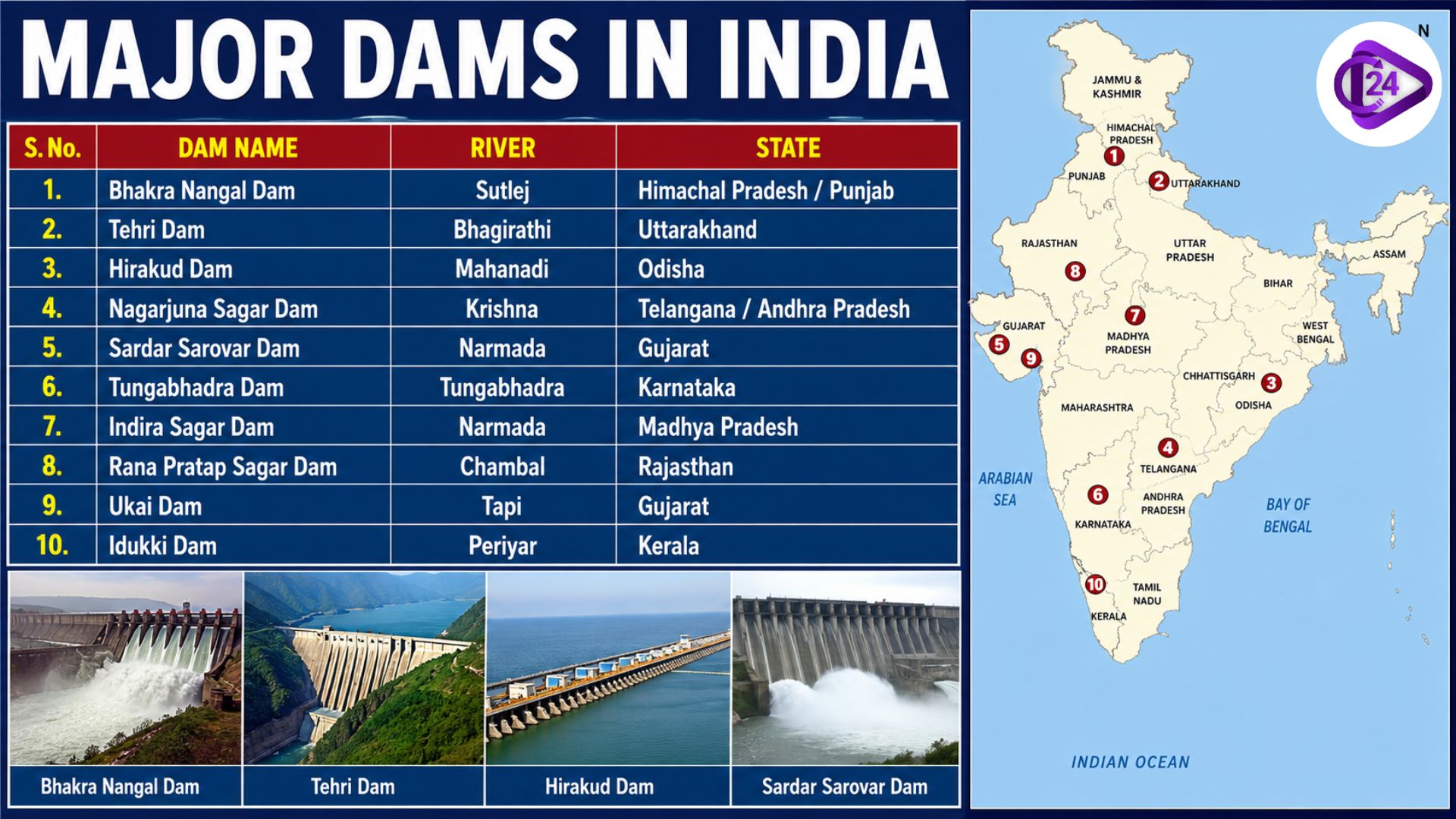
- Tallest Dam: Tehri Dam (Uttarakhand) – 260.5 m above the river bed at Bhagirathi River
- Longest Dam: Hirakud Dam, Odisha – 25.8 km (includes dykes); River Mahanadi
- Earliest Currently Functional Dam: Kallanai (Grand Anicut), either built by Karikala Chola on the (Kaveri) River around 2nd CE.
- Bhakra Dam (Himachal Pradesh): Largest Concrete Gravity Dam in the World on Sutlej River.
- Biggest Earthfill Dam – Banasura Sagar Dam (Kerala) on river Karamanathodu
- State with Highest Number of Completed Large Dams: Maharashtra (Total 2394)
- Check all major multipurpose dams: Sardar Sarovar Dam (Gujarat) – Narmada Irrigation Water Supply & Hydropower.
- Authority Retained: The National Register of Large Dams (NRLD) is maintained by the Central Water Commission (CWC), which also monitors dam safety in India.
List of Major Dams in India
These are large structures across rivers that store and regulate water. They provide irrigation, hydroelectricity generation, domestic potable water, flood control, navigation and industrial usage. These dams are either built as gravity, earth-fill, embankment or arch dams and constitute an integral part of water resource management and infrastructure development in India.
Major Dams in India (State-wise)
| State/UT | Dam Name | River |
| Andhra Pradesh | Srisailam Dam | Krishna |
| Polavaram Dam | Godavari | |
| Gujarat | Sardar Sarovar Dam | Narmada |
| Ukai Dam | Tapi | |
| Kadana Dam | Mahi | |
| Dharoi Dam | Sabarmati | |
| Himachal Pradesh | Bhakra Dam | Sutlej |
| Pong Dam | Beas | |
| Pandoh Dam | Beas | |
| Jharkhand | Maithon Dam | Barakar |
| Panchet Dam | Damodar | |
| Konar Dam | Konar | |
| Tilaiya Dam | Barakar | |
| Chandil Dam | Subarnarekha | |
| Jammu & Kashmir | Salal Dam | Chenab |
| Baglihar Dam | Chenab | |
| Dul Hasti Dam | Chenab | |
| Karnataka | Almatti Dam | Krishna |
| Narayanpur Dam | Krishna | |
| Tungabhadra Dam | Tungabhadra | |
| Krishna Raja Sagara (KRS) Dam | Kaveri | |
| Kabini Dam | Kabini | |
| Hemavathi Dam | Hemavathi | |
| Kerala | Idukki Dam | Periyar |
| Mullaperiyar Dam | Periyar | |
| Banasura Sagar Dam | Karamanathodu | |
| Cheruthoni Dam | Cheruthoni | |
| Malampuzha Dam | Malampuzha | |
| Madhya Pradesh | Indira Sagar Dam | Narmada |
| Omkareshwar Dam | Narmada | |
| Bargi Dam | Narmada | |
| Gandhi Sagar Dam | Chambal | |
| Tawa Dam | Tawa | |
| Matatila Dam* | Betwa | |
| Maharashtra | Koyna Dam | Koyna |
| Jayakwadi Dam | Godavari | |
| Ujani Dam | Bhima | |
| Isapur Dam | Penganga | |
| Odisha | Hirakud Dam | Mahanadi |
| Rengali Dam | Brahmani | |
| Punjab | Ranjit Sagar (Thein) Dam | Ravi |
| Rajasthan | Rana Pratap Sagar Dam | Chambal |
| Jawahar Sagar Dam | Chambal | |
| Mahi Bajaj Sagar Dam | Mahi | |
| Bisalpur Dam | Banas | |
| Tamil Nadu | Mettur Dam | Kaveri |
| Kallanai (Grand Anicut) | Kaveri | |
| Vaigai Dam | Vaigai | |
| Bhavanisagar Dam | Bhavani | |
| Telangana | Nagarjuna Sagar Dam | Krishna |
| Srisailam Dam* | Krishna | |
| Sri Ram Sagar Dam | Godavari | |
| Uttar Pradesh | Rihand Dam | Rihand |
| Matatila Dam* | Betwa | |
| Uttarakhand | Tehri Dam | Bhagirathi |
| West Bengal | Durgapur Barrage | Damodar |
| Mayurakshi Dam | Mayurakshi |
Also Read – Major Dams
Significance of Major Dams in India
As defined by the Central Water Commission (CWC) and the Ministry of Jal Shakti, large dams are multipurpose water resource projects providing benefits across multiple sectors including irrigation, hydropower, flood management, water supply and regional development. Their key significance includes:
- Agriculture: Ensures water supply, increases cropping intensity and food security.
- Hydroelectric Power: Produces renewable electricity, minimises fossil fuel reliance, supports India’s transition to clean energy.
- Flood Mitigation: Absorbs additional monsoon water, which helps prevent flooding in downstream locations.
- Drinking-water Supply: Ensures a consistent supply of safe drinking water to urban and rural populations.
- Industrial Water Supply: Supply of required water for industries, thermal power plants and manufacturing units
- Conservation of water for the rainy season and to take advantage of it during dry periods and droughts.
- Recharge of Groundwater: Helps recharge aquifers and enhances groundwater availability to areas nearby.
- River Regulation: Regulate river flows for effective and sustainable water resource management.
- Fisheries Development: Reservoirs foster inland fisheries, providing jobs and enhancing food production.
- Navigation: Certain reservoirs and controlled streams optimise inland water shipping.
- Tourism & Recreation: Large reservoirs are conducive to tourism, boating, water sports and eco-tourism activities.
- Regional Development: Promotes Rural development, employment and infrastructure development in the surrounding areas.
- Environmental Dimensions: Preservation of environmental flows, enrichment through afforestation around reservoirs and climate resilience through sound water management.
Environmental, Social and Economic Impacts of Major Dams
- Ecological Disruption of Rivers: Modifies natural river flows, impacting aquatic life and biodiversity.
- Loss of Forests and Wildlife Habitat: Loss of Submerged Forests and Wildlife Habitat, where the creation of reservoirs may submerge forests or wetlands and important wildlife habitats.
- Sedimentation: Sediment deposition reduces reservoir volume capacity and affects land soil fertility downstream.
- Changes in Water Quality: Changes the temperature, oxygen levels, and distribution of nutrients (so you have changes in water quality categories) of rivers.
- Impact on Fish Migration: Prevents the passage of migratory fish species, disrupting reproductive cycles.
- Greenhouse Gas Emissions: Methane is released from some reservoirs as vegetation decomposes beneath the water surface.
Social Impacts – Major Dams
- Relocation: Large dam projects often necessitate relocation of families and communities that have been affected.
- Changes in Livelihood: Tidal and river flow changes can affect fishers and farmers dependent on rivers and forests.
- Better Water Security: Provides large-scale access to safe drinking water and irrigation for millions.
- Employment Generation: It provides jobs during the dam construction and operational and maintenance work as well as in related sectors.
- Regional Development: Better infrastructure, roads, electricity and public services in the vicinity.
Economic Impacts – Major Dams
- Investing in Agricultural Growth: Improves irrigation facilities, increases crop yields and boosts food security.
- Hydropower Generation: Produces renewable electricity and reduces reliance on traditional energy sources.
- Flood Damage Reduction: Reduces the economic impact of flooding by controlling water.
- Industrial Development: Ensures a reliable water supply for industry and manufacturing.
- Tourism & Fisheries: Reservoirs are a source of tourism, recreation, domestic fishing and local commercial activities.
- Long-Term water storage: Improves access to water in droughts, supporting the economy sustainably.