


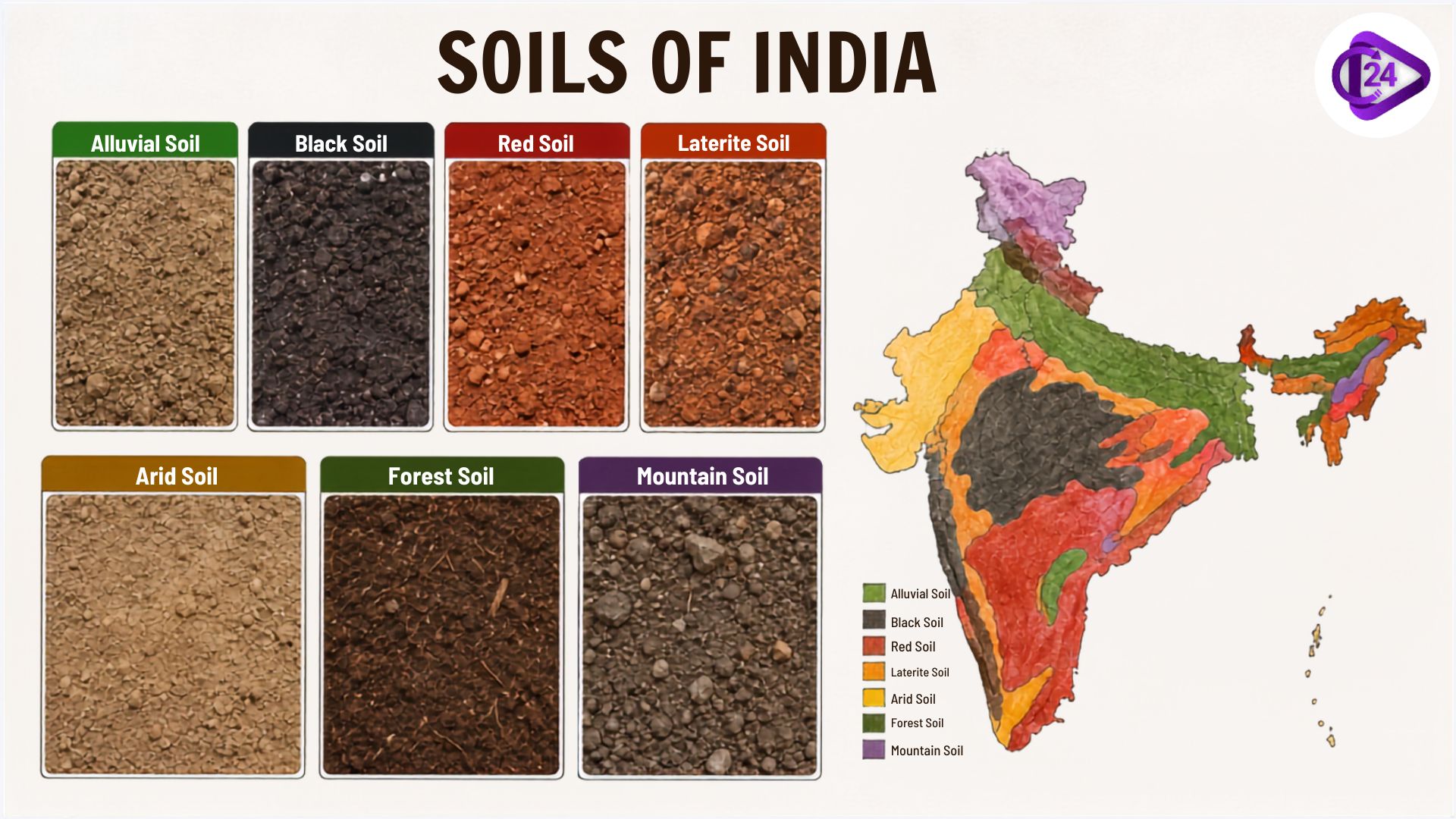
The soils of India are one of the most valuable natural resources for the country and form the basis for agriculture, biodiversity, and sustainable development. The diverse climate, topography and geological formations of India in different regions have resulted in several major soil types, which can be differentiated by physical and chemical characteristics. Nature: India has eight major soil groups, namely Alluvial, Black, Red & Yellow, Laterite, Arid (Desert), Forest & Mountain and Saline & Alkaline (or Peaty and Marshy) soils as per the Indian Council of Agricultural Research (ICAR).
These soils are different from each other regarding fertility, texture, moisture retention and the types of crops that they can grow. Soil gives life to crops, forests and grasslands in combination with the climate of a region. Understanding its kinds, distribution, characters, and significance creates an impact on Indian Agriculture-Environment Conservation-Rural Development so we will try to know each and everything relating to it.
Classification of Indian Soils
Indian soils are classified based on their formation, composition, texture, colour, climate, fertility history and origin. India has 8 major soil types according to the Indian Council of Agricultural Research (ICAR), which are divided into Alluvial, Black, Red & Yellow, laterite, Arid (Desert), Forest & Mountain, Saline & Alkaline and Peaty & Marshy soils that exhibit different crops within each territory.
Alluvial Soil – Soils of India
- Characterised by deposition of sediments carried down by rivers Ganga, Brahmaputra and Indus.
- Is the largest soil group covering around 40% of the total geographical area of India.
- Common throughout the Northern Plains, Assam Valley, and coastal deltas.
- Potash, lime, and phosphoric acid are very abundant, but nitrogen and humus are generally in lack.
- Bhangar or old alluvium. Khadar or new alluvium.
- Very productive and suitable for rice, wheat, sugarcane, maize, jute, pulses and oilseeds.
- Great at retaining moisture and very easy to grow.
- Regarded as the backbone of Indian agriculture
Black Soil (Regur Soil) – Soils of India
- Mainly sourced from weathering of basaltic lava rocks of the Deccan Plateau.
- Mainly found in Maharashtra, Madhya Pradesh, Gujarat, Telangana, Karnataka and Andhra Pradesh.
- It is high in lime, iron, magnesium and alumina.
- Fights the high clay content, making it great for holding moisture.
- Deep cracks develop in summer, allowing for better aeration of the soil.
- Commonly referred to as Cotton Soil—because it is well-suited for growing cotton.
- Ideal for soybean, sugarcane, wheat, tobacco and pulses.
- Naturally fertile but low in nitrogen and phosphorus.
Red and Yellow Soil – Soils of India
- Developed from the breakdown of very old crystalline igneous and metamorphic rocks.
- Habitat – Native to areas of Tamil Nadu, Karnataka, Odisha, Chhattisgarh, Andhra Pradesh and Telangana and parts of Jharkhand
- The Red colour comes from Iron oxide.
- Looks yellow, caused by hydrated iron content
- Credibility: More permeable soil with reduced water retention capabilities
- Low in nitrogen, phosphorus, and organic matter.
- Irrigated with minor use, mainly suitable for millets, groundnut & pulses, cotton and oilseeds.
- Fertility increases with the use of fertilisers & organic manure.
Laterite Soil – Soils of India
- Established in warm and humid environments through strong leaching.
- Distribution: Western Ghats, Eastern Ghats, Kerala, Karnataka, Tamil Nadu, Odisha and Assam.
- Combination of titanium oxides and aluminium oxides.
- Deficiency of nitrogen, phosphorus, lime and potash.
- The upper layer hardens when it’s exposed to sunlight.
- Requires fertilisers for productive farming.
- Ideal for tea, coffee, rubber, coconut, cashew and spices.
- Also massively used as a building block [after cutting into blocks]
Arid (Desert) Soil – Soils of India
- More commonly seen in Rajasthan, Gujarat, Haryana and Punjab.
- Particularly: formed in hotter and drier climatic conditions
- Light, low organic matter sandy soil.
- Evaporation with a poor water retention capacity.
- Highly soluble salts but usually low humus or nitrogen.
- Often alkaline in nature.
- Well suited for millets, barley, guar, and fodder crops under irrigated conditions.
- Traditional agricultural activities were supported by irrigation projects like the Indira Gandhi Canal.
Forest and Mountain Soil – Soils of India
- Present in the Himalayan region, Western Ghats and other hilly areas.
- Caused by climatic conditions within the mountains and forest flora.
- Deep in organic matter and humus at high altitudes.
- Elevation dictates texture, ranging from coarse to loamy.
- Acidic in nature in high-rainfall places.
- Supports dense forests and biodiversity.
- Adaptation to tea, coffee, spices, temperate fruits and medicinal plants.
- Highly vulnerable to soil erosion from steep hills.
Saline and Alkaline Soil – Soils of India
- Often known as Usara or Reh soils in certain areas.
- Widely distributed across Gujarat, Rajasthan, Punjab, Haryana, Uttar Pradesh and coastal regions
- Toxicity of soluble salts on crop growth.
- Small particle size causes poor soil structure and less fertility.
- Resulting from irrigation, drainage and intrusion of seawater.
- The second is through the use of gypsum for soil reclamation and adequate drainage.
- Use: Suitable for salt-resistant crops after reclamation.
- Key for examination of land degradation and soil management.
Peaty and Marshy Soil – Soils of India
- Typical accumulation in moist and swampy places of vegetal matière.
- Location: Kerala, West Bengal, Odisha, Bihar, Tamil Nadu and Sundarbans
- This is high in humus, giving it a dark black colour.
- Aqueous, rich in organic carbon and acidic
- Poor drainage limits agricultural use.
- After drainage improvement, it is suitable for paddy, jute and some plantation crops.
- Supports wetland ecosystems and biodiversity.
- Critical for carbon sequestration and ecosystem health.
Importance of Soils of India
- Agriculture’s Base: The Indian soil helps in cultivating the staple food grains, cash crops, fruits, vegetables and plantation crops that guarantee national food security.
- Supports Crop Diversification: Alluvial soil provides a favourable growing environment for crops like wheat and rice, while black soil is used to grow cotton, and laterite soil supports tea and coffee plantations.
- Supports Biodiversity: Soil is home to microorganisms, insects and plant species
- Nutrient Provider: Soil provides important nutrients, such as nitrogen, phosphorus, potassium, calcium and magnesium that plants need to grow.
- Water Conservation: Healthy soils act like a sponge to soak up rainwater, recharge groundwater and reduce floods and droughts.
- Forestry Support: Forest and mountain soils support forests that conserve biodiversity, act to stabilise climate, and prevent soil erosion.
- Use of Soil for Industries: Some soils like laterite and clay are used in making bricks, cement, ceramics and construction materials.
- Carbon Storage: Soil stores organic carbon as part of the soil ecosystem and the natural carbon store of the Earth.
- Environmental Protection: Well-structured soils are less prone and resistant to erosion, which leads to better water quality; soil conditions are favourable for vegetation resistance against desertification, land degradation prevention and sustainable use of all natural resources.
Important Government Schemes Related to Soils of India
| Scheme | Launched By | Key Objective |
| Soil Health Card Scheme (SHC) | Ministry of Agriculture & Farmers Welfare (2015) | Provides farmers with soil health cards containing information on soil nutrients and fertiliser recommendations to improve productivity. |
| National Mission for Sustainable Agriculture (NMSA) | Ministry of Agriculture & Farmers Welfare | Promotes sustainable farming, integrated nutrient management, soil health, and efficient water use under the National Action Plan on Climate Change (NAPCC). |
| Paramparagat Krishi Vikas Yojana (PKVY) | Ministry of Agriculture & Farmers Welfare | Encourages organic farming through cluster-based cultivation to improve soil fertility and reduce chemical fertiliser use. |
| Pradhan Mantri Krishi Sinchayee Yojana (PMKSY) | Government of India | Enhances irrigation efficiency and promotes soil and water conservation through watershed development. |
| Watershed Development Component of PMKSY (WDC–PMKSY) | Department of Land Resources | Focuses on soil conservation, rainwater harvesting, groundwater recharge, and land restoration in rainfed areas. |
| National Project on Soil Health and Fertility (NPSHF) | Ministry of Agriculture & Farmers Welfare | Strengthens soil testing laboratories, nutrient management, and balanced fertiliser use across the country. |
| Rashtriya Krishi Vikas Yojana (RKVY-RAFTAAR) | Ministry of Agriculture & Farmers Welfare | Supports state-specific agriculture projects, including soil health improvement, land development, and sustainable agriculture. |
| National Innovations in Climate Resilient Agriculture (NICRA) | ICAR | Develops technologies to improve soil health, climate resilience, and sustainable farming under changing climatic conditions. |
Also Read
| Yamuna River System | Son River |
| Jhelum River System | Indus River System |
| Godavari River System | Indian River Systems |
| Kaveri River | Narmada River Explained |
| Krishna River System | Sutlej River System |