


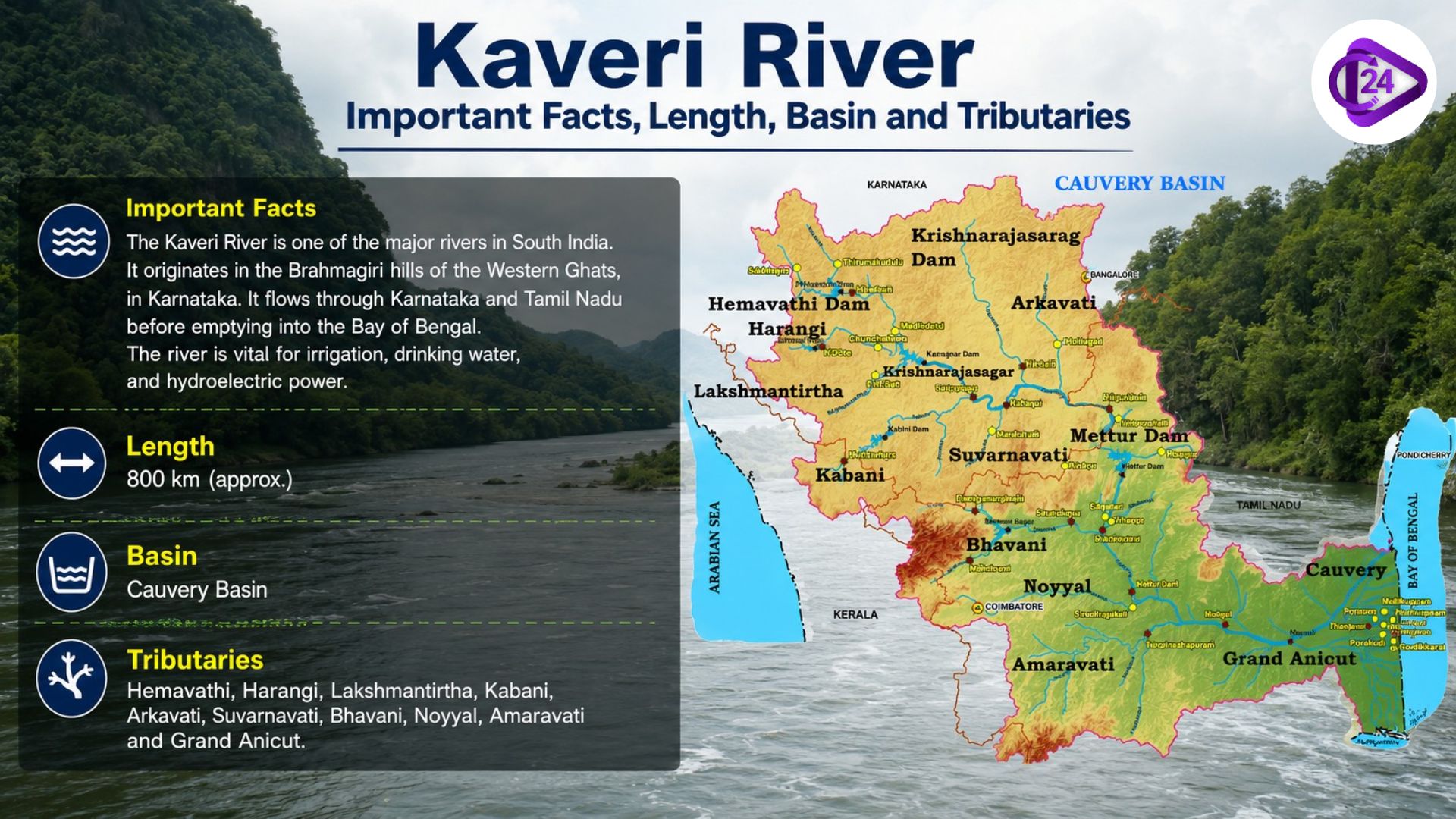
The Kaveri River, also known as the Cauvery, is one of the most significant east-flowing rivers of Peninsular India. It rises in the Talakaveri area of the Brahmagiri Hills in the Western Ghats, Karnataka, and flows for approximately 765 km before entering the Bay of Bengal. The Kaveri Basin spans almost 81,000 sq. km, mainly across Karnataka, Tamil Nadu, Kerala, and the Union Territory of Puducherry, often referred to as “Ganga of South India” and being important for agriculture, drinking water withdrawal, hydropower generation and high biodiversity. The larger Kaveri’s tributaries are: Hemavati, Kabini, Bhavani, Amaravati, Shimsha, and Arkavati.
Origin of Kaveri River
The Kaveri River rises from Talakaveri, a sacred spot in the Brahmagiri Hills of Western Ghats located in Kodagu (Coorg) district of Karnataka at approximately 1,341 metres (4,403 ft) above sea level. Talakaveri holds the status of being the birthplace of the river and is an important pilgrimage site in South India. It moves southeast from its source in the western part of Karnataka and Tamil Nadu, draining into the Bay of Bengal. The monsoon rainfall in the region of origin makes a large contribution to the flow of the Kaveri River. The source region of the Kaveri River is equally notable for its biodiversity and ecological importance in the Western Ghats.
Major Tributaries of the Kaveri River
| Tributary | Bank of Kaveri | Origin | States Covered | Key Features |
| Hemavati | Left Bank | Western Ghats, Chikkamagaluru (Karnataka) | Karnataka | One of the largest tributaries, the Hemavati Dam built on it. |
| Kabini | Left Bank | Wayanad Hills, Kerala | Kerala, Karnataka | Major contributor to Kaveri’s flow; Kabini Reservoir is located on it. |
| Shimsha | Right Bank | Devarayanadurga Hills, Karnataka | Karnataka | Known for the historic Shivanasamudra Hydroelectric Project. |
| Arkavati | Right Bank | Nandi Hills region, Karnataka | Karnataka | Supplies water to the Bengaluru region. |
| Lakshmana Tirtha | Left Bank | Brahmagiri Hills, Karnataka | Karnataka | Joins the Kaveri near Krishnarajasagar. |
| Suvarnavathi | Right Bank | Western Ghats, Karnataka | Karnataka | An important tributary in southern Karnataka. |
| Bhavani | Left Bank | Nilgiri Hills, Western Ghats | Kerala, Tamil Nadu | A major tributary in Tamil Nadu, the Bhavanisagar Dam is situated on it. |
| Noyyal | Right Bank | Velliangiri Hills, Tamil Nadu | Tamil Nadu | Supports agriculture in the Coimbatore region. |
| Amaravati | Right Bank | Anamalai Hills, Western Ghats | Tamil Nadu | Amaravathi Dam was constructed on this river. |
| Harangi | Left Bank | Pushpagiri Hills, Karnataka | Karnataka | Harangi Dam is built across this tributary. |
Important Facts About Kaveri River
- The Kaveri River is one of Peninsular India’s major east-flowing rivers and is sometimes referred to as the “Ganga of South India.”
- It begins at Talakaveri, situated in the Brahmagiri hills in Kodagu district of Karnataka.
- The river runs 800 km before ending in the Bay of Bengal area
- Kaveri Basin spreads over an area of 81,155 sq. filled to a height of 120 km and covering over 600 km (370 mi) across the states of Karnataka, Tamil Nadu, Puducherry and Kerala.
- This is largely supported by extensive irrigation along major projects such as the Krishna Raja Sagar and Mettur Dam.
- Major tributaries are Kabini, Hemavati, Bhavani, Amaravati, Shimsha, Arkavati and more.
- The river creates the fertile Kaveri Delta, a major agricultural region of Tamil Nadu.
- It is an important source of drinking water, hydropower generation and biodiversity conservation.
- The South West & North East Monsoons feed the basin with rainfall.
- The river is of great cultural, religious and economic importance in the southern part of India.
Major Dams and Hydropower Projects on KaveriRiver
| Project/Dam | River | State | Type | Key Significance |
| Krishna Raja Sagar (KRS) Dam | Kaveri | Karnataka | Multipurpose Dam | A major source of irrigation and drinking water; it creates the KRS Reservoir. |
| Mettur Dam (Stanley Reservoir) | Kaveri | Tamil Nadu | Multipurpose Dam | One of the largest dams in South India supports Cauvery Delta irrigation. |
| Kabini Dam | Kabini (Tributary) | Karnataka | Irrigation & Water Supply Dam | Regulates water flow and supplies water to Karnataka. |
| Hemavathi Dam (Gorur Dam) | Hemavati (Tributary) | Karnataka | Multipurpose Dam | Important for irrigation and drinking water supply. |
| Harangi Dam | Harangi (Tributary) | Karnataka | Irrigation Dam | The first major dam was built in the Cauvery Basin of Karnataka. |
| Bhavanisagar Dam | Bhavani (Tributary) | Tamil Nadu | Irrigation Dam | One of the largest earthen dams in India. |
| Amaravathi Dam | Amaravati (Tributary) | Tamil Nadu | Multipurpose Dam | Supports irrigation, fisheries, and flood control. |
| Upper Anaicut (Mukkombu) | Kaveri | Tamil Nadu | Barrage | Diverts water between the Kaveri and Kollidam rivers. |
| Grand Anicut (Kallanai) | Kaveri | Tamil Nadu | Ancient Barrage | Built by the Cholas, among the world’s oldest functioning water-diversion structures. |
Also Read
Major Cities Located on the Kaveri River
- Madikeri (Karnataka): Roughly near Talakaveri, the Kaveri River source region
- Runner-up: Kushalnagar (Karnataka): An important town in the upper Kaveri Basin
- Srirangapatna (Karnataka): Island fortress town on the Kaveri, home of Tipu Sultan.
- Mysuru (Karnataka): An important cultural hub, drawing its entire drinking and irrigation waters from the Kaveri
- Mandya (Karnataka): A region also known for sugarcane cultivation, with irrigation from the KRS Dam.
- Shivanasamudra (Karnataka): Waterfalls, along with one of India´s first hydroelectric projects
- Erode (Tamil Nadu): A big commercial city at the junction of two rivers, viz. Bhavani and Kaveri.
- Bhavani (Tamil Nadu): Bhavani Sangam. At the congregation of Rivers Bhavani and Kaveri.
- Tiruchirappalli(State of Madras): Principal city at the division of the Kaveri into two branches, the Kaveri and Kolīḍam.)
- Thanjavur (Tamil Nadu): The agricultural capital of the prosperous Cauvery Delta
- Kumbakonam, Tamil Nadu: A famous temple town in the delta area.
- Mayiladuthurai (Tamil Nadu): A major pilgrimage and cultural site on the river.
- Poompuhar (Tamil Nadu): Ancient Chola port town at the mouth of one of India’s major rivers, the Kaveri, into the Bay of Bengal.
FAQs on Kaveri River System