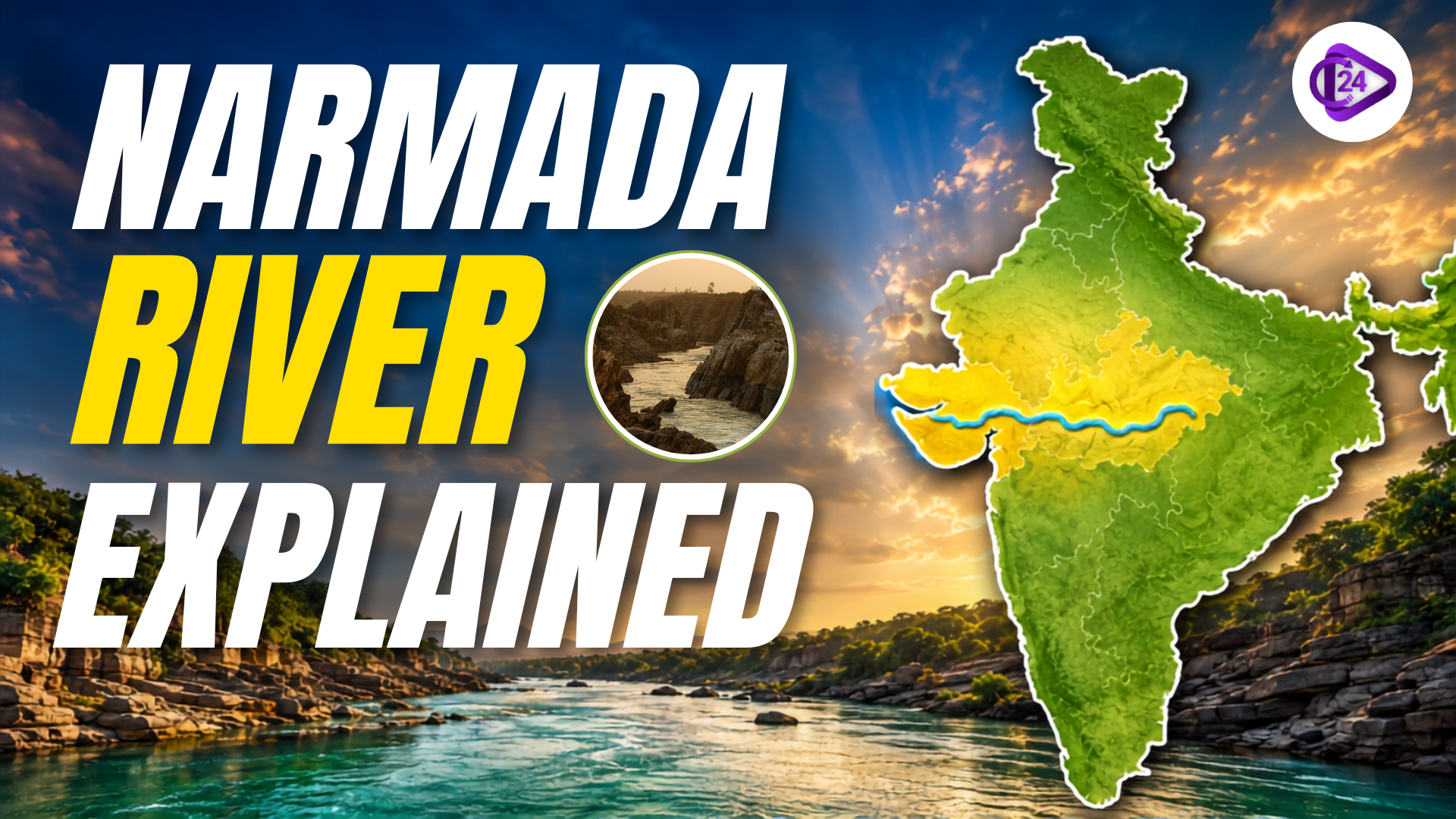
Narmada River Explained: Source, Course, Tributaries & Map Locations

The Narmada River is the longest west-flowing river in India and one of its largest peninsular rivers. The river, originating from Narmada Kund in Amarkantak (Maikala Range), Madhya Pradesh, flows over a length of about 1,312 km through Madhya Pradesh, Maharashtra and Gujarat before falling into the Gulf of Khambhat(Arabian...

Narmada River Explained: Source, Course, Tributaries & Map Locations
Narmada River

The Narmada River is the longest west-flowing river in India and one of its largest peninsular rivers. The river, originating from Narmada Kund in Amarkantak (Maikala Range), Madhya Pradesh, flows over a length of about 1,312 km through Madhya Pradesh, Maharashtra and Gujarat before falling into the Gulf of Khambhat(Arabian Sea). Most peninsular rivers, such as the dammed Narmada between the Vindhya and Satpura ranges, flow eastward along a rift valley. The river basin spreads across almost 98,800 sq. km of this region, providing benefits for irrigation, hydropower production, biodiversity and livelihoods over a wide area across central India. The major tributaries are the Tawa, Shakkar, Dudhi, Banjar and Hiran rivers.

Narmada River Origin

Narmada River rises from Narmada Kund, a sacred tank on the Amarkantak Plateau in Anuppur district of Madhya Pradesh. The point of origin is located at the Maikala Range at an approximate elevation of 1,057 metres (3,465 ft) above sea level, situated at the confluence of the Vindhya and Satpura mountain systems. The Narmada, one of India’s most sacred rivers which originates in Amarkantak, central India and flows westward to the sea. The origin site is a pilgrimage location of geographical and ecological significance, drawing many devotees and visitors from all over the country. What makes the river stand out from most other major peninsular rivers of India is that it flows westwards.

Major Tributaries of Narmada River

Tributary Bank Origin State(s) Key Feature
Tawa Left Bank Satpura Range Madhya Pradesh Largest tributary of the Narmada; Tawa Dam is built on it.
Shakkar Left Bank Satpura Hills Madhya Pradesh Important seasonal tributary in the middle basin.
Dudhi Left Bank Satpura Hills Madhya Pradesh Supports irrigation and local agriculture.
Ganjal Left Bank Satpura Range Madhya Pradesh Drains parts of Betul and Harda districts.
Kolar Left Bank Vindhya–Satpura Region Madhya Pradesh Known for Kolar Dam, a major water source.
Banjar Right Bank Maikal Hills Madhya Pradesh Flows through forested areas near the Kanha region.
Hiran Right Bank Vindhya Range Madhya Pradesh One of the major northern tributaries.
Barna Right Bank Vindhya Hills Madhya Pradesh Associated with the Barna Dam project.
Orsang Right Bank Vindhya Hills Gujarat Important tributary in the lower Narmada basin.
Kundi Right Bank Vindhya Range Madhya Pradesh Seasonal tributary contributing to basin flow.

Major Dams on the Narmada River

Dam Project River State Purpose Key Feature
Sardar Sarovar Dam Narmada Gujarat Irrigation, Drinking Water, Hydropower Largest and most famous project on the Narmada; supplies water to Gujarat, Rajasthan, Maharashtra, and Madhya Pradesh.
Indira Sagar Dam Narmada Madhya Pradesh Hydropower & Irrigation Largest reservoir in India by water storage capacity.
Omkareshwar Dam Narmada Madhya Pradesh Hydropower & Irrigation Located near the sacred town of Omkareshwar.
Maheshwar Dam Narmada Madhya Pradesh Hydropower Situated near the historic town of Maheshwar.
Bargi Dam (Rani Avanti Bai Sagar Project) Narmada Madhya Pradesh Irrigation, Hydropower & Fisheries First major completed dam under the Narmada Valley Development Project.
Jobat Dam Hathni River (Narmada Basin) Madhya Pradesh Irrigation Important project in the Narmada basin region.
Tawa Dam Tawa (Tributary of Narmada) Madhya Pradesh Irrigation & Hydropower Built on the largest tributary of the Narmada River.
Barna Dam Barna (Tributary of Narmada) Madhya Pradesh Irrigation & Water Supply Important reservoir in central Madhya Pradesh.

Also Read

Yamuna River System Son River
Ganga River System Jhelum River System
Indus River System Godavari River System
Brahmaputra River System Indian River Systems

Key Geological Features of Narmada River Basin

  • Through a Rift Valley: One of the few major Indian river which flows through a tectonic rift valley between the Vindhya and Satpura mountain ranges, the Narmada.
  • West-flowing peninsular river: Flows westward to empty into the arabian sea total of 6 rivers.
  • Origin at Amarkantak Plateau: The river originates from Narmada Kund in the Amarkantak, Maikal hills.
  • Narmada Valley: It demarcates a natural boundary between North and South India.
  • Marble Rocks Formation: The river intersects magnificently at Bhedaghat near Jabalpur through splendid Marble Rocks.
  • Dhuandhar Waterfall: Responsible for the famed Dhuandhar Falls due to sudden changes in rock formation.
  • Alluvial and Black Soils: The basin is primarily made of rich alluvial soils, which can be formed by volcanic rocks or sediments.
  • Seismic Requirements: The Narmada–Son Lineament is one of India’s major geological fault lines.
  • Estuary Formation: The river creates an estuary instead of a delta as it meets the Gulf of Khambhat

FAQs on Narmada River

The Narmada River originates from Narmada Kund at Amarkantak Plateau in the Anuppur district of Madhya Pradesh.
Bimal N. Patel Elected to Prestigious ITLOS Judicial Panel
India’s Major Reservoir Storage Falls to 28.28% of Total Capacity
Government Tightens Foreign Funding Norms for NGOs Under FCRA
Government to Notify Western Ghats Eco-Sensitive Areas in At Least Three States
Tushar Mehta Reappointed as Solicitor General of India for Three Years
CRED Founder Kunal Shah Appointed Global Head of WhatsApp

Start Learning Today with Class24

Class24 Mobile Application

Class24 also has a mobile application so that it becomes easily accessible and convenient. This can be downloaded on an Android device. Users have appreciated this app and the content provided as 4.1 out of 5 is its rating in the App Store. People loved it because Class24 is giving content which is extremely rich in every sense. The app comprises a wide variety of features for smooth learning:

  • User-Friendly Interface: The app is categorized into various sections so that students can navigate and access various resources with ease.
  • Offline Access: The study materials can be downloaded and the student can access them even when not connected to the internet.
  • Inbuilt eBook Reader: There is a lightning-fast reader for eBooks within the app, so reading is seamless.
  • Progress Tracking: The app tracks student’s progress in preparation and keeps them organized and focused.

Courses and Subjects Offered

The total syllabus will be covered, and there are in-depth practice materials so as to give deep preparation in the courses designed to each one of them. All the subjects come under the aegis of courses offered by Class24 to meet different needs of various aspirants such as:

Preparation Tips for All Exams

Preparation tips for all exams mentioned below:

  • Previous Year Papers: Try to attempt at least 5-10 years of question papers to know the pattern of questions, how much difficulty one would face while answering, and how many frequently asked topics were in the examination.
  • Take Mock Tests: Attempt Mock Tests regularly in order to time and accuracy. You may analyze the performance and make an improvement for weak areas.
  • Focus on Time Management: Solve questions in the given time to make a habit of having speed and efficiency. Allocate time sensibly between Paper 1 and Paper 2, while appearing in the examination.
  • Current Affairs: For Current Affairs and TET exams, be updated about current affairs, teaching aptitude, and general awareness.
  • Regular Revision: Spend your daily and weekly time for revisions to not forget concepts and formulas. Use flashcards or do self-summary notes for quick revisions.
  • Understand the Exam Pattern and Syllabus: Understand the pattern of your exam paper and syllabus very well. Both Current Affairs and CSIR NET examinations are two-tier ones and involve both Paper 1, which consists of general aptitude and Paper 2 that involves specific aptitude subjects.
  • Make a Study Plan: Divide the preparation time into three phases of concept building, revision, and mock tests. Allocate more time to weaker areas while maintaining equilibrium with stronger sections.
  • Online Coaching or Study Groups: Enroll in online coaching programs like Class24 to get proper guidance and a structured approach to the study. Study groups will be useful to discuss doubts and share resources.
  • Stay Consistent and Motivated: Maintain a steady study schedule. Stay motivated by making small achievable goals.
  • Use Quality Study Materials: Suggested study material refers to a textbook, a set of previously published question papers, and web sources such as Class24.

Conclusion

Class24 is a one stop solution for aspirants preparing for Current Affairs, CSIR NET, SET, UP PGT English, UP TGT PGT, UPHESC Assistant Professor, TET, IGNOU B.Ed and other competitive exams. There are structured courses, live classes, mock tests along with the guidance of experts to assist candidates in achieving success in their respective fields.


Get success in your hand. Start study anytime anywhere.

The journey becomes simple and enjoyable when you start taking interest in it. And through our app “Class24”, we will be your trusted partners in developing that interest.

Daily Quizzes
Mock Tests
Ongoing

No ongoing tests right now.