


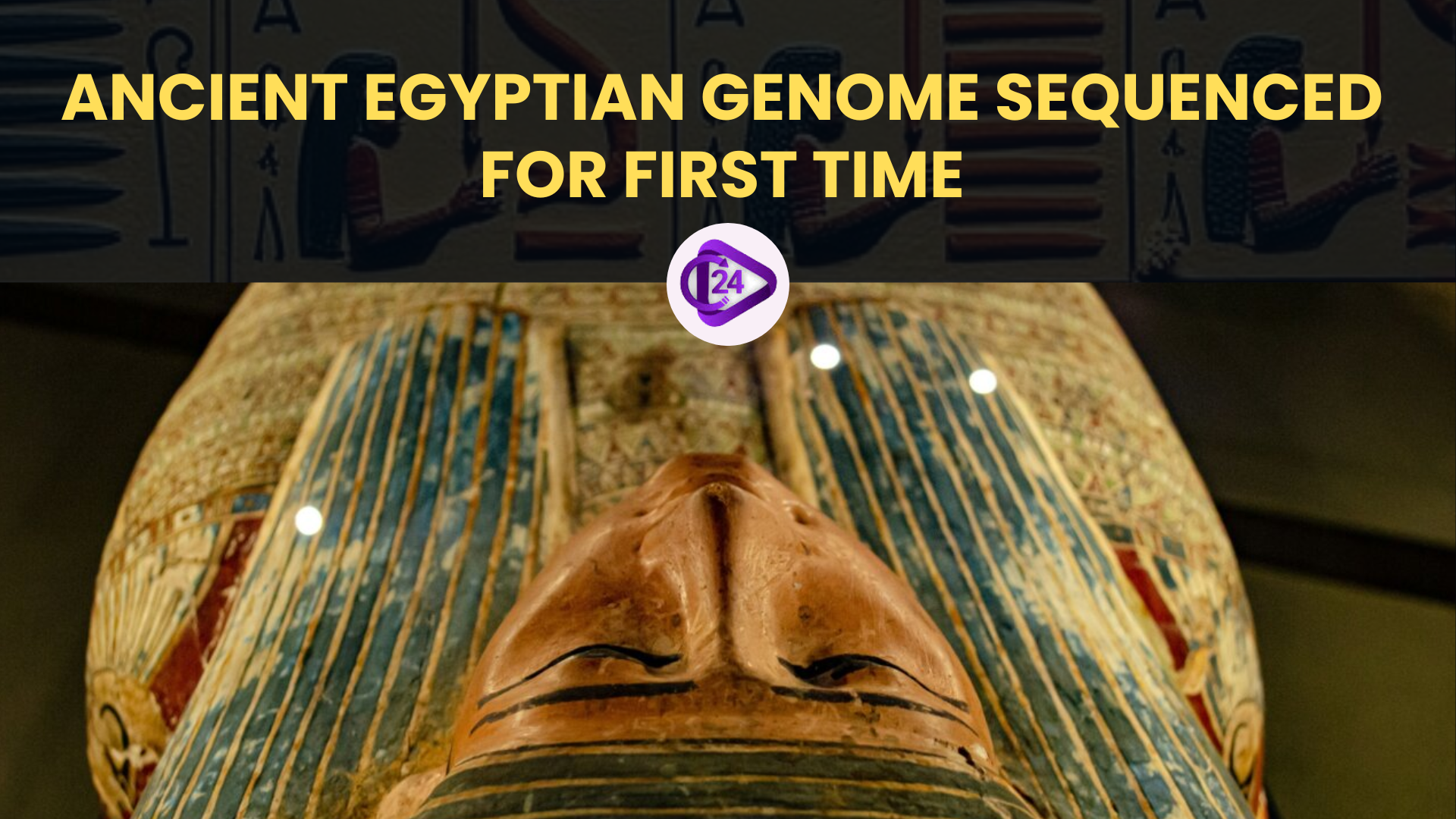
First Ancient Egyptian Genome Sequenced: 4,500-Year-Old DNA Offers Clues to Ancestry and Preservation

This is the first time that a whole genome of an ancient Egyptian was sequenced, who lived about 4,500-4800 years ago, in the Old Kingdom era. It is the oldest and most complete DNA ever recovered in an Egyptian, extracted from a person buried in a ceramic pot in a...

First Ancient Egyptian Genome Sequenced: 4,500-Year-Old DNA Offers Clues to Ancestry and Preservation

This is the first time that a whole genome of an ancient Egyptian was sequenced, who lived about 4,500-4800 years ago, in the Old Kingdom era. It is the oldest and most complete DNA ever recovered in an Egyptian, extracted from a person buried in a ceramic pot in a rock-cut tomb in Nuwayrah in the south of Egypt. This is a person whose family origin was mainly that of North Africa with limited connections to ancient Mesopotamian farmers. The results give insight to the ancestral heritage and preservation techniques of the civilizations of ancient Egypt. On July 2, the research was posted in the journal Nature.

Context

  • The oldest complete genome study of a male Egyptian mummy, dated to 4,500 years ago showed largely North African ancestry with a Mesopotamian component. 

  • DNA was most possibly well conserved by burial conditions in such harsh climate of Egypt.
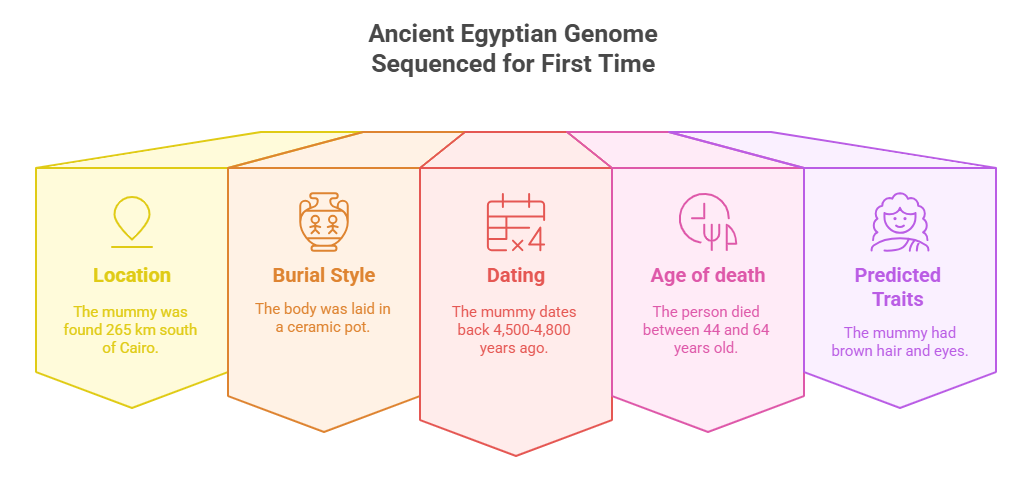
Key Points

Discovery context and Burial

  • Location: Nuwayrat, 265 km south of Cairo

  • Burial Style: The body laid in a large ceramic pot in rock-cut tomb

  • Dating Third to Fourth Dynasties (Old Kingdom, 4,500-4,800 years ago)

  • Age of death: 44-64 years

  • Predicted Traits: Brown hair, brown eyes, dark to black skin color, 157 and 160 cm of height

Genetic Findings

  • 78% Ancestry: Prehistoric North Africa (Neolithic Morocco)

  • 22% Ancestry: Early Fertile Crescent farmers (Mesopotamia)

  • Evolvable genetic southward movement by way of Levantine populations (Israel, Syria, Jordan)

Aspects of Scientific and Technological dimension

  • DNA source: Root tips of teeth- the best to store

  • Preservation Factors: Such grave salutations as pot burial and rock-cut tomb due to stable micro-environment despite external heat

  • Significance: the most complete and oldest sequenced ancient Egyptian genome

Implications

  • Illuminates demography and social dynamics in North Africa and West Asia.

  • Offers archaeogenetic implications regarding burials, and the flow of genes in prehistoric societies.

  • Illustrates the relationships between burial environment and preservation practices and the achievement of DNA in archaeology.

What is Ancient DNA (aDNA)?

  • An ancient DNA (aDNA) is a genetic material derived out of ancient biological remains such as bones, teeth or frozen tissues. 

  • It provides clues into the ancestry of humanity, migration, the patterns and course of diseases, and the development of evolution.

Value of aDNA in India

  • Assists in the reconstruction of the ancient genetic background of populations.

  • throws some light on Indus Valley Civilization, Aryan migration, Dravidian ancestry and tribal origins.

  • Combines archaeology, history and genomics to make evidence based conclusions.

Important India Human Ancient DNA Studies
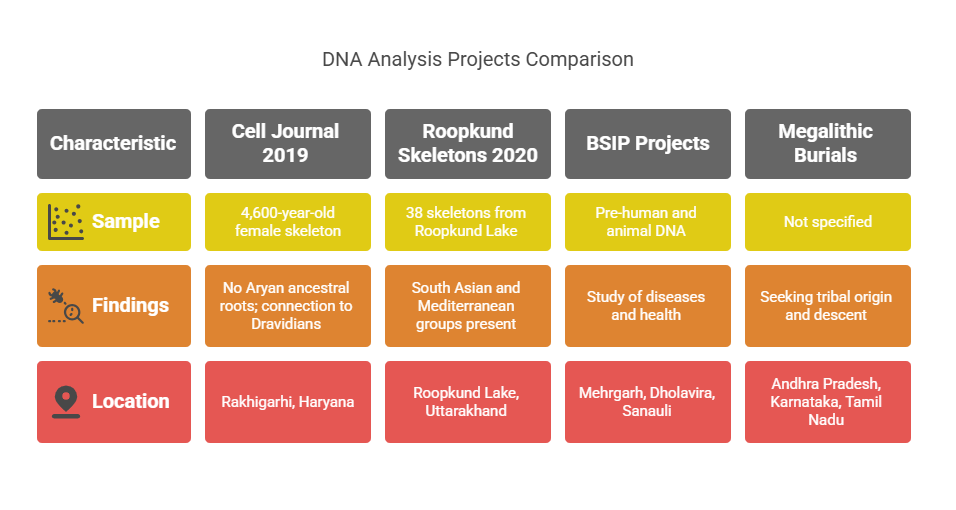
1. Rakhigarhi Study (Indus Valley Civilization)- 2019

  • Journal: Cell (September 2019)

  • Directed by: Deccan College, Pune & Harvard Medical School

  • Sample: 4,600-year-old female skeleton of a person excavated in Rakhigarhi, Haryana

  • Findings:

    • The steppe pastoralists (Aryan) were not the ancestral roots of IVC.

    • The nearest contemporary genetic connection: South Asians, specifically Dravidians and a certain amount of tribal people.

    • Indicates that there must have been a pre-Indo-European continuity genetic contribution in the sub-continent.

2. DNA Analysis of Roopkund Skeletons (2020)

  • Publication date: August 2020 2020, Nature Communications

  • Sample: 38 roopkund lake skeletons, Uttarakhand

  • Findings:

    • There are two genetically different groups:

      • One of the South Asian (800 CE)

      • The other one is a specimen of the eastern Mediterranean (Greek/Crete, c. 1800 CE)

      • The traces of several migration acts or pilgrimages during centuries

3. Projects of BSIP (Birbal Sahni Institute of Palaeosciences)

  • Focus: Prehistoric and protohistoric pre human and animal DNA study Prehistoric, Prehistoric Ancient animal DNA Prehistoric

  • Locations: Mehrgarh, Dholavira, Sanauli and so on

  • Partnerships with ICMR and AIIMS to combine paleogenetics to the study of diseases and health werden

4. Megalithic Burials DNA Analysis

  • Districts: Andhra Pradesh, Karnataka, Tamil Nadu

  • Current work in seeking tribal origin and descent and relationship with Aboriginal first speakers of dravidian

Problems of Ancient DNA Research in India

  • DNA in hot and humid climates decays very fast

  • Historically, poor protocols of excavation preservation

  • Moral and ethical issues of testing human remains

  • Few centers of expertise in aDNA (but this is getting better)

Conclusion

The arranging of the 4,500-year-old archaic Egyptian genome is one of the biggest steps forward in archaeogenetics, which is a rare chance to see inside the roots, routine, and dialogs of the early cultures. It demonstrates the capabilities of scientific preservation methods of extreme climates as well.

Cabinet approves Emergency Credit Line Guarantee Scheme 5.0
Cabinet Approves Increase in Supreme Court Judge Strength to 37
Union Cabinet Approves Mission for Cotton Productivity in India
Vande Mataram Insult to Become Punishable Offence, Cabinet Clears Amendment
UDGAM Portal Update: 30 Banks Integrated to Help Legal Heirs Trace Unclaimed Funds
Malcolm Adiseshiah Award 2026, Raghav Das Gaiha Honoured
07 May 2026
06 May 2026
05 May 2026
04 May 2026
02 May 2026
01 May 2026
30 April 2026
29 April 2026
17 April 2026
16 April 2026

Start Learning Today with Class24

Buy a course

SSC

Railway

Banking

Teaching Exams

Rajasthan Exams

K12 Courses

Class24 Mobile Application

Class24 also has a mobile application so that it becomes easily accessible and convenient. This can be downloaded on an Android device. Users have appreciated this app and the content provided as 4.1 out of 5 is its rating in the App Store. People loved it because Class24 is giving content which is extremely rich in every sense. The app comprises a wide variety of features for smooth learning:

  • User-Friendly Interface: The app is categorized into various sections so that students can navigate and access various resources with ease.
  • Offline Access: The study materials can be downloaded and the student can access them even when not connected to the internet.
  • Inbuilt eBook Reader: There is a lightning-fast reader for eBooks within the app, so reading is seamless.
  • Progress Tracking: The app tracks student’s progress in preparation and keeps them organized and focused.

Courses and Subjects Offered

The total syllabus will be covered, and there are in-depth practice materials so as to give deep preparation in the courses designed to each one of them. All the subjects come under the aegis of courses offered by Class24 to meet different needs of various aspirants such as:

Preparation Tips for All Exams

Preparation tips for all exams mentioned below:

  • Previous Year Papers: Try to attempt at least 5-10 years of question papers to know the pattern of questions, how much difficulty one would face while answering, and how many frequently asked topics were in the examination.
  • Take Mock Tests: Attempt Mock Tests regularly in order to time and accuracy. You may analyze the performance and make an improvement for weak areas.
  • Focus on Time Management: Solve questions in the given time to make a habit of having speed and efficiency. Allocate time sensibly between Paper 1 and Paper 2, while appearing in the examination.
  • Current Affairs: For Current Affairs and TET exams, be updated about current affairs, teaching aptitude, and general awareness.
  • Regular Revision: Spend your daily and weekly time for revisions to not forget concepts and formulas. Use flashcards or do self-summary notes for quick revisions.
  • Understand the Exam Pattern and Syllabus: Understand the pattern of your exam paper and syllabus very well. Both Current Affairs and CSIR NET examinations are two-tier ones and involve both Paper 1, which consists of general aptitude and Paper 2 that involves specific aptitude subjects.
  • Make a Study Plan: Divide the preparation time into three phases of concept building, revision, and mock tests. Allocate more time to weaker areas while maintaining equilibrium with stronger sections.
  • Online Coaching or Study Groups: Enroll in online coaching programs like Class24 to get proper guidance and a structured approach to the study. Study groups will be useful to discuss doubts and share resources.
  • Stay Consistent and Motivated: Maintain a steady study schedule. Stay motivated by making small achievable goals.
  • Use Quality Study Materials: Suggested study material refers to a textbook, a set of previously published question papers, and web sources such as Class24.

Conclusion

Class24 is a one stop solution for aspirants preparing for Current Affairs, CSIR NET, SET, UP PGT English, UP TGT PGT, UPHESC Assistant Professor, TET, IGNOU B.Ed and other competitive exams. There are structured courses, live classes, mock tests along with the guidance of experts to assist candidates in achieving success in their respective fields.

Get success in your hand. Start study anytime anywhere.

The journey becomes simple and enjoyable when you start taking interest in it. And through our app “Class24”, we will be your trusted partners in developing that interest.

Daily Quizzes
Mock Tests
Ongoing

No ongoing tests right now.