

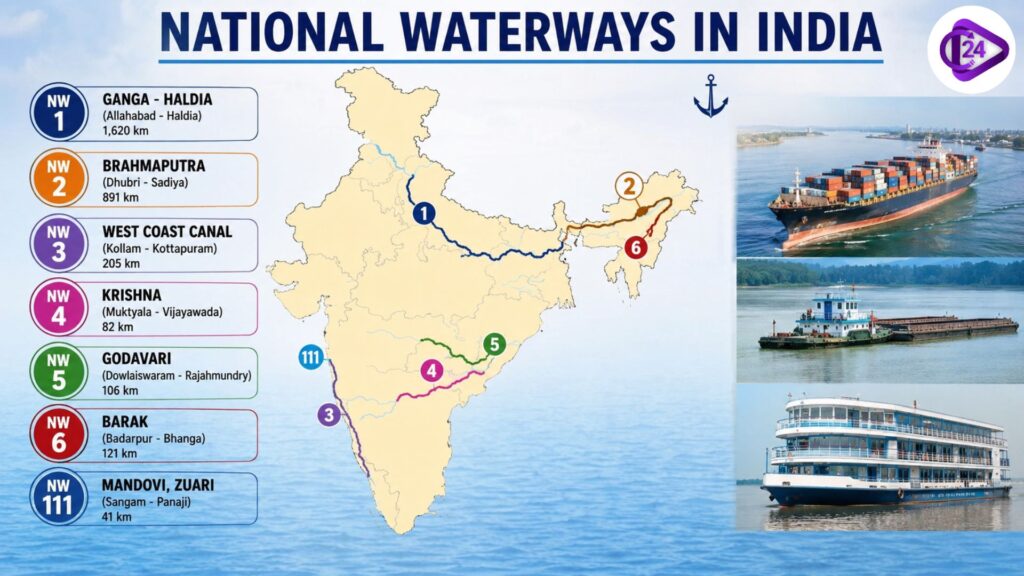
National Waterways of India are defined under the National Waterway Act, 2016 as “all inland waterways which are declared to be national waterways by notifications issued by the Government”. National waterways are created and notified by the Inland Waterways Authority of India (IWAI) as per the provisions of the National Waterway Act, 2016. India has made 111 declared National Waterways, covering more than 20,000 km in the States and Union Territories. Inland waterways are an economic, fuel-efficient, and eco-friendly mode of transportation, making multimodal connectivity easier & economical, with a contribution to regional economic development.
List of Important National Waterways in India
Complete list of National Waterways in India as notified under the National Waterways Act, 2016. Along with the states, river or canal systems and route details for easy reference for all relevant exams, we have provided a table containing all declared National Waterways.
| National Waterway | River/Waterway | Location (States/UTs) | Significance |
| National Waterway 1 (NW-1) | Ganga–Bhagirathi–Hooghly River System | Uttar Pradesh, Bihar, Jharkhand, West Bengal | India’s longest operational National Waterway. Connects major industrial and agricultural regions, supports bulk cargo movement, and forms the backbone of inland water transport under the Jal Marg Vikas Project. |
| National Waterway 2 (NW-2) | Brahmaputra River | Assam | Provides a vital transport corridor for Northeast India, facilitates cross-border trade with Bangladesh, and improves connectivity to remote regions. |
| National Waterway 3 (NW-3) | West Coast Canal, Champakara Canal & Udyogmandal Canal | Kerala | Supports passenger ferries and cargo transport, links ports with industrial hubs, and promotes eco-friendly inland navigation. |
| National Waterway 4 (NW-4) | Kakinada–Puducherry Canal System, Godavari & Krishna Rivers | Andhra Pradesh, Tamil Nadu, Puducherry | Enhances coastal and inland connectivity, supports agriculture and industries, and integrates ports with the hinterland. |
| National Waterway 5 (NW-5) | East Coast Canal, Brahmani River & Mahanadi Delta | Odisha, West Bengal | Facilitates transportation of coal, iron ore, fertilizers, and industrial goods while improving port connectivity. |
| National Waterway 16 (NW-16) | Barak River | Assam | Improves connectivity in southern Assam and strengthens trade and passenger transport in the Barak Valley. |
| National Waterway 68 (NW-68) | Mandovi River | Goa | Supports tourism, mining-related cargo movement, and inland water transport within Goa. |
| National Waterway 73 (NW-73) | Narmada River | Gujarat | Has the potential to improve regional connectivity, cargo transportation, and economic development in western India. |
| National Waterway 86 (NW-86) | Tapi River | Gujarat | Supports industrial and agricultural freight movement and offers scope for sustainable inland navigation. |
| National Waterway 97 (NW-97) | Sunderbans Waterways | West Bengal | Strengthens transport in the Sundarbans region, boosts tourism, and enhances connectivity to remote island communities. |
Significance of National Waterways in India
- Affordable transportation: Inland waterways are one of the cheapest ways to transport goods, which helps in reducing costs of logistics for industrialists and businesses.
- Water transport is comparatively energy efficient as it uses less fuel per tonne-kilometre than road and rail.
- Eco-friendly: National Waterways emits less carbon and contributes to the sustainable and green transportation initiatives of India.
- Decongest roads and railways: Its assist to move bulk cargo, considerably lightens the pressure on street traffic, reduces the cost of road renovation works, moreover lifting strain on railway networks;
- Enhances multimodal connectivity: All the Waterways flow directly into Ports, Highways, Railway stations and Logistics Parks as envisioned in the PM Gati Shakti National Master Plan.
- Boosts regional trade: Capable of inland movement of commodities like coal, cement and food grains.
- Promotes regional development: National Waterways enhance connectivity in distant and deprived regions, which leads to livelihood generation and balanced economic development.
- Increases Port-Led Development: By enhancing hinterland connectivity to major ports, inland waterways contribute towards the vision of Maritime India Vision 2030 and port-led industrialisation.
- Boosting tourism: Water tourism generates new incomes for local economies and hospitality accommodation through river cruises, ferry services and so on.
- Improves disaster resilience: Waterways can be used as a supply network in flooding, road closures and other emergencies.
What is the National Waterways Act, 2016?
The National Waterways Act, 2016 is a historic legislation passed by the Government of India for development and regulation of inland water transport in the country. The Act was enforced on 12 April 2016, repealing five of its predecessors and converting an additional 106 waterways into National Waterways in addition to the existing first five National Waterways, making a total of 111. The Act provides a legal framework for the development, maintenance and regulation of inland waterways as well as those specified in the Dictionary Part to be a National Waterway by the Inland Waterways Authority of India (IWAI), which is set up under the Ministry of Ports, Shipping and Waterways.
Important Provisions of National Waterways Act, 2016
- Pending keeps declare 111 inland waterways in India as National Waterways
- This repealed the five separate Acts that previously declared National Waterways 1–5.
- It authorises the Inland Waterways Authority of India (IWAI) to develop, maintain and regulate National Waterways.
- To cultivate Safe, Efficient, economical, and Environmentally Sustainable development of the Inland Water Transport
- Enables multimodal logistics, facilitating smooth flow of cargo as well as enhanced connectivity to ports, industries and hinterland.
- Legal basis for infrastructural developments related to navigation channels, terminals, jetties, river information systems and navigational aids
- Seeks to reduce logistics costs, boost freight efficiency and regional economic development through inland waterways
Major Government Schemes for National Waterways in India
| Scheme/Initiative | Launch Year | Ministry/Implementing Agency | Objective | Key Highlights |
| Jalvahak Scheme | 2024 | Ministry of Ports, Shipping and Waterways (MoPSW) & Inland Waterways Authority of India (IWAI) | Promote cargo movement through inland waterways | Provides financial incentives to shift cargo from road and rail to National Waterways, reducing logistics costs and carbon emissions. |
| Jal Marg Vikas Project (JMVP) | 2018 | MoPSW, IWAI & World Bank | Develop National Waterway-1 | Focuses on fairway development, multimodal terminals, navigation locks, and River Information System on the Ganga waterway. |
| Harit Nauka Guidelines | 2024 | Ministry of Ports, Shipping and Waterways | Promote green inland vessels | Encourages electric, hybrid, hydrogen, and other low-emission vessels to support sustainable inland navigation. |
| River Cruise Tourism Roadmap 2047 | 2023 | Ministry of Ports, Shipping and Waterways, IWAI, and State Governments | Promote river cruise tourism | Targets significant growth in river cruise routes, terminals, and tourism infrastructure across National Waterways by 2047. |
| National Waterways Development Programme (NWDP) | 2016 (ongoing) | Inland Waterways Authority of India (IWAI) | Develop National Waterways infrastructure | Focuses on fairways, terminals, jetties, navigation aids, and night navigation facilities across operational waterways. |
| PM Gati Shakti National Master Plan | 2021 | Government of India | Integrates multimodal transport | Connects National Waterways with highways, railways, ports, airports, and logistics parks for seamless cargo movement. |
| Sagarmala Programme | 2015 | Ministry of Ports, Shipping and Waterways | Port-led development | Enhances port connectivity through coastal shipping and inland waterways while reducing logistics costs. |
| Digital Portal (CAR-D Portal) | 2023 | Inland Waterways Authority of India (IWAI) | Digitise inland waterway services | Enables online approvals, vessel registration, and regulatory clearances for inland vessel operators. |