

Daily Quizzes
Mock Tests
No tests attempted yet.
Select Category
Black Hole Becomes Active After 100 Million Years, Scientists Observe
Overview:
Astronomers have observed a rare cosmic event where a dormant black hole became active after nearly 100 million years. The supermassive black hole released massive jets of energy, resembling a “cosmic volcano.” This discovery provides new insights into black hole life cycles and galaxy evolution.
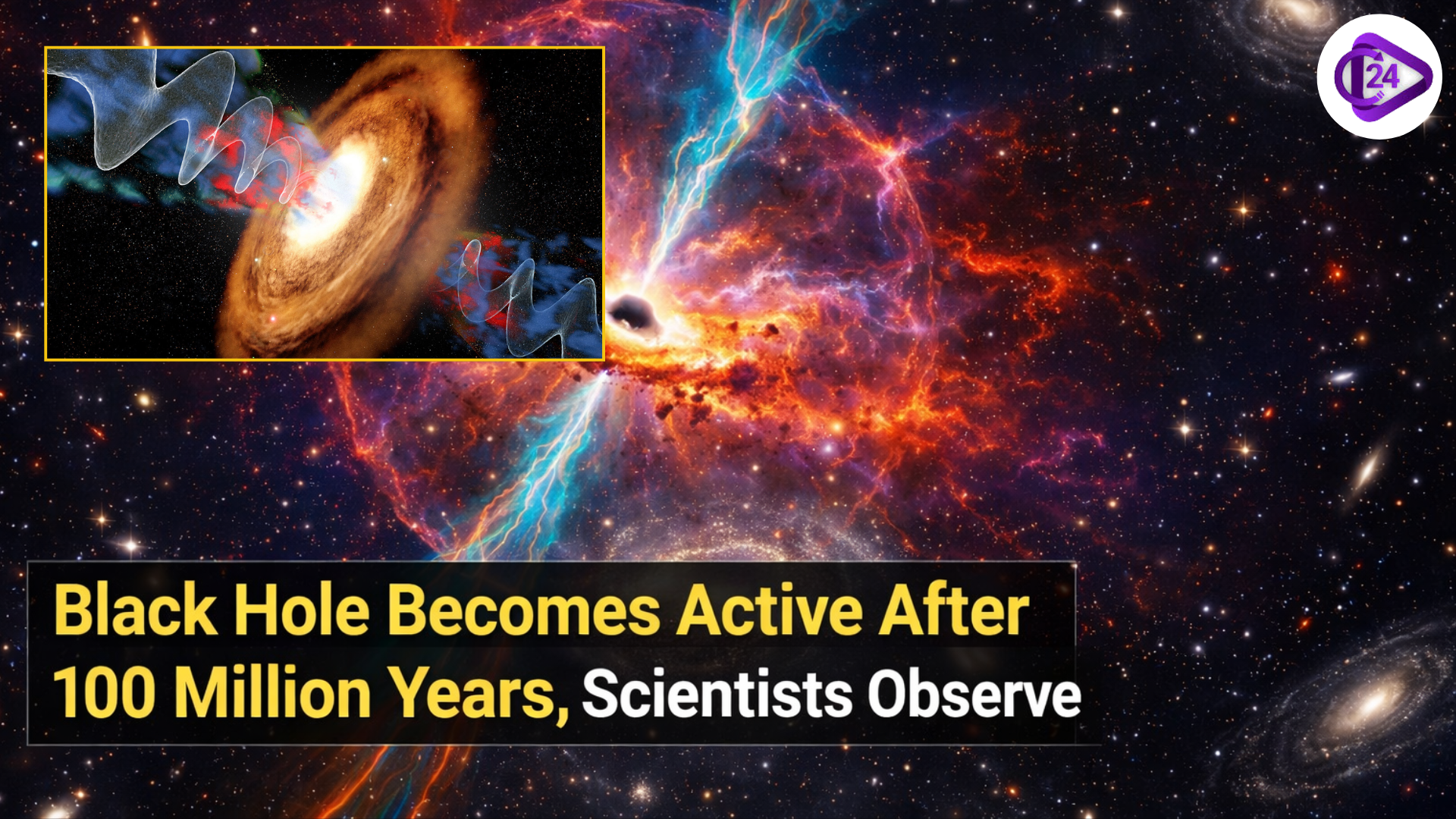
Researchers have witnessed a rare occurrence in the cosmos when a dormant black hole became active after almost 100 million years. This supermassive black hole is at the core of a remote galaxy, and it began to work again, releasing the strong jets of energy and plasma. This discovery was observed with the help of sophisticated radio telescopes by astronomers, and it was found that black holes can alternate between dormant and active over time. The occurrence has been likened to a cosmic volcano that emits colossal radiation into space. This discovery is important in understanding the life cycle of black holes and their effect on galaxies.
Black Hole Reactivation After 100 Million Years: Key Facts and Scientific Insights
-
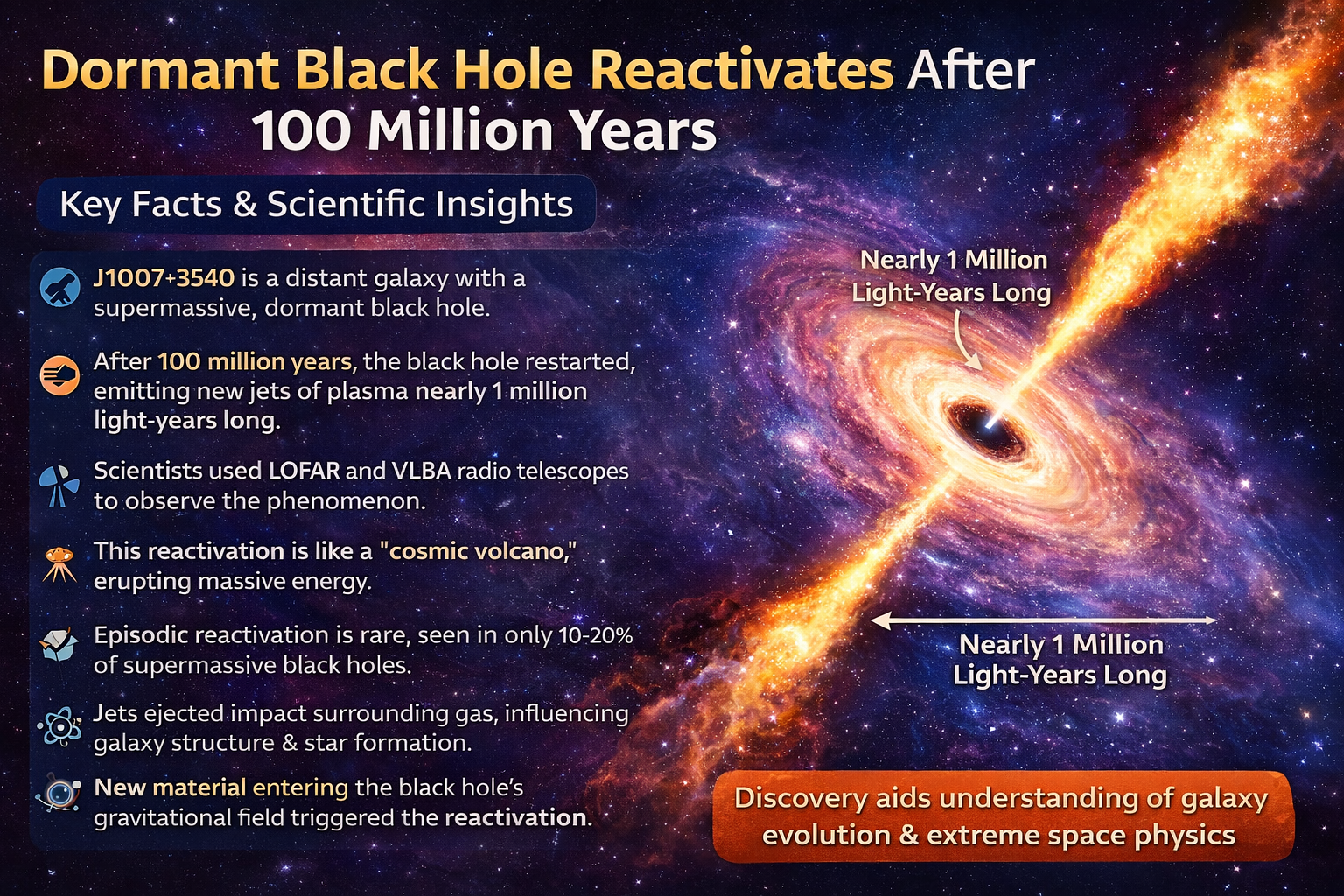
The identified black hole took almost 100 million years to reactivate itself.
-
Scientists have spotted new jet emissions, which means that the black hole has restarted devouring matter around it.
-
This reactivation was in a distant galaxy called J1007+3540, which has a supermassive black hole in the centre.
-
The phenomenon is referred to as a cosmic volcano since it emits colossal energy just like an eruption.
-
It was observed with the help of the most sophisticated devices, such as the Low Frequency Array (LOFAR) and radio telescopes.
-
The black hole produced jets of plasma that were almost one million light-years long.
-
This is included in the so-called episodic activity, when black holes switch on and off on long cosmic time scales.
-
Such episodic behaviour is rare and only observed in about 10–20% of supermassive black holes.
-
The jets react with gas around them, influencing the structure of galaxies and the process of star formation.
-
Scientists think that the reactivation occurred due to the entrance of new material into the gravitational field of the black hole.
-
The discovery aids researchers in comprehending galaxy evolution and extreme space physics.
-
It also contradicts the previous assumptions that dormant black holes do not become active at any time.
Conclusion – Black Hole Re-Activation
The black hole, which had been dormant for almost 100 million years, points to the dynamism and vagaries of the universe. These rare events give useful information on the evolution of black holes, their interactions with the matter around them and their effects on galaxy formation. It is observed that black holes can switch between dormant and active states under the influence of the presence of gas and stellar material. This finding reinforces our knowledge of extreme gravity, energy emissions, and cosmic evolution. It also refutes previous conjectures that once black holes become inactive, they stay in the same state indefinitely, paving new avenues of study in the field of astrophysics and space exploration.
Related Current Affairs
 Google AI Data Centre Foundation in Visakhapatnam by Ashwini Vaishnaw and AP CM
 Skyroot Aerospace Prepares Vikram-1 for India’s First Private Orbital Launch
 Finland Builds World’s First Permanent Nuclear Waste Vault
 Odisha to Set Up India’s First Advanced 3D Chip Packaging Unit in 2026
 India Achieves 1,000-km Quantum Communication Breakthrough
 Government Notifies India’s First Chip Fab Plant at Dholera SEZ in Gujarat
- Black Hole Becomes Active After 100 Million Years, Scientists Observe
 India’s First Quantum Computer to Launch in Andhra Pradesh
 Meta Launches Muse Spark AI Model
 ISRO Launches Mission MITRA: Big Boost to Astronaut Safety in Space Missions