

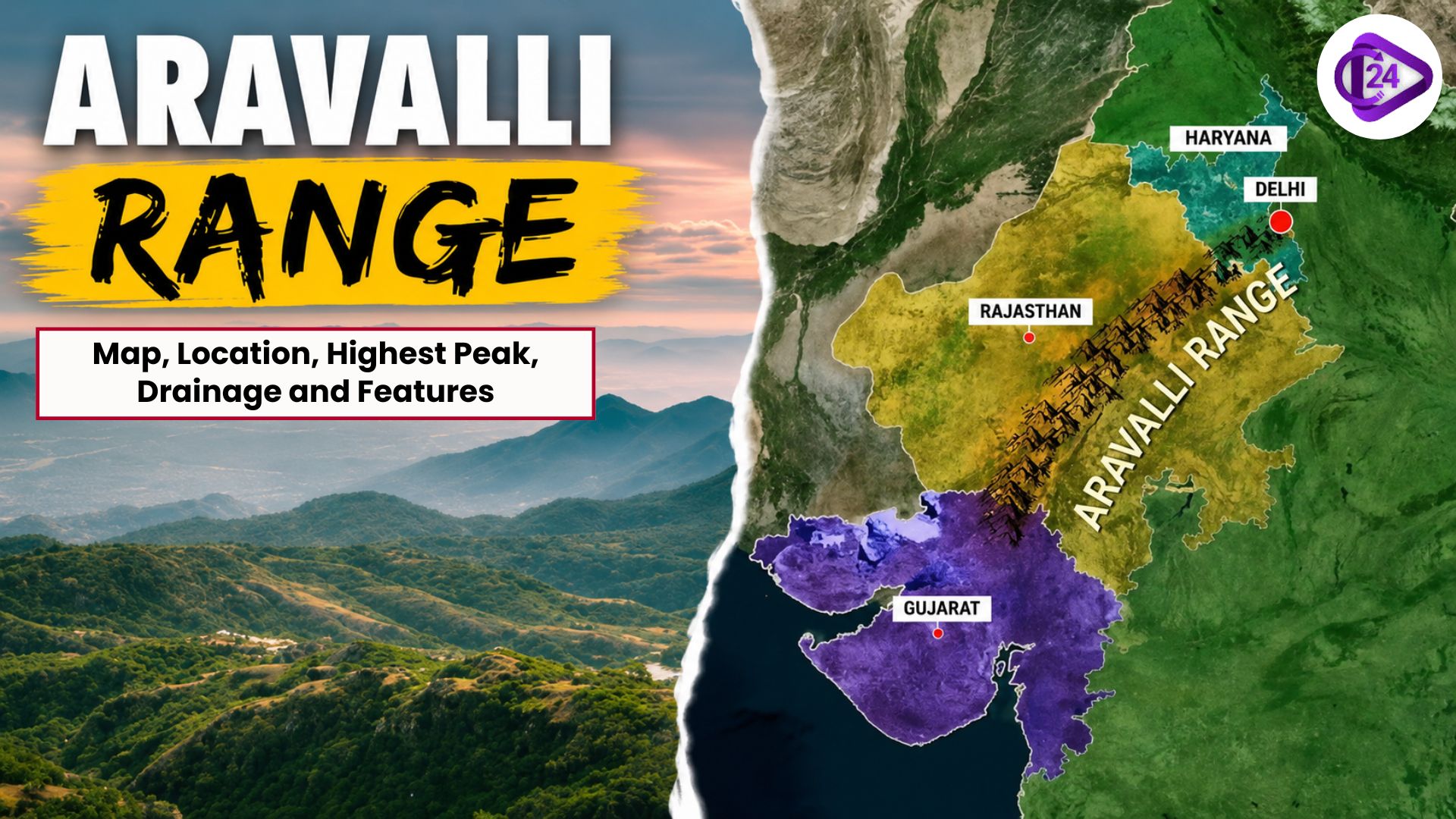
The Aravalli Range is one of the oldest fold mountain ranges in the world and India’s oldest mountain range in India. and India’s oldest mountain range, with rocks dating back to the transformation period that took place near the Geozone and North India during the coming together of continents (Archaean–Proterozoic era). Running southwest–northeast for about 670 km from Palanpur (Gujarat) in the western state, it crosses Rajasthan and Haryana and reaches Delhi.
The Aravalli Range acts as a barrier separating the deserts of Thar to its south and the fertile plains of northwestern India. Moreover, it is abundant in minerals, forests and wildlife, and water resources; as well as being essential to combat desertification, recharge groundwater levels, store biodiversity and regulate the climate. The highest peak in the range is Guru Shikhar (1,722 m) near Mount Abu, Rajasthan.
Aravalli Range: Location
- The Aravalli Range is the oldest fold mountain of India and one of the oldest in the world.
- It runs southwest to northeast over a 670 km length.
- It extends from south-west of Palanpur in the state of Gujarat through Rajasthan, to Haryana, and finally ends at the Delhi Ridge in the National Capital Territory of Delhi.
- Rajasthan has the largest share (nearly 80%) of the Aravalli Range.
- The Aravalli Range serves as a natural barrier between the desert region of Thar to the west and the fertile level grounds of eastern Rajasthan and the Indo-Gangetic Plain in western India.
- It is located at a latitude of approximately 24°N–28°N and a longitude of 72°E–77°E.
- The range represents an essential geographical barrier that affects the climate and runoff of northwestern India.
Aravalli Range: Formation
- Aravalli Range – One of the oldest fold mountain ranges in the world, formed during the Precambrian Era.
- Geological Research suggests that it is around 1.8–2.5 billion years old
- The range is crumbling, formed by ancient tectonic movements and continent-clashing that led to its creation.
- It has undergone weathering and erosion over a period of millions of years, resulting in hills that are rounded and the mountains that remain are residual.
- The Aravalli Range is primarily made of meta-sedimentary rocks and igneous rocks; other geological formations in the region include gneiss, schist, quartzite, marble, as well as granite and phyllite.
- It has some of the richest deposits of metallic and non-metallic minerals in India.
Aravalli Range: Highest Peak
- Guru Shikhar: The highest peak of the Aravalli Range
- Height: 1722m (5650 feet) above sea level.
- Positioned in the Mount Abu Hills of Sirohi district, Rajasthan
- Guru Shikhar is additionally the most noteworthy point in Rajasthan.
- The highest peak has the Guru Dattatreya Temple, visited as a pilgrimage site.
- The Mount Abu Observatory of the Physical Research Laboratory (PRL) is located here as well.
Aravalli Range: Drainage System
-
- The Aravalli Range is a crucial watershed of northwestern India.
- A system of west-flowing rivers east of the Aravallis drains into the Yamuna–Ganga river system.
- The rivers that flow west of the Aravallis run into the Thar Desert and the Rann of Kutch.
- It refers to the following major rivers originating from or associated with the Aravalli Range:
- Banas River
- Luni River
- Sabarmati River
- Sahibi (Sabi) River
- Sota River
- Significance of Aravallis: The range is crucial for groundwater recharge, soil conservation and water availability in Rajasthan and the neighbourhood.
Aravalli Range: Physical Features
- The range stretches for about 670 km, starting from Gujarat all the way to Delhi.
- The oldest fold mountain range in the world
- Marking of non-continuous hill features, steep rocky ridges and
- Average altitude 300–900 meters.
- Guru Shikhar(1,722 m) Highest point
- It is abundant in granite, marble, quartzite, limestone and copper, zinc and lead-bearing mica.
- To the east, it naturally shields the advance of the Thar Desert.
- The range supports dry deciduous forests, thorn forests, and scrub vegetation.
Aravalli Range: Biodiversity
-
- Suit tropical dry deciduous forests and thorn forests, with scrubs.
- It provides habitat to several key wildlife species:
- Leopard
- Sloth Bear
- Striped Hyena
- Indian Wolf
- Nilgai
- Sambar Deer
- Chinkara
-
- Rich in bird species including:
- Indian Peafowl
- Grey Francolin
- Indian Eagle-Owl
- Vultures
- Important protected areas include:
- Sariska Tiger Reserve
- Ranthambore Tiger Reserve (a zone of eastern influence of Aravalli)
- Mount Abu Wildlife Sanctuary
- Kumbhalgarh Wildlife Sanctuary
- Jaisamand Wildlife Sanctuary
Aravalli Range: Challenges
- Illegal Mining: Illegal and unscientific mining of marble, granite, quartz and other minerals has led to degradation of land, habitat loss and imbalance in ecology.
- Deforestation: Massive clearing of forest for agricultural, urban, and infrastructure projects has diminished forest cover and biodiversity.
- Urbanisation: Cities like Delhi, Gurugram, Faridabad, Jaipur and Udaipur are witnessing rapid urban expansion, putting a lot of pressure on the Aravalli ecosystem through construction and land-use change.
- Forest Land Encroachment: Unlawful invasion of forest land for housing, business and industrialisation has resulted in fragmentation of wildlife habitats.
- Decline in Biodiversity: Many species have been threatened with losing their habitat, like leopards, striped hyenas, sloth bears and many birds.
- Excessive extraction of groundwater with degradation of natural recharge zones has lowered the level of groundwater in many parts of the Aravalli region.
- Soil Erosion and Land Degradation: Deforestation along with mining has worsened soil erosion, making lands lose productivity and further causing desertification.
- Desertification: The Aravalli Range can sustain only limited dry periods, and further degradation of the range weakens its natural barrier function, which ensures that the Thar Desert does not move eastwards.
- Forest Fires: Recurrent forest fires, largely within the dry season periods, destroy vegetation, wildlife habitats and soil quality.
- Climate Change: Rising temperatures, erratic rainfall, and prolonged droughts are increasing ecological stress on the Aravalli ecosystem.
- Pollution: Mining, industrial activities, construction dust, and improper waste disposal contribute to air, water, and soil pollution.
- Human–Wildlife Conflict: Shrinking forests and fragmentation of habitats have resulted in increased interactions between wildlife and humans living in proximity.
- Weak Environmental Laws Enforcement: Despite many of the real issues being legally protected or under the direction of a court in some way, weak monitoring and enforcement often lead to illegal mining and encroachment over land reserved for these purposes.
Aravalli Range: Supreme Court Guidelines
The Supreme Court of India has issued several directions to protect the Aravalli Range from illegal mining, deforestation, and environmental degradation. The Court has stressed that the Aravallis are an important ecological feature and need to be protected to maintain environmental equilibrium.
Important Supreme Court Directions Regarding the Aravalli Range
- Strict ban on illegal mining in Aravalli Range to safeguard ecology.
- Closure of mines operating without proper environmental and forest clearances in an orderly manner.
- Directs State Governments to demarcate and preserve forest land in Aravalli areas.
- It said no developmental activity would be permitted without complying with the Forest (Conservation) Act, 1980 and the Environment (Protection) Act, 1986.
- Ordered authorities to take steps to stop encroachments, unauthorised construction and changes in land use in ecologically sensitive areas.
- That called for mass afforestation and ecological restoration of degraded Aravalli landscapes.
- Ordered continuous surveillance of mining operations by environmental regulators and state bodies.
- Directed the governments to prepare scientific management and conservation plans for the Aravalli ecosystem.
- Emphasised wildlife protection ranges and biodiversity and groundwater recharge zones inside the Aravalli Range.
- Restated and emphasised the return of the Precautionary Principle and the Public Trust Doctrine: Natural resources are to be entrusted for protection on behalf of current and future generations, respectively.