


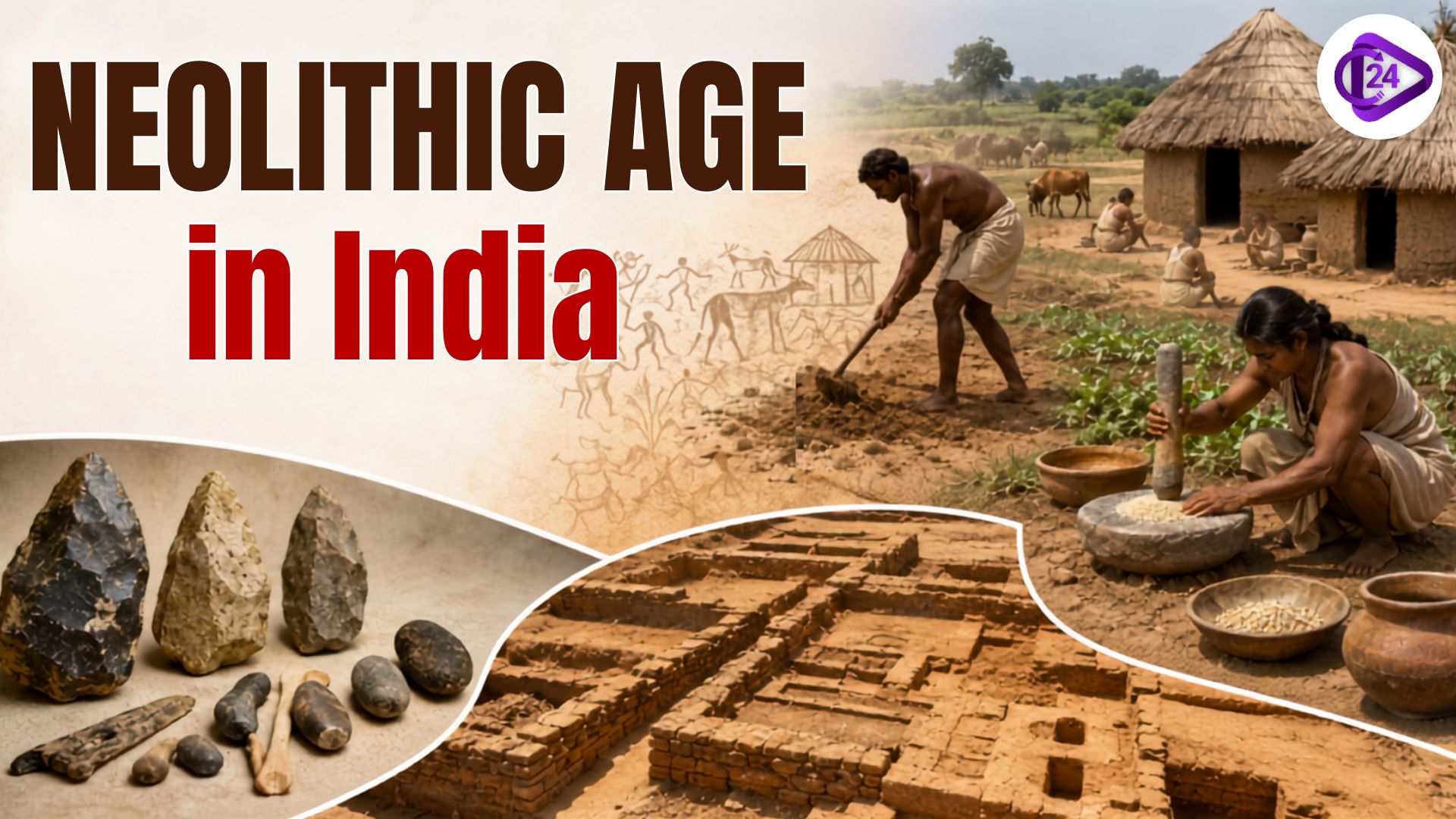
Neolithic Age: The Indian Neolithic is the postgraduate of the New Stone Age, as we now know from habitation in India until a giant swath of civilization was done by this time, broken habits like hunters-gatherer tourism to settled cultured and domesticated for agricultural aridization and gatherings.
The period is usually dated broadly from c. 7000 BCE to between 2000 BCE and 10000 BCE, but its beginning varied widely according to region– a phenomenon the Archaeological Survey of India refers to as a status quo definition. In the Neolithic period, polished stone tools appeared, more permanent villages became established, pottery and weaving started to develop, and food production was made possible. With agriculture and the raising of livestock, communities became more settled prospering; even complex social organisation emerged. Neolithic settlement sites like Mehrgarh, Burzahom, Koldihwa, Chirand and Hallur testify to this vital step in the pre-history of India.
The Earliest Phase of the Prehistoric Period: Palaeolithic Age
- The Palaeolithic Age (Old Stone Age) in India is the first and greatest human prehistory phase.
- It started approximately 2 million years ago, ending around 10,000 BCE as per the Archaeological Survey of India.
- Humans got by from hunting, fishing and foraging for wild plants.
- Their tools were rough, unrefined stone implements (handaxes, cleavers, choppers and flakes).
- Early humans lived in caves, rock shelters and temporary camps, making frequent movements to find food.
- The mastery of fire in the later phases broadened cooking, warmth and security.
- Significant sites in India include Bhimbetka, Hunsgi, Attirampakkam, Isampur, Didwana and Belan Valley.
- The Palaeolithic Age, in turn, prepared the ground for the technological and cultural advancements represented by the Mesolithic and Neolithic periods.
Neolithic Lifestyle and Cultural Developments
The transition from a hunter-gatherer lifestyle to agriculture and village life also occurred during this time period in what is termed the Neolithic Age, which essentially forever changed human history. During this period, plants and animals were domesticated, polished stone tools were used, permanent houses were built, pottery developed, and organised communities grew (ASI 2000). These developments helped to establish the foundations for later civilisations of the Indian subcontinent.
Agriculture and Animal Domestication
Agriculture is often referred to as the Neolithic Revolution because it provided a paradigm shift in human behaviour in which humans transitioned from being food gatherers to food producers. During the Neolithic period, crops like rice, wheat, barley, ragi (finger millet), horse gram and cotton were cultivated, while herding of cattle, sheep, goats and dogs was prevalent. Farming guaranteed enough food production, which also promoted permanent settlements and led to population expansion.
Tools, Pottery and Housing
The Neolithic people relied on much more efficient polished stone axes (celts), adzes, chisels, grinding stones, and bone tools than were generally used in the Palaeolithic Age. Agriculture required the storage of surplus grain which led to an explosion in the use of pottery for storage (and cooking and transport of water) — New, permanent homes began to be built from mud, reeds, timber and using mud bricks as a foundation compared to these new temporary houses. At Mehargarh, people had mud-brick houses, and Burzahom in Kashmir is famous for its unique pit habitations.
Community Life and Social Organisation
During the Neolithic Age, it was a time when you had more permanent village communities and a much more functional social structure. The ability to produce surplus food promoted cooperation and the combination of different crafts and goods exchanges. This was the time of farming, animal husbandry, pottery, weaving and tool-making, and community life became fixed and structured. Megalithic traditions also appeared in some areas during this time, indicating the changing sociocultural and ritual practices that later cultures were affected by.
The Neolithic Age Culture in India
Neolithic culture in India reflects another significant connection that leads to a transformative period of human advancement, characterised by the commencement of agriculture, construction of permanent dwellings, polished stone tools, pottery and herding domesticated animals. These cultural achievements provided a basis for organised village life and subsequent civilisations, as noted by the Archaeological Survey of India.
Neolithic Sites and Features
| Neolithic Site | Present State/UT | Key Features / Significance |
| Mehrgarh | Balochistan (Pakistan) | One of the earliest farming settlements in South Asia; mud-brick houses, wheat and barley cultivation, cattle domestication, and pottery. |
| Burzahom | Jammu & Kashmir | Famous for pit dwellings, stone and bone tools, dog burials, and evidence of hunting and farming. |
| Gufkral | Jammu & Kashmir | Pit houses, polished stone tools, domesticated animals, and early agricultural practices. |
| Koldihwa | Uttar Pradesh | Provides some of the earliest evidence of rice cultivation in India along with polished stone tools. |
| Mahagara | Uttar Pradesh | Evidence of cattle domestication, agriculture, and permanent village settlements. |
| Chirand | Bihar | Known for polished stone tools, bone implements, pottery, and mixed farming economy. |
| Daojali Hading | Assam | Rich in polished stone celts, cord-impressed pottery, and links with Southeast Asian Neolithic cultures. |
| Hallur | Karnataka | Evidence of millet cultivation, domesticated cattle, polished stone tools, and copper objects in later levels. |
| Maski | Karnataka | Neolithic settlement with polished stone axes, farming, and animal husbandry. |
| Piklihal | Karnataka | Important pastoral settlement with evidence of cattle rearing and circular huts. |
| Brahmagiri | Karnataka | Neolithic-cum-Megalithic site with polished stone tools, pottery, and farming evidence. |
| Utnur | Telangana | Known for cattle pens, pastoral economy, polished stone tools, and ash mounds. |
| Paiyampalli | Tamil Nadu | Evidence of agriculture, polished stone tools, pottery, and early iron use in later phases. |
Also Read
Social Organisation, Rituals and Beliefs
- The Neolithic communities resided in fixed villages based on familial and ancestral organisation.
- Agriculture and herding led to cooperation and task specialisation.
- Communal Elders likely had a lot to do with decision-making within the community.
- The burial practice, where graves frequently house vessels, tools, and ornaments, implies the belief in life after death.
- At Burzahom, however, there has been evidence of burial of both humans and other animals.
- Health, reproduction and ancestral propitiation seem to have been a part of their religious life.
- Clay figures and ritualised articles point to the fact that mother-goddess or fertility worship was taking place.
- The collective rituals and beliefs helped bind people together, a source of unity in Neolithic culture.