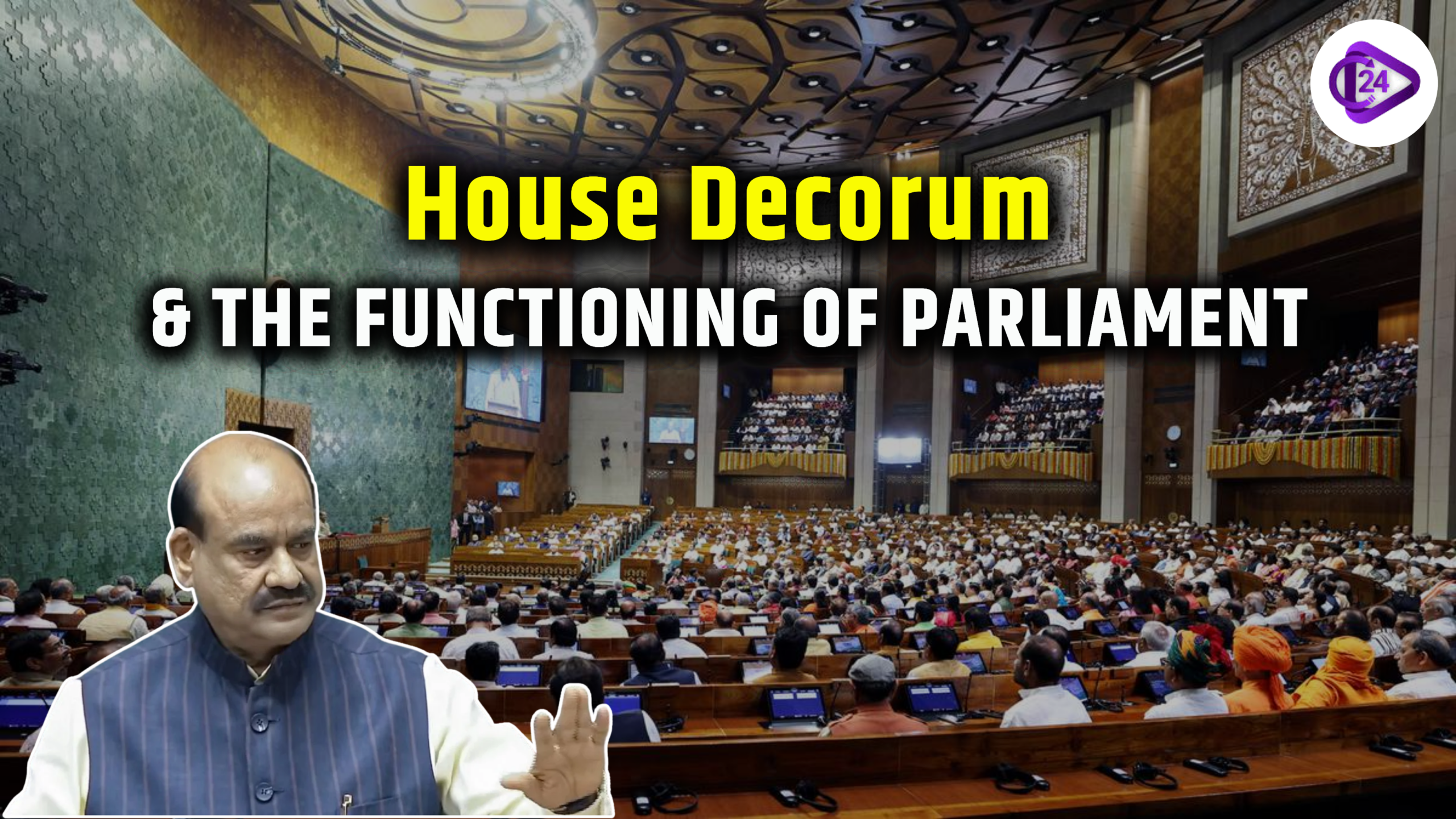
House Decorum and the Functioning of Parliament: Why Discipline in Legislatures Matters
Parliament is the central institution of India’s representative democracy, where elected representatives deliberate on policies, enact laws, and hold the executive accountable. The smooth functioning of the legislature depends not only on constitutional provisions and procedural rules but also on the conduct and discipline of its members. In recent years, however, concerns about declining House decorum, frequent disruptions, and reduced legislative productivity have sparked debate about the health of parliamentary democracy. Maintaining decorum in Parliament is essential for ensuring effective deliberation, safeguarding democratic values, and preserving public confidence in political institutions. As India’s political landscape becomes increasingly competitive, restoring parliamentary discipline has become a pressing institutional and democratic priority.
What is Parliamentary Decorum?
Parliamentary decorum refers to the set of rules, conventions, ethical standards, and behavioural norms that guide the conduct of members of Parliament (MPs) during legislative proceedings. These norms ensure orderly debates, mutual respect among members, and adherence to parliamentary procedures.
In India, decorum within the legislature is governed by:
- The Constitution of India
- Rules of Procedure and Conduct of Business of each House
- Parliamentary conventions and precedents
- Directions issued by the presiding officers
Members are expected to follow certain principles, such as:
- Speaking only when recognised by the presiding officer
- Avoiding personal allegations and unparliamentary language
- Respecting the authority of the Chair
- Not entering the well of the House or disrupting proceedings
Structure of the Indian Parliament
The Parliament of India consists of three components:
- The President of India
- The Lok Sabha (House of the People)
- The Rajya Sabha (Council of States)
Lok Sabha
The Lok Sabha is the directly elected lower house of Parliament.
Key features include:
- Maximum strength of 552 members
- Current strength: 543 elected members
- Represents the people through direct elections
- Normal tenure of five years unless dissolved earlier
The Lok Sabha plays a dominant role in financial matters, including the passage of money bills.
Rajya Sabha
The Rajya Sabha is the upper house representing the states of the Indian Union.
Important features include:
- Maximum strength: 250 members
- 238 elected members from states and Union Territories
- 12 nominated members by the President for contributions in art, literature, science, and social service
- Permanent body with one-third of its members retiring every two years
The Rajya Sabha acts as a revising chamber and safeguards federal interests.
Key Functions of Parliament
Parliament performs several vital functions that are essential for democratic governance.
- Legislative Function
The primary function of Parliament is to make laws. Bills introduced in either house undergo a process of discussion, scrutiny, and approval before becoming law.
Legislation may be categorised into:
- Ordinary Bills
- Money Bills
- Constitutional Amendment Bills
- Financial Bills
- Debate and scrutiny are essential for improving the quality of legislation.
- Executive Accountability
Parliament holds the executive accountable through several mechanisms, such as:
- Question Hour
- Zero Hour
- Motions and resolutions
- Parliamentary committees
- Ministers are collectively responsible to the Lok Sabha under Article 75 of the Constitution.
- Financial Control
- Parliament exercises control over public finances through:
- Annual Budget approval
- Discussion of demands for grants
- Passing of appropriation bills
- Without parliamentary approval, the government cannot withdraw money from the Consolidated Fund of India.
- Representation
Members of Parliament represent the interests of their constituencies and regions. Parliamentary debates allow diverse viewpoints to be expressed in national policymaking.
Declining Parliamentary Productivity
Despite its central role, the functioning of Parliament has been affected by several challenges in recent years.
Frequent Disruptions
Legislative sessions have often witnessed disruptions caused by:
- Political protests
- Slogan shouting
- Walkouts
- Members entering the well of the House
These disruptions lead to frequent adjournments and reduce the time available for legislative work.
Reduced Debate on Bills
Several important bills have been passed with limited debate due to disruptions or tight legislative schedules. This reduces the opportunity for detailed scrutiny.
Shorter Parliamentary Sessions
India’s Parliament sits for fewer days compared to many other democracies. Reduced sitting days further limits the time available for meaningful debate.
Political Polarization
Increasing political competition and ideological differences have intensified confrontational politics within Parliament.
Role of the Presiding Officers
Presiding officers play a crucial role in maintaining parliamentary discipline.
Speaker of the Lok Sabha
The Speaker is responsible for:
- Conducting proceedings of the House
- Maintaining order and decorum
- Interpreting parliamentary rules
- Deciding on disqualification under the anti-defection law
The Speaker can suspend members for misconduct under the Rules of Procedure.
Chairman of the Rajya Sabha
The Vice President of India serves as the Chairman of the Rajya Sabha and performs similar responsibilities in the upper house.
Both presiding officers are expected to act impartially and ensure the smooth functioning of the House.
Parliamentary Committees: Strengthening Deliberation
Parliamentary committees are often described as the mini-Parliaments of the legislative system.
These committees perform detailed examinations of bills, budgets, and policy issues.
Major committees include:
- Public Accounts Committee
- Estimates Committee
- Committee on Public Undertakings
- Department-related Standing Committees
Committees enable detailed scrutiny and allow experts to contribute to policymaking.
Encouraging greater use of committee scrutiny can significantly improve legislative quality.
Global Comparisons
Many parliamentary democracies have mechanisms to ensure disciplined legislative conduct.
For example:
- In the United Kingdom, strict enforcement of parliamentary rules prevents members from disrupting proceedings.
- In Canada and Australia, presiding officers have the strong authority to suspend members for disorderly behaviour.
- Several countries rely extensively on committee systems to ensure detailed legislative examination.
- Learning from international best practices can help improve parliamentary functioning in India.
Importance of Constructive Opposition
A healthy democracy requires both an effective government and a responsible opposition.
The opposition plays a vital role by:
- Questioning government policies
- Highlighting policy failures
- Representing alternative viewpoints
However, opposition strategies should rely on debate and parliamentary tools rather than persistent disruptions.
Conclusion – House Decorum and the Functioning of Parliament
Parliament is the heart of India’s democratic framework, responsible for lawmaking, executive accountability, and representation of citizens’ interests. However, its effectiveness depends on the conduct and discipline of its members. Declining House decorum and frequent disruptions have raised serious concerns about legislative productivity and democratic functioning. Restoring parliamentary discipline requires collective responsibility from political parties, presiding officers, and legislators. Strengthening committee systems, enforcing procedural rules, and promoting constructive dialogue can help revitalise parliamentary functioning. Ultimately, preserving decorum within Parliament is essential not only for efficient governance but also for maintaining the integrity and credibility of India’s democratic institutions.