
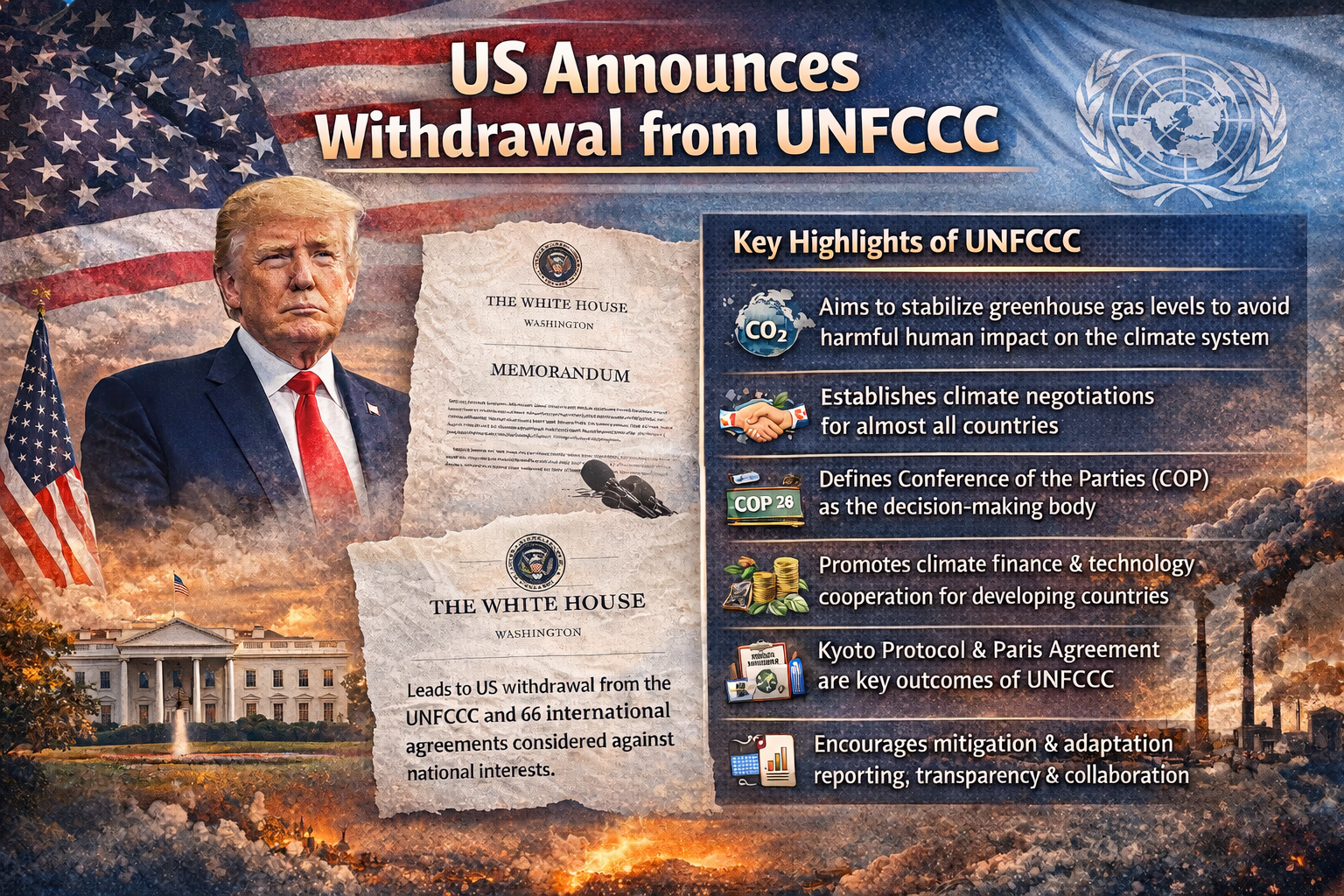
President Donald Trump announced that the United States would officially withdraw from the United Nations Framework Convention on Climate Change (UNFCCC), a foundational global climate treaty upon which key agreements on greenhouse gas reduction and international climate action are based. This ruling was proclaimed in a White House memorandum, which instructed the withdrawal from 66 international organisations and treaties considered against U.S. interests, among them the major climate bodies, the UNFCCC and the Intergovernmental Panel on Climate Change. The step, as part of a broader withdrawal from multilateralism, has increased America's pullback from global climate collaboration and has become an international issue of widespread anxiety.
Key Highlights of UNFCCC
-
The UNFCCC is an international document committed to the stabilisation of the level of greenhouse gases to ensure that the climate system is not put at risk due to the harmful intervention of human beings.
-
It establishes a precedent of climate negotiations and activities of almost all countries of the world.
-
It also defined the Conference of the Parties (COP) as the decision-making institution in which the climate objectives are discussed and promoted.
-
It promotes climate finance and technology collaboration, particularly in developing countries.
-
The Kyoto Protocol, as well as the Paris Agreement, are the results of the UNFCCC.
-
It encourages mitigation and adaptation reporting, transparency and collaboration.
What is UNFCCC?
-
The United Nations Framework Convention on Climate Change (UNFCCC) is a global environmental treaty that was adopted in 1992 and became effective in 1994 in order to deal with climate change.
-
The main task is to stabilise greenhouse gas concentrations to eliminate the risk of harmful human intervention in the climate system.
-
The Convention offers an international platform for collaboration and climate action negotiation between almost all states.
-
It is the foundation of such significant climate agreements as the Kyoto Protocol and the Paris Agreement.
-
Countries that are members of it hold an annual conference known as the Conference of the Parties (COP) in order to discuss the progress and reinforce commitments.
-
The UNFCCC leads in global endeavours in mitigation, adaptation, climate finance, technology transfer, and transparency.
PYQs Based MCQs for UNFCCC
| Exam | Year | Question | Answer |
|---|---|---|---|
| UPSC Prelims | 2016 | With reference to the Agreement at the UNFCCC meeting in Paris in 2015, which of the following statements is/are correct? (1) The Agreement was signed by all UN members and will go into effect in 2017. (2) It aims to limit the rise in global temperature to 2°C/1.5°C above pre-industrial levels. (3) Developed countries committed to donating $1000 billion annually from 2020 to help developing countries. |
Only statement 2 is correct. |
| Bihar CET B.Ed. | 2019 | The 24th session of the Conference of the Parties to the UNFCCC (COP24) was held at | Katowice, Poland |
| AP Police Constable | 2017 | The UNFCCC COP22 was held in which place? | Marrakesh, Morocco |
| SSC CGL | 2023 | The UNFCCC has announced which country will host COP28 in 2023. | United Arab Emirates |
| UPSC | 2010 | The United Nations Framework Convention on Climate Change was an international treaty drawn up at? | UN Conference on Environment and Development, Rio de Janeiro, 1992 |
Expected Questions and Answers About UNFCCC Framework
Q. The principle of “common but differentiated responsibilities (CBDR)” implies:
a) All countries have identical obligations
b) Developed countries have greater responsibility
c) Only developing countries reduce emissions
d) No binding obligations
Answer: b) Developed countries have greater responsibility
Explanation: CBDR acknowledges the historical responsibility of developed nations for climate change and their capacity to act.
Q. The Paris Agreement’s main goal is to limit global warming to:
a) 5°C above pre-industrial levels
b) 4°C above pre-industrial levels
c) Well below 2°C, preferably 1.5°C
d) 3°C above pre-industrial levels
Answer: c) Well below 2°C, preferably 1.5°C
Explanation: The Paris Agreement sets scientifically guided temperature limits to prevent catastrophic climate impacts.
Q. Which mechanism under the UNFCCC allows developed countries to invest in emission-reducing projects in developing nations?
a) CDM
b) Carbon Tax
c) Kyoto Export Scheme
d) Global Emission Market
Answer: a) CDM (Clean Development Mechanism)
Explanation: CDM lets developed countries invest in emission reduction projects in developing nations to earn carbon credits.
Q. The UNFCCC entered into force in:
a) 1990
b) 1992
c) 1994
d) 1997
Answer: c) 1994
Explanation: Adopted in 1992 at Rio, the UNFCCC became legally binding in 1994.
Q. “Nationally Determined Contributions (NDCs)” under the Paris Agreement refer to:
a) Mandatory financial contributions to the UN
b) Country-specific climate action plans
c) Annual GDP contributions
d) Trade policies
Answer: b) Country-specific climate action plans
Explanation: NDCs define each country’s voluntary climate mitigation and adaptation targets.
Q. COP meetings under UNFCCC are held:
a) Once every 6 months
b) Annually
c) Every 2 years
d) Every 5 years
Answer: b) Annually
Explanation: COP meets annually to review progress and adopt new climate decisions.
Q. Which body reviews the implementation of UNFCCC commitments?
a) COP
b) IPCC
c) UNEP
d) WTO
Answer: a) COP
Explanation: Conference of the Parties (COP) is the main decision-making body assessing progress and guiding policies.
Q. The Kyoto Protocol is associated with UNFCCC because it:
a) Introduced legally binding emission reduction targets
b) Created the UN Climate Fund
c) Introduced carbon trading only for India
d) Focused on ozone layer depletion
Answer: a) Introduced legally binding emission reduction targets
Explanation: The Kyoto Protocol (1997) set binding targets for developed countries to reduce greenhouse gas emissions.
Q. Which developing country pledged to achieve net-zero emissions by 2070 under UNFCCC?
a) India
b) China
c) Brazil
d) Indonesia
Answer: a) India
Explanation: India announced its net-zero target by 2070 at COP26.
Q. Which of the following reports guides UNFCCC negotiations?
a) IPCC Assessment Reports
b) World Bank Annual Reports
c) WTO Trade Statistics
d) IMF Climate Reports
Answer: a) IPCC Assessment Reports
Explanation: IPCC provides scientific data to inform climate policy decisions under UNFCCC.
Conclusion (Trump Withdraws U.S. from Key Climate Treaty)
President Trump's leaving the major climate treaty can be seen as a strong back-step of the climate cooperation on a global level. This action compromises global actions to curb the emission of greenhouse gases, frustrates multilateral climate regulations, and casts doubt on the appropriateness of global climate agreements towards dealing with the impending environmental risks.