



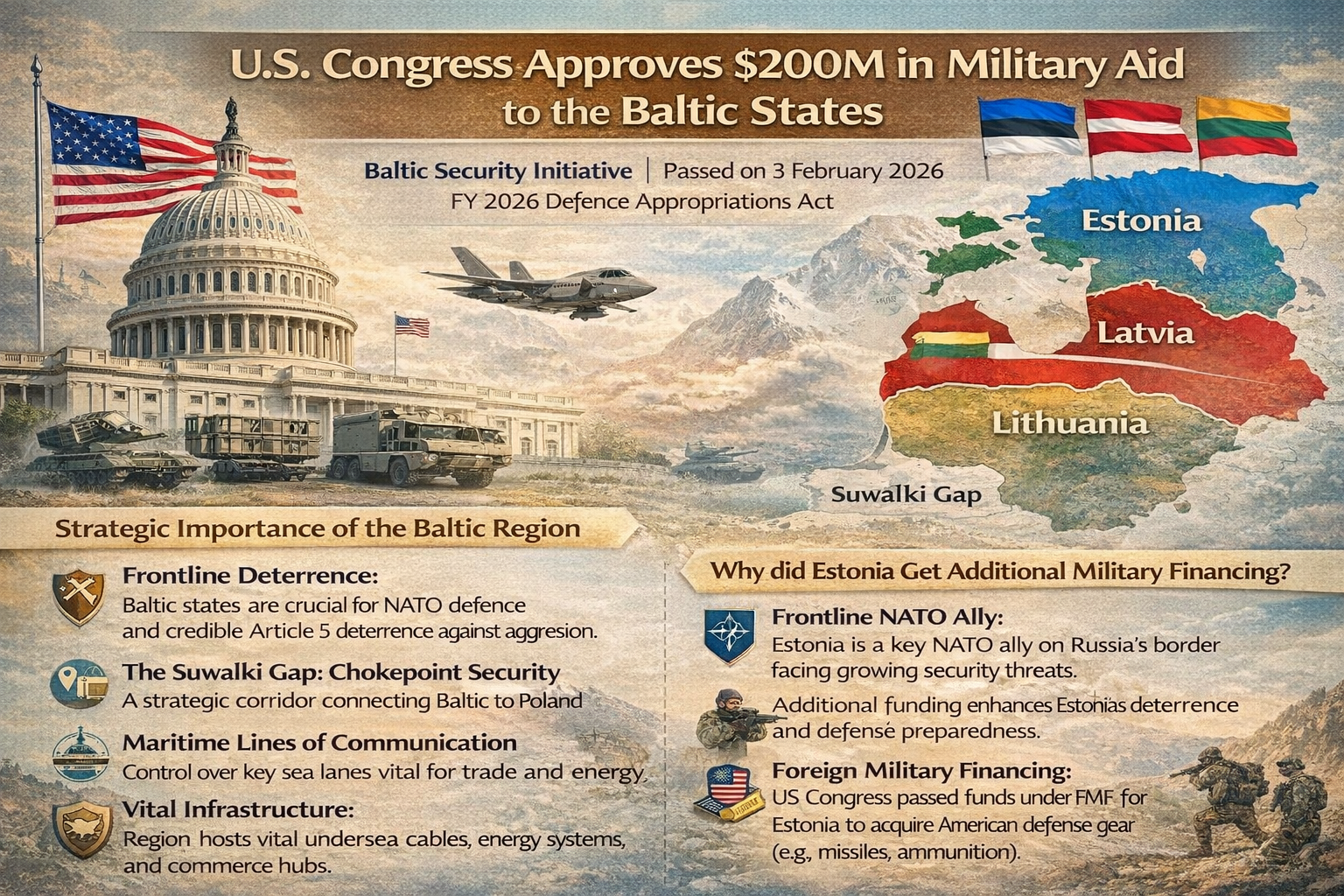
On 3 February 2026, the Congress of the United States passed USD 200 million of military aid to the Baltic states of Estonia, Latvia, and Lithuania in the Baltic Security Initiative (BSI) under the Fiscal Year 2026 Defence Appropriations Act. This investment is aimed at consolidating the defence abilities and integration of the Baltic states through the acquisition of the latest US military gear, as well as the improvement of air defence and other important infrastructures. The package takes a fresh commitment to European security and transatlantic defence cooperation by the US in the face of current challenges in the region.
Strategic Importance of the Baltic Region
Frontline Deterrence: Baltic states are a vital stronghold of collective defence to NATO, and it is the credibility of the article 5 against the possibility of aggression.
The Suwalski Gap: Chokepoint Security. A land route that links the Baltic to Poland and NATO as a whole is a key strategic route that can be used to rapidly reinforce the area in case of a threat.
Maritime Lines of Communication: The Baltic Sea dominates some of the important sea routes that are critical in trade, energy and movement of armies.
Vital Infrastructure: The area possesses key undersea cables, energy infrastructural systems, and accommodates a large amount of commerce, and it is a hub of economic and national security concerns.
Hybrid Threat Environment: Its geographical closeness to Russia and augmented hybrid hazards propose an enduring NATO troop presence and strength.
Why did Estonia Get Additional Military Financing?
-
Frontline NATO Ally: Estonia is located on the eastern side of NATO in proximity to Russia. It is a strategically critical ally that is exposed to increased security threats.
-
Deterrence Requirement: Extra finances would enhance the capability of Estonia to deter possible aggression through improving defence preparedness.
-
Foreign Military Financing: The US Congress passed additional funds under Foreign Military Financing to allow Estonia to acquire American defence equipment (ex. missiles, artillery ammunition).
-
NATO Capability Goals: More support is in line with Estonia and NATO's objective of strengthening defence interoperability and current military capabilities.
-
Regional Stability: It is used to prevent collective security and stability in the Baltic region.
Important PYQs Asked on the Baltic States
| Exam Name | Year | Question | Options | Correct Answer |
|---|---|---|---|---|
| UPSC Prelims | 2021 | The Baltic Sea is connected to which ocean? | (A) Arctic Ocean (B) Atlantic Ocean (C) Indian Ocean (D) Pacific Ocean | (B) Atlantic Ocean |
| UPSC Prelims | 2019 | Which of the following countries are known as the Baltic States? | (A) Finland, Sweden, Norway (B) Estonia, Latvia, Lithuania (C) Poland, Czech Rep., Slovakia (D) Denmark, Iceland, Norway | (B) |
| SSC CGL | 2020 | Which sea lies between Scandinavia and mainland Europe? | (A) Black Sea (B) Baltic Sea (C) Adriatic Sea (D) Caspian Sea | (B) |
| SSC CHSL | 2018 | Estonia, Latvia and Lithuania together are called | (A) Balkan States (B) Nordic States (C) Baltic States (D) Slavic States | (C) |
| SSC GD | 2022 | Which of the following countries does NOT border the Baltic Sea? | (A) Latvia (B) Estonia (C) Poland (D) Czech Republic | (D) |
| CDS | 2020 | The Baltic States are located in which part of Europe? | (A) Southern Europe (B) Western Europe (C) Northern Europe (D) Eastern Europe | (C) |
| NDA | 2021 | How many countries are collectively called the Baltic States? | (A) Two (B) Three (C) Four (D) Five | (B) |
| RRB NTPC | 2019 | Lithuania is bordered by which water body? | (A) Mediterranean Sea (B) North Sea (C) Baltic Sea (D) Black Sea | (C) |
| State PSC | 2022 | Which one of the following is NOT a Baltic country? | (A) Latvia (B) Lithuania (C) Estonia (D) Finland | (D) |
| UPSC Prelims | 2020 | The Baltic Sea separates which two regions? | (A) Europe & Asia (B) Scandinavia & mainland Europe (C) Europe & Africa (D) Asia & Africa | (B) |
Conclusion
The Congress of the US funding the Baltic military support through USD 200 million strengthens the support American troops provide to NATO and European security. The move increases the deterrence of the region and the collective security provided to the region, as well as promoting stability within the NATO eastern flank by developing the defence capabilities of Estonia, Latvia and Lithuania.