
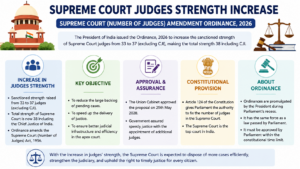
The President of India issued Supreme Court (Number of Judges) Amendment Ordinance, 2026, to bring the sanctioned strength of judges in Supreme Court from 33 to 37 judges (Supreme Court may have the Chief Justice of India as well). The amendment has led to an increase in the number of judges in the apex court to 38, at present, including the CJI. The decision was made to lighten the backlog of cases and speed up the judiciary. This Ordinance made the necessary changes to the Supreme Court (Number of Judges) Act, 1956. The proposal had been earlier approved by the Union Cabinet, which had emphasised the need for quicker justice delivery and better judicial infrastructure in the country.
Key Objective of Supreme Court Judges Strength Increase
- The President issued the Supreme Court (Number of Judges) Amendment Ordinance 2026.
- The sanctioned strength of the Supreme Court bench was raised from 33 to 37 judges (excluding the Chief Justice of India).
- The strength of the Supreme Court now stands at 38 with the CJI.
- The ordinance modified the Supreme Court (Number of Judges) Act, 1956.
- The move aims to reduce the large backlog of pending cases in the apex court.
- The Union Cabinet on 25th May 2028 approved the proposal.
- The government assured that there will be speedy justice with the additional judges.
- Article 124 of the Constitution gives Parliament the authority to fix the number of judges in the Supreme Court.
- The Supreme Court is the top court in India.
- Ordinances are promulgated by the President during Parliament’s recess.
- If an Ordinance is passed, it bears the same force as a law passed by Parliament.
- The ordinance needs to be approved in due course by Parliament within the constitutional time limit.
- With the rise in the number of cases being filed in courts, judicial reforms have become significant.
- The last change in the strength of the Supreme Court was in 2019.
- There are hopes that there will be more judges to assist in the speedy disposal of criminal, civil and constitutional cases.
- The Supreme Court is also the guardian and protector of the Constitution and Fundamental Rights.
- Addressing judicial capacity is seen as a crucial aspect of enhancing access to justice.
- The allocations of salaries and infrastructure will come from the Consolidated Fund of India.
- The proposal is to update and improve the Indian judiciary with the transition.
Recently Asked PYQs
| Exam Name & Year | Question | Options | Answer |
| UPSC Prelims 2020 | Which Article of the Constitution empowers the President to promulgate ordinances? | A. Article 123 B. Article 143 C. Article 32 D. Article 356 | A. Article 123 |
| SSC CGL 2022 | Who appoints the judges of the Supreme Court of India? | A. Prime Minister B. President of India C. Parliament D. Chief Justice alone | B. President of India |
| UPSC Prelims 2019 | The Supreme Court of India was established under which Part of the Constitution? | A. Part III B. Part IV C. Part V D. Part VI | C. Part V |
| SSC CHSL 2023 | Who is known as the guardian of the Indian Constitution? | A. Parliament B. Supreme Court C. Election Commission D. UPSC | B. Supreme Court |
| State PCS 2021 | An ordinance issued by the President must be approved by Parliament within how many weeks of reassembly? | A. 4 weeks B. 6 weeks C. 8 weeks D. 12 weeks | B. 6 weeks |
Rupee Breaches 96 Against US Dollar
Conclusion – Supreme Court Expansion
The ordinance to make Supreme Court judges more powerful is certainly a step towards robustening the judicial system of India and speeding up justice delivery. The pressure on the top court, in recent years, has been a result of litigation and heavy workload of unheeded cases, due to which an expansion of the Judges is inevitable as per the need of the apex court. The Government will ensure efficiency and minimise delays in the courts by increasing the number of judges. The development also underscores the judicial administrative powers of the President and Parliament in the Constitution. Topics like ordinance, Article 124, judicial reforms, and the Supreme Court are very significant as far as competitive examinations and current affairs preparation are concerned.