

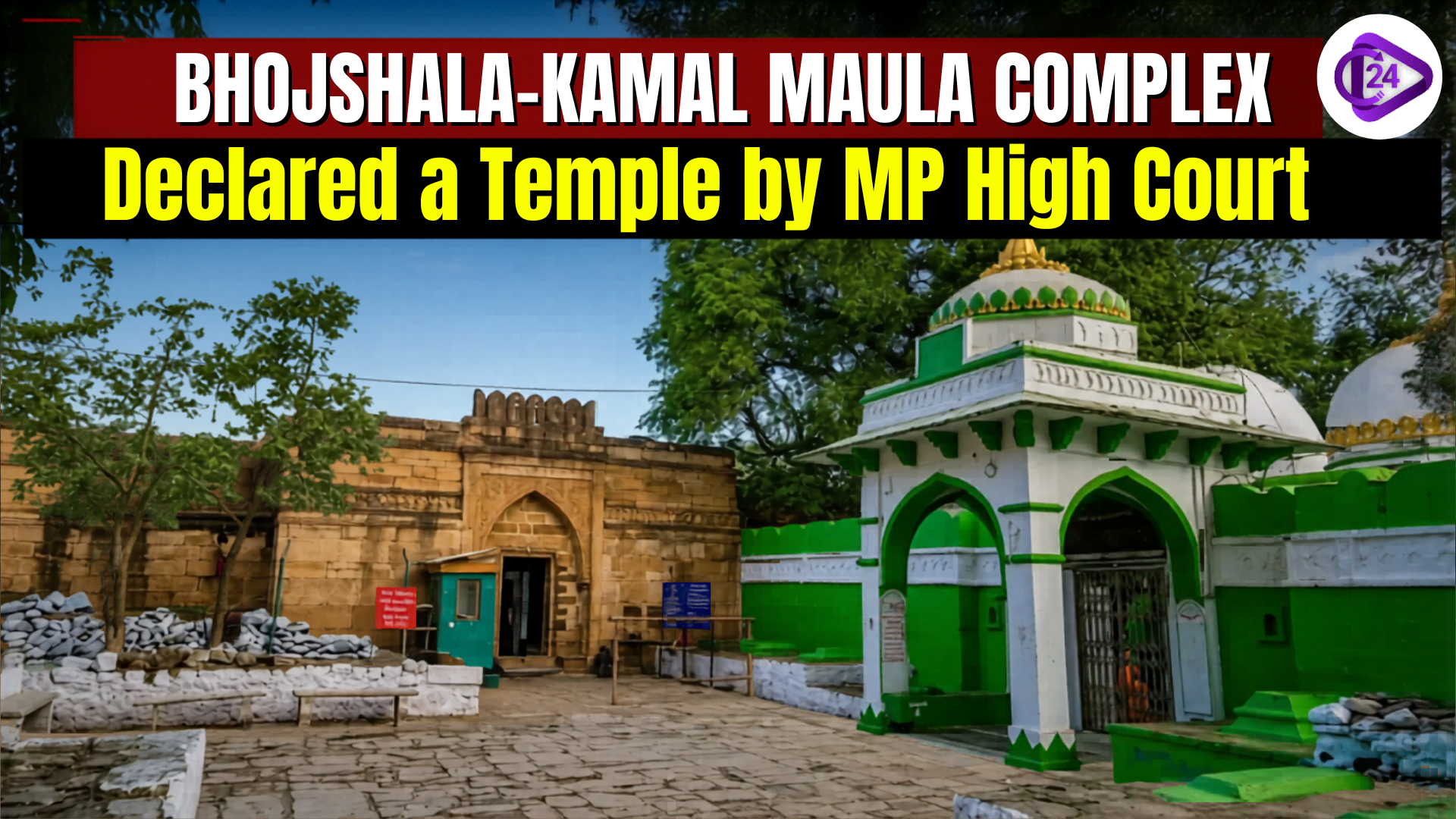
The bench also set aside the 2003 directive issued by the Archaeological Survey of India, which had permitted Friday prayers at the site. The ruling was pronounced by a division bench of Justice Vijay Kumar Shukla and Justice Alok Awasthi after reviewing archaeological material, historical documentation, and findings from ASI surveys. The decision is being viewed as an important development in matters related to heritage claims and religious rights in India.
Key Highlights of Bhojshala-Kamal Maula Complex Verdict
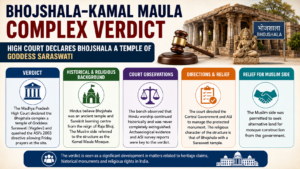
- The Madhya Pradesh High Court declared the Bhojshala complex a temple of Goddess Saraswati (Vagdevi).
- The site is located in Dhar district of Madhya Pradesh and has long been disputed between Hindu and Muslim groups.
- Hindus believe Bhojshala was an ancient temple and Sanskrit learning centre established during the reign of Raja Bhoj.
- The Muslim side referred to the structure as the Kamal Maula Mosque.
- The court quashed the ASI’s 2003 arrangement that allowed Muslims to offer Friday namaz at the site.
- The bench observed that Hindu worship at the complex had continued historically and was never completely extinguished.
- Archaeological evidence and ASI survey reports were considered important in the final verdict.
- The court directed the Central Government and ASI to manage and administer the protected monument.
- The judgment stated that the religious character of the disputed structure is that of Bhojshala with a Saraswati temple.
- The Muslim side was permitted to seek alternative land for mosque construction from the government.
- The case became nationally important due to debates surrounding historical monuments and religious identity.
- Security arrangements in Dhar were strengthened after the judgment to maintain law and order.
Important Previous Year Question
| Exam Name & Year | Question | Options | Answer |
| UPSC Prelims 2020 | Which Article of the Indian Constitution guarantees Freedom of Religion? | A. Article 14 B. Article 19 C. Article 25 D. Article 32 | C. Article 25 |
| SSC CGL 2022 | Archaeological Survey of India functions under which Ministry? | A. Home Ministry B. Culture Ministry C. Tourism Ministry D. Education Ministry | B. Culture Ministry |
| UPSC Prelims 2019 | Which authority protects monuments of national importance in India? | A. NITI Aayog B. ASI C. Election Commission D. UPSC | B. ASI |
| MPPSC 2021 | Raja Bhoj was associated with which dynasty? | A. Maurya B. Paramara C. Chola D. Gupta | B. Paramara |
| SSC CHSL 2023 | The Supreme Court of India is established under which Part of the Constitution? | A. Part III B. Part IV C. Part V D. Part VI | C. Part V |
Supreme Court Flags Bias in CEC, EC
Conclusion
The Bhojshala-Kamal Maula Complex judgment marks a significant moment in India’s legal, cultural, and historical discourse. By identifying the site as a Saraswati temple, the Madhya Pradesh High Court sought to address a long-standing dispute on the basis of archaeological findings and historical records. The decision also underlines the responsibility of the Archaeological Survey of India and other constitutional bodies in the preservation and administration of protected monuments.