

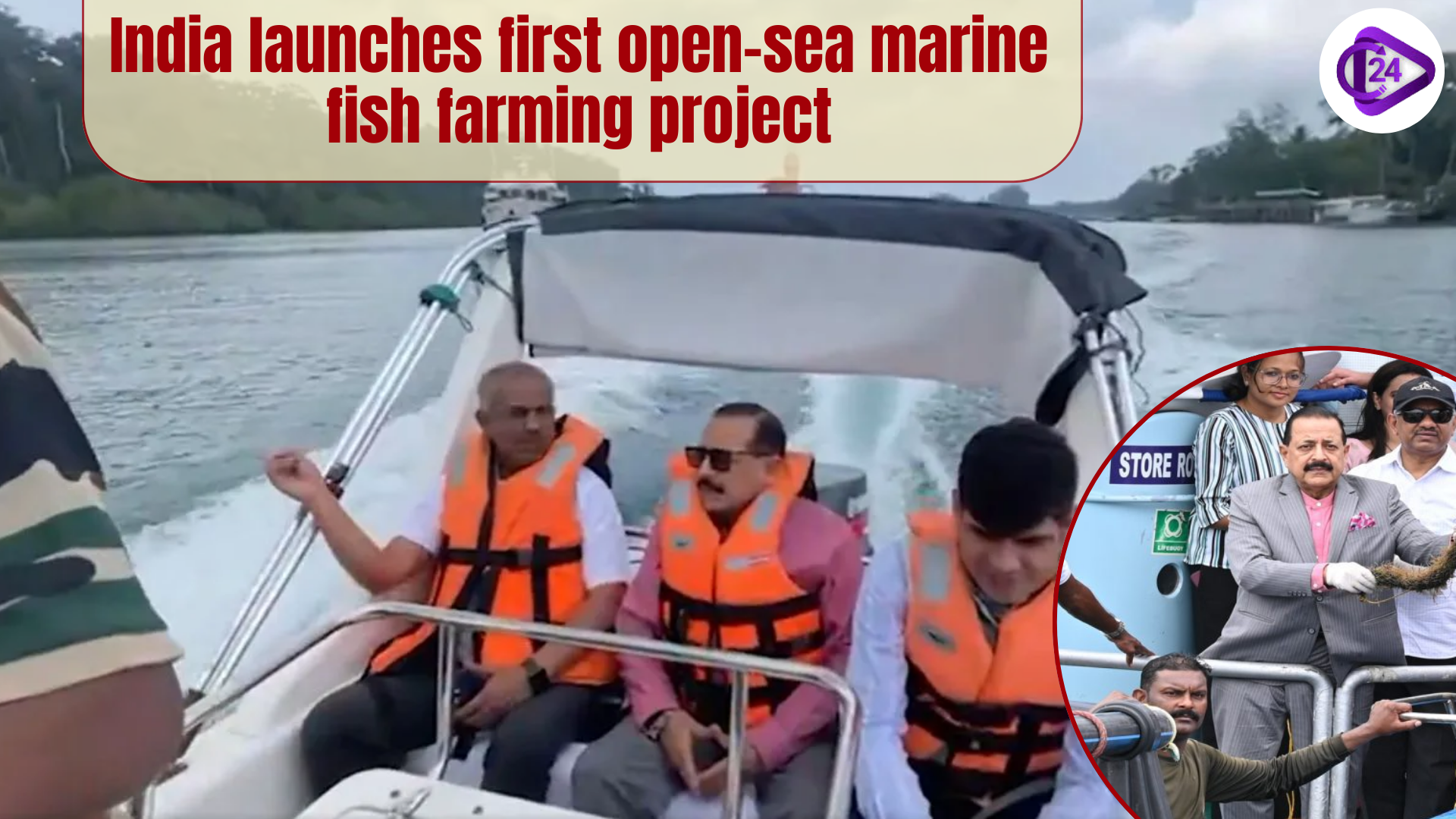
India has already initiated the first open-sea marine fish farming project in the Andaman Sea, which is a significant milestone in utilising its ocean resources and in the development of the Blue Economy strategies in the country. Union Minister of State for Earth Sciences Dr Jitendra Singh inaugurated the pilot project at North Bay near Sri Vijaya Puram in an open water field visit. The project, which will be observed in collaboration with the Ministry of Earth Sciences, the National Institute of Ocean Technology (NIOT), and the Andaman and Nicobar Islands administration, will be based on the open-sea farming of the marine finfish and seaweeds under the natural conditions of the ocean to produce sustainable livelihood and science.
India’s First Open-Sea Fish Farming Project Boosts Blue Economy
-
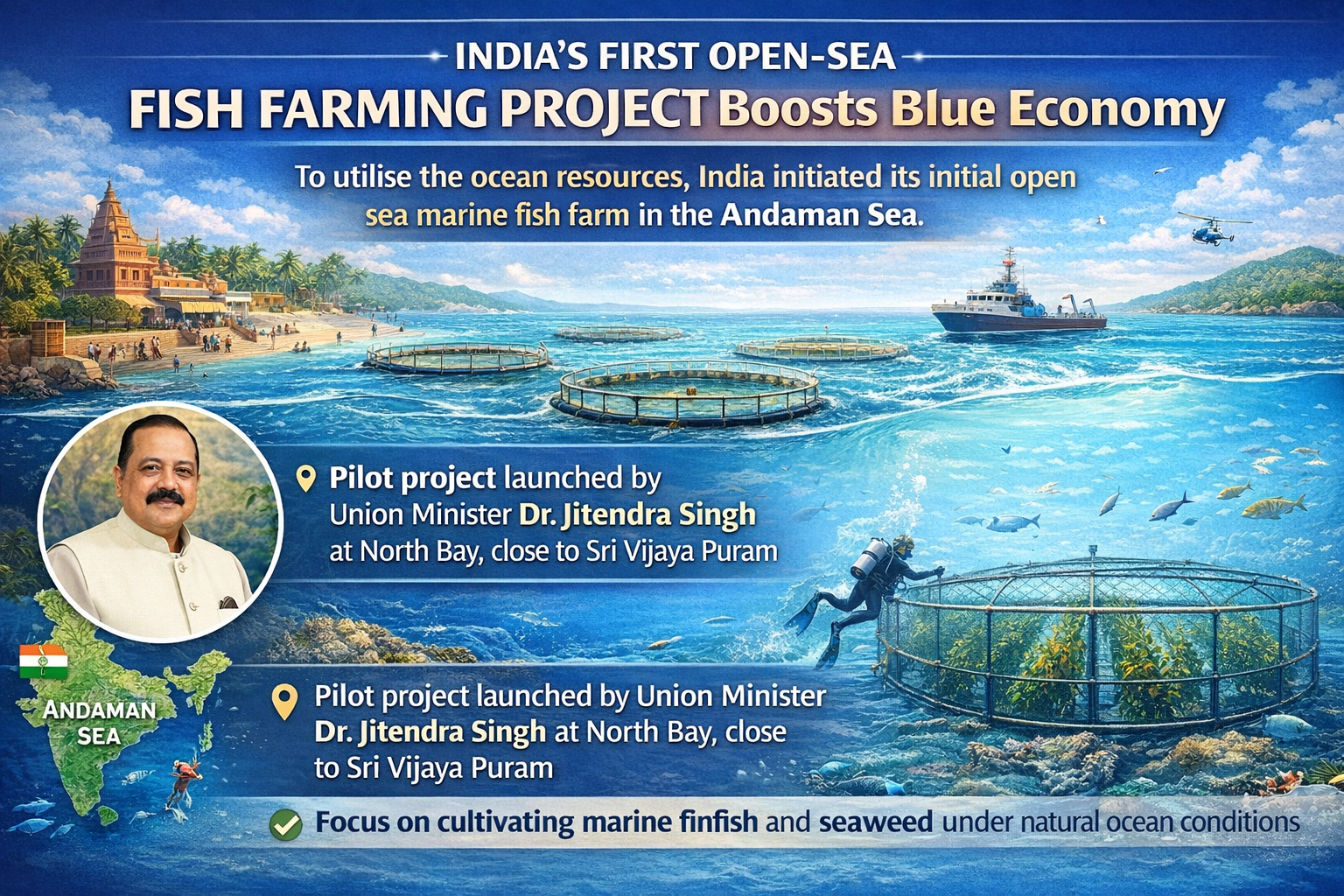
To utilise the ocean resources, India initiated its initial open sea marine fish farm in the Andaman Sea.
-
The pilot project was launched by the Union Minister Dr Jitendra Singh at North Bay, close to Sri Vijaya Puram.
-
The project is aimed at the cultivation of marine finfish and seaweed in the natural ocean conditions.
-
It is a huge move towards the realisation of the vision of India's Blue Economy.
-
The project will create sustainable livelihoods among the coastal inhabitants.
-
It is a combination of scientific innovation and livelihood.
-
The Ministry of Earth Sciences, NIOT, and UT administration carry out the implementation.
-
Finfish seeds and seaweed were given to the local fishers to farm.
Important Previous Year Questions
| Year / Exam | Question | Answer |
|---|---|---|
| UPSC Mains 2018 | Define Blue Revolution; explain the problems and strategies for pisciculture development in India. | Blue Revolution refers to major growth in fish production and aquaculture; problems include lack of infrastructure and disease; strategies include modern techniques and government support. |
| CGPSC Prelims 2016 | Among the following, which one is related to the Blue Revolution in India? (Horticulture / Floriculture / Pisciculture / Sericulture) | Pisciculture |
| HSSC Police Constable 2021 | Match List-I and List-II: White Revolution, Grey Revolution, Blue Revolution, and Green Revolution with corresponding sectors. | Blue Revolution corresponds to fish production. |
| RSMSSB Stenographer 2018 | Is pisciculture the rearing and production of? | Fish |
| RRB NTPC CBT-2 2022 | According to the Ministry of Fisheries (2020), India contributes approximately what percentage to global fish production? | 7.7% |
| UPSC Prelims 2008 | The release of which one of the following into ponds and wells helps in controlling mosquitoes? (a) Crab (b) Dogfish (c) Gambusia fish (d) Snail | Gambusia fish (western mosquitofish) |
| UPSC Prelims 2021 | Which one of the following is a filter feeder? (a) Catfish (b) Octopus (c) Oyster (d) Pelican | Oyster |
| UPSC Mains 2018 | Define the Blue Revolution and explain the problems and strategies for pisciculture development in India. | Blue Revolution refers to sustainable fisheries and aquaculture growth with strategies to improve fish production and livelihoods. |
Conclusion (India Launches First Open-Sea Fish Farming Project)
The initial fish cultivation venture in open water is an important milestone in the development of the Blue Economy, the advancement of sustainable fisheries, and the provision of employment to local populations. The project enhances marine aquaculture and promotes economic growth by integrating science and natural ocean resources that can provide a template for open-sea farming in the rest of the nation.