



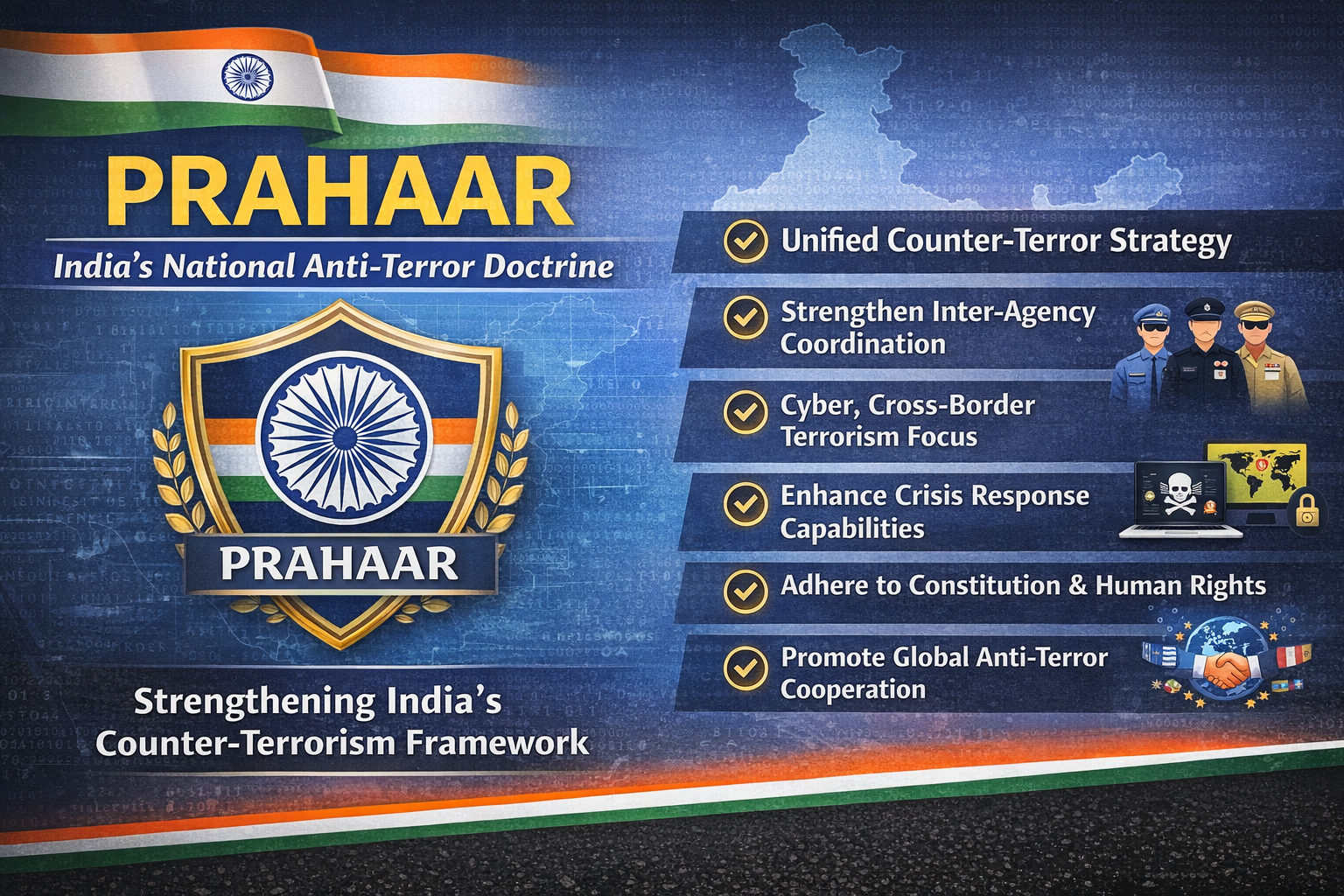
India has introduced PRAHAAR, its first structured National Anti-Terror Doctrine, aimed at strengthening the country’s counter-terror framework. Announced by the Ministry of Home Affairs, the policy lays out a coordinated and intelligence-driven strategy to prevent, detect and respond to terrorist threats. It focuses on better inter-agency cooperation, faster operational response, and tackling emerging challenges such as cyber-radicalisation and cross-border terrorism. The doctrine also highlights adherence to constitutional principles and legal safeguards while maintaining a firm stance against terrorism. PRAHAAR reflects India’s effort to modernise its security architecture in response to evolving national and global threats.
What Is PRAHAAR, and Why Was It Introduced?
-
PRAHAAR is India’s first comprehensive National Anti-Terror Doctrine, introduced by the Ministry of Home Affairs to strengthen the country’s counter-terror framework.
-
It provides a structured strategy focused on prevention, preparedness, response, and recovery in dealing with terrorist threats.
-
The doctrine was formulated to address emerging security challenges such as cross-border terrorism, online radicalisation, terror financing, and misuse of advanced technologies.
-
It promotes intelligence-driven operations and better coordination among central and state security agencies.
-
PRAHAAR emphasises faster response mechanisms and improved crisis management capabilities.
-
The policy also underlines adherence to constitutional principles, human rights, and the rule of law while combating terrorism firmly.
-
Strengthening inter-agency data sharing and operational synergy is a core objective of the doctrine.
-
It encourages international cooperation to counter global terror networks and financial channels.
-
Overall, PRAHAAR aims to modernise India’s national security architecture to respond effectively to evolving threats.
Most Previous Year Questions
| Exam | Year | Question (With Options) | Correct Answer |
|---|---|---|---|
| UPSC Civil Services (Prelims) | 2017 | The term “money laundering” is related to which of the following? (a) Terror Financing (b) Tax Evasion (c) Counterfeit Currency (d) All of the above |
(d) All of the above |
| UPSC Civil Services (Prelims) | 2018 | The National Investigation Agency (NIA) was established in which year? (a) 2006 (b) 2008 (c) 2010 (d) 2012 |
(b) 2008 |
| CDS Exam | 2019 | The Unlawful Activities (Prevention) Act (UAPA) is primarily related to: (a) Cybercrime (b) Terrorism (c) Drug Trafficking (d) Human Trafficking |
(b) Terrorism |
| SSC CGL | 2020 | The Multi-Agency Centre (MAC) is related to: (a) Disaster Management (b) Intelligence Sharing (c) Election Monitoring (d) Border Trade |
(b) Intelligence Sharing |
| State PSC | 2021 | The National Security Council in India deals primarily with: (a) Financial Policy (b) Foreign Trade (c) Strategic and Security Issues (d) Judicial Reforms |
(c) Strategic and Security Issues |
Conclusion (India Introduces PRAHAAR Security Policy)
India’s introduction of PRAHAAR marks a significant step in strengthening its national security framework. The policy brings a structured and coordinated approach to countering terrorism, focusing on prevention, intelligence sharing, rapid response, and recovery. By addressing emerging threats such as cyber-radicalisation and cross-border networks, PRAHAAR aims to modernise security mechanisms. The doctrine reflects India’s firm stance against terrorism while reinforcing cooperation between agencies and upholding constitutional principles.