

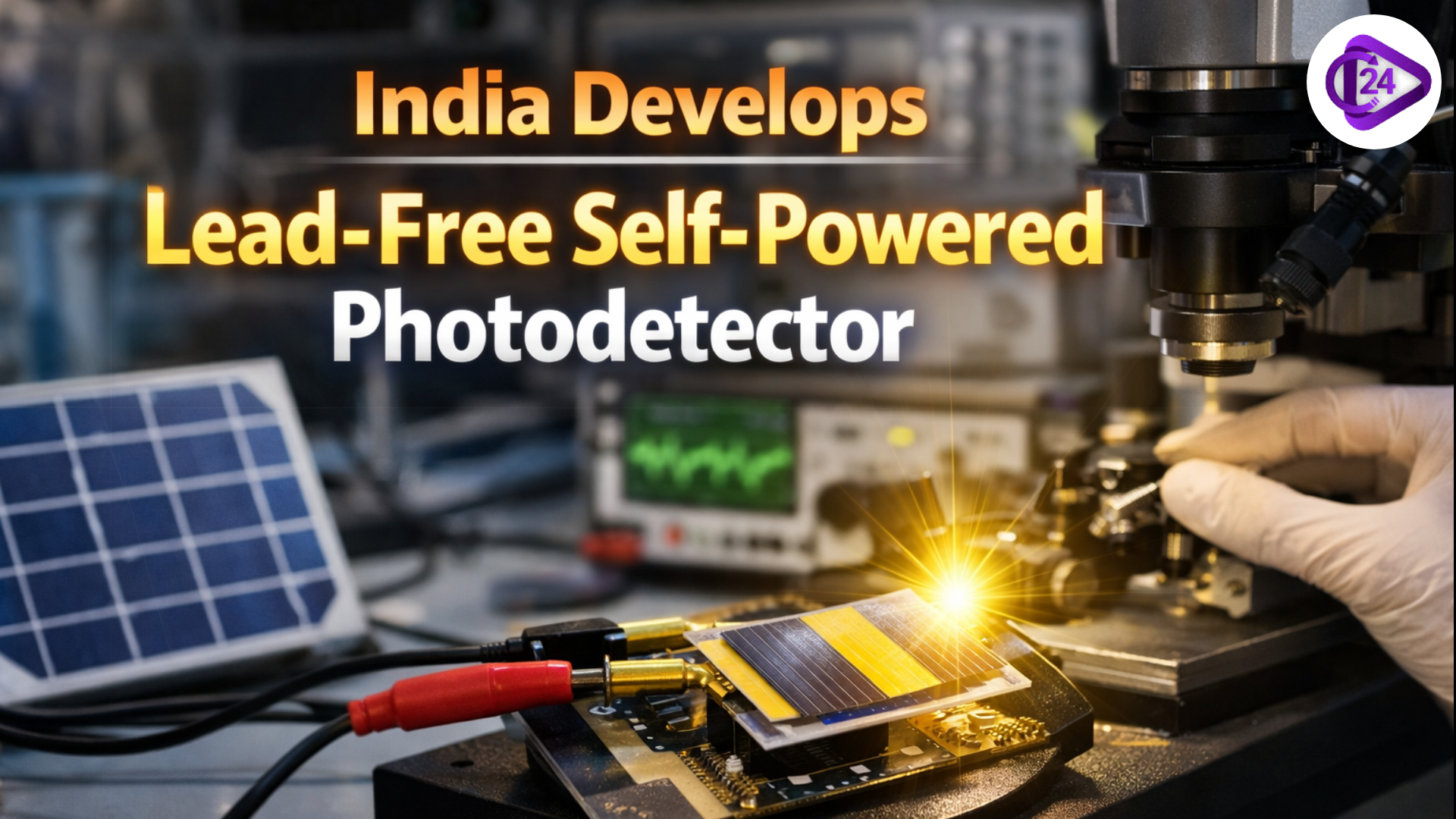
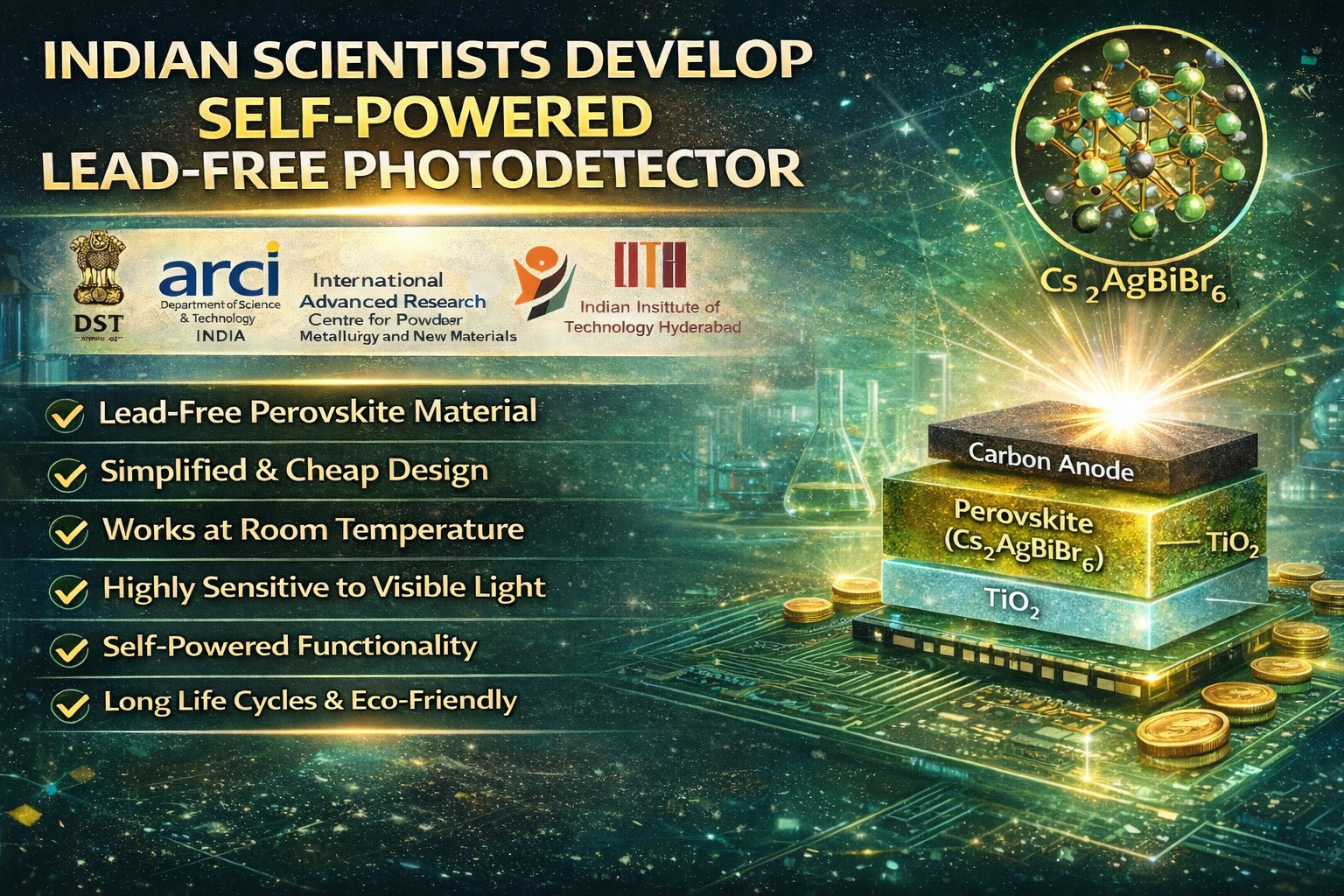
The Department of Science and Technology of India has verified that scientists at the International Advanced Research Centre of Powder Metallurgy and New Materials (ARCI), Hyderabad, in collaboration with the Indian Institute of Technology Hyderabad, have invented a new photodetector that is self-powered and lead-free. It operates on a perovskite (Cs₂AgBiBr₆) material that does not contain toxic lead, and its simplified design, which includes a cheap carbon anode, is produced at room temperature. It is highly sensitive to visible light, does not need an external power source, and has long life cycles of use, making it a greener substitute for electronics, industrial sensors, imaging systems, and security systems.
Advantages of Lead-Free Materials in Photodetector Design
-
The use of lead-free materials will help to avoid toxic lead, which predisposes health and the environment to hazards in the production, operation and disposal of devices. Replacing lead facilitates safer production, and it is in tandem with the world's aim to be eco-friendly.
-
The problem of lead poisoning in the past has been solved by using non-toxic elements like magnesium or bismuth in the perovskite structures.
-
Perspective Lead-free perovskites and other alloys demonstrate their intrinsic stability and eco-friendliness, thereby contributing to the devices and increasing their functionality and efficiency.
-
Lead-free materials also show good optical characteristics and have been shown to have good light absorption and charge carrier generation and transport that make them good for high photoresponsivity and detectivity in photodetectors.
-
It removes the requirement to use the expensive encapsulation format and other safety controls necessary when working with a lead-based technology, since less costly fabrication processes can be used, and costs are perhaps lower as well because expensive encapsulation and safety requirements when using lead technologies are done or removed.
-
Designs that are free of lead allow large-scale application to consumer, industry and environmental sensing markets where the toxicity issue has posed a hindrance to usage before.
Conclusion
The invention of a lead-free, self-powered photodetector by India is a notable achievement towards a cleaner and greener electronic world. The innovation will impact the enduring environmental and energy issues in the design of photodetectors by removing noxious lead present, and will eliminate the necessity of outside power sources. The technology is also ready to be used in real-world implementation, as it is made of durable materials that are cheap and fabricated in an easy process. This development enhances India's leadership in the field of green photonics and provides possibilities of safer applications in imaging, sensing, security and optoelectronics and brings scientific activities in resonance with the environment.