


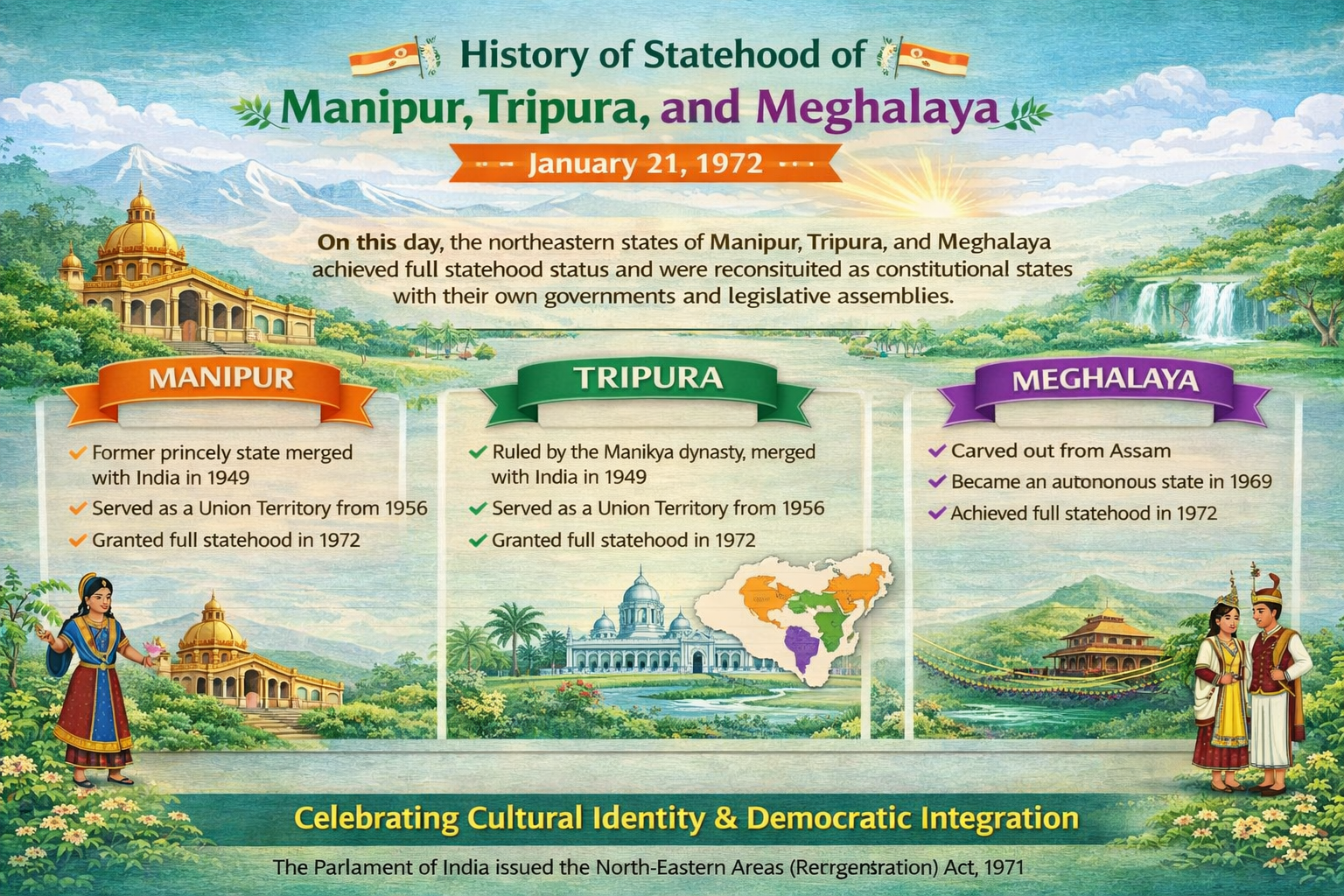
The states of Manipur, Tripura, and Meghalaya observe their statehood day on January 21 every year, marking the day when the three northeastern parts of India – Meghalaya, Tripura, and Manipur – were granted full statehood status under the North-Eastern Areas (Reorganisation) Act, 1971. On this date, Tripura and Manipur, formerly princely states that had acceded to the Indian Union, and Meghalaya, formerly a part of Assam, were reconstituted as separate constitutional states with their own governments and legislative assemblies. This is a day that is observed to celebrate their special cultural identities, democratic integration, and contributions towards the unity and development of India.
History of Statehood of Manipur, Tripura, and Meghalaya
-
Date of Statehood: on 21 January 1972, Manipur, Tripura, and Meghalaya achieved full statehood, marking an important milestone in the political reorganisation of the Northeast of India.
-
Legal Status: The Parliament of India had passed the North-Eastern Areas Reorganisation Act, 1971, which granted them statehood.
Manipur:
-
Manipur, which was once a state of the princely regime, became a part of the Indian Union in 1949.
-
It was serving as a Union Territory since 1956 and finally became a complete state in 1972.
Tripura:
-
Tripura, which was ruled by the Manikya dynasty, also integrated with India in 1949.
-
It joined the Union Territory in 1956 and became a state in the year 1972.
Meghalaya:
-
Meghalaya was established as an autonomous state in 1969 o
-
ut of the state of Assam.
-
In 1972, it was granted independent statehood to safeguard the tribal identity and administrative autonomy.
Capital Cities: Imphal (Manipur), Agartala (Tripura), and Shillong (Meghalaya).
Administrative Effect: Statehood made elected legislatures, separate high courts, and more financial independence.
Best PYQs on Tripura, Meghalaya, and Manipur
| Exam | Year | Question (PYQ) | Options | Correct Answer |
|---|---|---|---|---|
| SSC CGL | 2019 | Manipur, Meghalaya, and Tripura became states under which act? | A. States Reorganisation Act 1956 B. North Eastern Areas Reorganisation Act 1971 C. Government of India Act 1935 D. Indian Independence Act 1947 |
B |
| SSC CPO | 2019 | Which states celebrate their Statehood Day on 21 January? | A. Assam, Mizoram, Nagaland B. Manipur, Tripura, Meghalaya C. Arunachal, Sikkim, Mizoram D. Nagaland, Manipur, Tripura |
B |
| SSC JE | 2020 | Manipur, Meghalaya, and Tripura celebrated their Statehood Day on? | A. 15 August B. 26 January C. 21 January D. 1 November |
C |
| SSC CHSL | 2022 | On 21 January 1972, which of the following states were granted statehood? | A. Nagaland, Mizoram, Arunachal B. Manipur, Tripura, Meghalaya C. Assam, Meghalaya, Tripura D. Manipur, Mizoram, Tripura |
B |
| SSC CGL | 2018 | Manipuri dance is associated with which state? | A. Assam B. Tripura C. Manipur D. Meghalaya |
C |
| SSC CHSL | 2020 | Which of the following is a classical dance form of India? | A. Hozagiri B. Manipuri C. Bihu D. Wangala |
B |
| SSC GD | 2017 | Lai Haraoba festival is celebrated in? | A. Tripura B. Assam C. Manipur D. Meghalaya |
C |
| SSC MTS | 2021 | Hozagiri dance belongs to which state? | A. Meghalaya B. Manipur C. Tripura D. Assam |
C |
| SSC CGL | 2019 | Wangala, also known as the Hundred Drums Festival, is celebrated in? | A. Nagaland B. Meghalaya C. Tripura D. Manipur |
B |
| SSC CPO | 2020 | Nongkrem dance festival is related to which state? | A. Manipur B. Assam C. Tripura D. Meghalaya |
D |
| SSC CHSL | 2022 | Behdienkhlam festival is associated with which state? | A. Meghalaya B. Tripura C. Manipur D. Mizoram |
A |
| SSC CGL | 2016 | Garia festival is mainly celebrated in? | A. Manipur B. Tripura C. Meghalaya D. Assam |
B |
| SSC GD | 2018 | Thabal Chongba dance is related to? | A. Tripura B. Meghalaya C. Manipur D. Assam |
C |
| SSC MTS | 2021 | Khasi, Garo and Jaintia tribes are mainly found in? | A. Tripura B. Assam C. Manipur D. Meghalaya |
D |
Conclusion (Statehood Day of Manipur, Tripura, and Meghalaya)
On 21 January, Manipur, Tripura, and Meghalaya celebrate the day of statehood through Statehood Day, which was granted to the states in 1972. It emphasises the democratic unification of Northeast India, glorifies the cultural diversity, and strengthens the significance of inclusion in governance, regional identity, and balanced national development through the federal framework of India.