

The World Bank has approved a $300 million loan to support Uttar Pradesh’s transition toward cleaner air and sustainable urban development. This initiative aims to tackle rising air pollution levels in one of India’s most populous states, where rapid urbanisation and industrial growth have significantly impacted air quality. The project focuses on strengthening air quality management systems, promoting cleaner technologies, and enhancing institutional capacity. It aligns with India’s broader climate commitments and public health goals, ensuring long-term environmental sustainability while improving the quality of life for millions of residents across urban centres.
Key Highlights of the Clean Air Transition Project
-
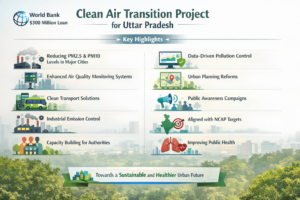
Focus on reducing PM2.5 and PM10 pollution levels in major cities of Uttar Pradesh
-
Strengthening air quality monitoring infrastructure with advanced data systems
-
Promoting clean transport solutions, including electric mobility and public transport upgrades
-
Encouraging industrial emission control technologies and cleaner production methods
-
Capacity building of state and local authorities for better policy implementation
-
Integration of data-driven decision-making for real-time pollution control
-
Supporting urban planning reforms to reduce congestion and emissions
-
Enhancing public awareness campaigns on air pollution and health impacts
-
Alignment with India’s National Clean Air Programme (NCAP) targets
-
Expected improvement in public health outcomes, reducing respiratory diseases
-
Long-term goal of achieving sustainable and climate-resilient urban growth in Uttar Pradesh
Most Important PYQs on World Bank and Air Pollution
| Exam | Year | Question | Options | Answer |
|---|---|---|---|---|
| UPSC Civil Services Prelims | 2020 | Which of the following are objectives of the World Bank? | (a) Poverty reduction (b) Infrastructure funding (c) Military financing (d) Climate support | a, b, d |
| UPSC Civil Services Prelims | 2015 | The World Bank & IMF are known as Bretton Woods Institutions. Which statement is correct? | (a) Formed after WWI (b) Formed after WWII (c) UN agencies (d) Only for Europe | b |
| UPSC Civil Services Prelims | 2018 | What is the role of IBRD? | (a) Loans to poor countries (b) Loans to middle-income countries (c) Grants only (d) Trade regulation | b |
| UPSC Civil Services Prelims | 2021 | Which factors contribute to air pollution in India? | (a) Vehicular emissions (b) Crop burning (c) Industrial pollution (d) All of the above | d |
| UPSC Civil Services Prelims | 2017 | Sources of PM2.5 include: | (a) Vehicles (b) Industries (c) Dust (d) All | d |
| UPSC Civil Services Prelims | 2019 | H-CNG fuel reduces which emissions? | (a) CO₂ only (b) Hydrocarbon only (c) CO₂ + Hydrocarbon (d) None | c |
| UPSC Civil Services Prelims | 2023 | Direct Air Capture technology is used for: | (a) Carbon sequestration (b) Fuel production (c) Industrial reuse (d) All | d |
| RPSC RAS Prelims | 2021 | Major cause of air pollution in Rajasthan cities? | (a) Transport (b) Dust storms (c) Industry (d) All | d |
| SSC CGL Examination | 2020 | Which gas causes smog? | (a) CO₂ (b) SO₂ (c) Ozone (d) Nitrogen | c |
| State PCS Examination | 2022 | AQI is based on which pollutants? | (a) PM2.5 (b) NO₂ (c) SO₂ (d) All | d |
| UPSC Civil Services Prelims | 2024 | PM2.5 refers to: | (a) Gas (b) Liquid pollutant (c) Fine particulate matter (d) Ozone layer | c |
| UPSC Civil Services Prelims | 2022 | The World Bank report on climate risk mentions: | (a) Flood risk only (b) Heat stress (c) No impact (d) Only agriculture | b |
Odisha Tops NITI Aayog Fiscal Health Index 2026
Conclusion – World Bank Supports UP’s Fight Against Air Pollution
The World Bank support marks a significant step in Uttar Pradesh’s fight against air pollution. By strengthening governance, promoting clean technologies, and improving urban planning, the initiative can deliver long-term environmental and public health benefits. Effective implementation and continuous monitoring will be crucial to achieving cleaner, more sustainable air and to setting a model for other states.