


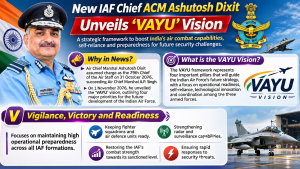
VAYU Vision: India’s defence preparedness is set to receive a renewed focus under the leadership of Air Chief Marshal Ashutosh Dixit, the newly appointed Chief of the Indian Air Force (IAF). He has introduced a strategic framework called ‘VAYU’, highlighting operational readiness, self-reliance, technological innovation and coordination among the three armed forces. The vision aims to strengthen India’s air combat capabilities and prepare the Indian Air Force for emerging security challenges and modern warfare.
Why in News?
Air Chief Marshal Ashutosh Dixit assumed charge as the 29th Chief of the Air Staff on 31 October 2026, succeeding Air Chief Marshal A.P. Singh.
On 1 November 2026, he unveiled the ‘VAYU’ vision, outlining four major priorities for the future development of the Indian Air Force.
What is the VAYU Vision?
The VAYU framework represents four important pillars that will guide the Indian Air Force’s future strategy.
1. V – Vigilance, Victory and Readiness
The first pillar focuses on maintaining high operational preparedness across all IAF formations.
- Keeping fighter squadrons and air defence units ready.
- Strengthening radar and surveillance capabilities.
- Restoring the IAF’s combat strength towards its sanctioned level.
- Ensuring rapid responses to security threats.
2. A – Aatmanirbharta
The second pillar focuses on defence self-reliance and indigenous technology development.
Important priorities include:
- LCA Tejas Mk1A and Mk2.
- Advanced Medium Combat Aircraft (AMCA).
- Indigenous sensors and weapons.
- Development of domestic defence technologies.
The objective is to reduce dependence on foreign suppliers and strengthen India’s defence manufacturing capabilities.
3. Y – Yukti
Yukti represents ingenuity, innovation and the adoption of advanced technologies in military operations.
Its major focus areas include:
- Artificial Intelligence (AI)-enabled command and control systems.
- Advanced counter-drone defence.
- Improved maintenance and operational efficiency.
- Force protection and resilience.
- Use of near-space as an emerging operational domain.
4. U – Unity of Effort
The fourth pillar focuses on strengthening coordination among the Indian Army, Indian Navy, Indian Air Force, and national agencies.
It aims to improve joint military planning and integrated operations.
This pillar is aligned with the national vision of JAI – Jointness, Aatmanirbharta and Innovation.
About Air Chief Marshal Ashutosh Dixit
- Appointment: 29th Chief of the Air Staff.
- Assumed Office: 31 October 2026.
- Predecessor: Air Chief Marshal A.P. Singh.
- Flying Experience: More than 3,500 hours.
- Specialisation: Experimental Test Pilot and Qualified Flying Instructor.
- Training: National Defence Academy (NDA).
- Previous Position: Vice Chief of the Air Staff.
He has also served as Chief of Integrated Defence Staff and Air Officer Commanding-in-Chief of Central Air Command.
Importance of the VAYU Vision
The new framework is important for India’s national security because modern warfare is changing rapidly.
- Combat Readiness: Strengthens the operational preparedness of fighter squadrons and air defence units.
- Defence Self-Reliance: Encourages the development and use of indigenous aircraft, weapons and sensors.
- Technological Advancement: Promotes AI, counter-drone systems and advanced military technologies.
- Joint Military Operations: Improves coordination among the Army, Navy and Air Force.
- National Security: Strengthens India’s ability to respond to emerging security threats.
Conclusion – VAYU Vision
The VAYU vision introduced by Air Chief Marshal Ashutosh Dixit provides a strategic direction for the future of the Indian Air Force. Its four pillars focus on readiness, self-reliance, innovation and jointness. The framework aims to strengthen India’s air power and prepare the force for the changing nature of modern warfare.