


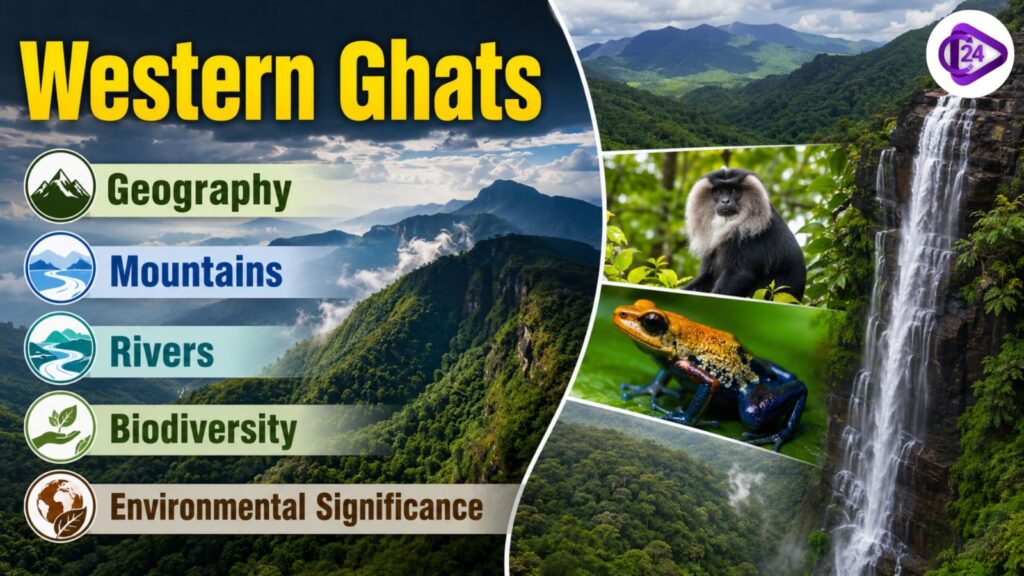
The Western Ghats are one of the major geographic features of India; a mountain range that runs parallel to the western coast, along the western side of the Indian Peninsula. Famous for mountain ranges, rivers, rich biodiversity, forests and unique ecosystems, the Western Ghat form an important part of the balance of the environment in India. They shape the Indian monsoon, feed several key rivers, and afford habitat to many endemic plants and animals. This place is of extraordinary biological and ecological importance, for which it has been recognised as a UNESCO World Heritage Site. The Western Ghat geography, which includes its mountain ranges, rivers, biodiversity, and environmental significance.
About Western Ghats
Western Ghats are a massive mountain chain along the western coast of India. They run all across Gujarat, Maharashtra, Goa, Karnataka and Kerala into Tamil Nadu. The range is characterised by some of the highest peaks, most extensive forests, and major rivers, as well as its incredible biodiversity. Kerala also boasts of the highest peak in the Western Ghats, called Anamudi (2,695 m). Mountains play a vital role in the monsoon; also, this region acts as an important watershed for Peninsular India. UNESCO World Heritage Sites: The Western Ghats, one of the eight “hottest hotspots” of biological diversity in the world, are also a UNESCO World Heritage Site.
Western Ghats Geography
-
- Geography: Along the western side of Peninsular India, parallel to the Arabian Sea coast.
- Alternative Name: Sahyadri Hills.
- Coverage Areas: Gujarat, Maharashtra, Goa, Karnataka, Kerala and Tamil Nadu.
- Extent: Extends about 1,600 km from the Tapi region in the north to peninsular India on the southern end.
- Tallest Mountain: Anamudi (2,695 m), Kerala
- Important Hill Ranges: Sahyadri, Nilgiri, Anaimalai, Cardamom and Agasthyamalai Hills.
- Palghat Gap: The Key Break Between Kerala & Tamil Nadu
- Slope: The western slopes are mostly steep and the eastern slopes shallower.
- Climate: The range is subject to orographic lift from the Southwest Monsoon of India, which brings heavy rainfall.
- Drainage: It acts as an important watershed, which has rivers flowing towards both the Arabian Sea and the Bay of Bengal.
- Geological importance: The Western Ghats are one of the oldest mountain systems associated with the geological structure of peninsular India.
- Environmental Contribution: They sustain forests, rivers, wildlife and agriculture with high biodiversity.
Western Ghats Mountain Ranges
The Western Ghats geography mainly consists of the extensive series of mountain ranges called by their western ghats and other associated hill systems. Different ranges of the Western Ghats have different altitudes, landscapes, climate and biodiversity.
- Sahyadri Hills: The northern and central part of the Western Ghats, most identifiable with Maharashtra and interspersed areas.
- Nilgiri Hills: Where Karnataka, Kerala and Tamil Nadu meet, Doddabetta is here.
- Anamudi Mountain: Highest peak of the Western Ghats, situated in Kerala and Tamil Nadu. Anaimalai hills
- Palani Hills: Located in Tamil Nadu and famous for its forest, grassland and diversity of wildlife
- Cardamom Hills: South Kerala, forests and plantations; rich in Western Ghats biodiversity.
- Agasthyamalai Hills: Scattered in southern Kerala and Tamil Nadu, including remarkable biodiversity with ecological significance.
- Brahmagiri Hills: Strip of forests and watersheds along the Karnataka-Kerala border, home to rich wildlife.
- Kudremukh Range: Situated in Karnataka, known for its high ranges, grassland, dense forests and wildlife.
- Biligiriranga Hills (BRH): Situated in Karnataka and a place of great ecological significance, providing the only connection between the Western Ghats and the Eastern Ghats.
Western Ghats Rivers
The rivers of the Western Ghats are central to Western Ghats physical geography as well as Peninsular India drainage, agriculture, irrigation, hydropower and biodiversity. Numerous Indian rivers originate within the different sections of the Western Ghats mountains and nearly always drain either to the Arabian Sea or to the Bay of Bengal. Beyond this function, the river systems of the Western Ghats are also the lifeblood of its ecosystem, forests, wildlife and water resources.
- Godavari: It originates from Trimbakeshwar (Maharashtra) and flows east towards the Bay of Bengal.
- Krishna: Originates in Maharashtra (near Mahabaleshwar) and flows eastward.
- Kaveri: It begins at Talakaveri in Karnataka and flows southeast to the Bay of Bengal.
- Tungabhadra: A river formed by the combination of Tunga & Bhadra rivers, and it meets the Krishna River.
- Bhima: A major tributary of the Krishna, it cuts across a part of Maharashtra.
- Periyar: It originates from the Western Ghats of Kerala and flows towards the Arabian Sea westward.
- Sharavathi: Flows from Karnataka to the Arabian Sea; Jog Falls is on this river
- Netravati: Originating from Karnataka and flowing west to the Arabian Sea.
- Mandovi: One of the major west-flowing rivers in Goa, which rises in the Western Ghats.
Western Ghats Environment
The environment of the Western Ghats is integral to India’s ecological balance, climate, water resources and biodiversity. This area has thick forests, grasslands, wetlands, rivers, and many kinds of wildlife habitats. Its unique ecosystems help regulate rainfall, prevent soil loss, store carbon and provide habitat to many endemic species. The Western Ghats ecosystem is equally linked with the well-being of millions of people.
- Diverse Ecosystem: The Western Ghats are one of the eight ‘hottest hotspots’ of biological diversity in the world and has 27% endemism.
- Forest ecosystem: Tropical evergreen, semi-evergreen, moist deciduous forests and montane grasslands are found all over the region.
- Climate Regulation: For the Southwest Monsoon and for the regional rainfall pattern, the mountains exert an influence.
- Water Resources: The Western Ghats serve as a source of origin, and also water sheds for many rivers flowing throughout Peninsular India.
- Endemic Species: If you foolishly ignore 5, endemic flora and fauna found nowhere on the planet.
- Habitats: This area is home to Elephants, tigers, Nilgiri Tahr, lion-tailed macaque, hornbills, and many amphibians.
- Soil Preservation: Forest cover prevents soil erosion and keeps the watershed stable.
- Carbon Storage: Forests absorb and store carbon as they grow, which is important to mitigating the effects of climate change.
- Threats to the environment: Deforestation, mining, infrastructure expansion, fragmentation of habitat; invasive species; forest fires and climate change are among the biggest problems.
- Significance of Conservation: National parks, wildlife sanctuaries, tiger reserves, biosphere reserves and other protected areas conserve the Western Ghats environment and biodiversity.
Western Ghats Biodiversity
One of the key features of such a mountain system is the Western Ghats biodiversity. It is designated as a global biodiversity hotspot because of its exceptional species richness and endemism, extensive forest cover and unique ecosystems. Western Ghats is a biodiversity hotspot of numerous flora and fauna, such as plants, mammals, birds, reptiles, amphibians, and insects. Even more than that, its forests and habitats help maintain ecological balance by protecting watersheds and moderating the climate for the region while providing a living for local communities.
- Global biodiversity hotspot: The Western Ghats are one of the recognised hotspots for biological biodiversity.
- High endemism: A high number of species that are only found in the region.
- Flora: In this region, tropical evergreen forests, semi-evergreen forests, moist deciduous forests, montane forests and grassland are found.
- Fauna: The animal species in the region include the Elephant, Indian Tiger, leopard, Indian gaur or bison (Bos gaurs), Nilgiri tahrs, Lions-tailed macaques and Malabar Giant squirrels.
- Birds: Birds of the region include Malabar grey hornbill, Nilgiri wood pigeon, and great hornbill.
- Amphibia: The Western Ghats play host to a wealth of endemic frogs and other amphibians.
- Conservation: The Western Ghats are conserved with the help of Protected areas including National Parks, Wildlife sanctuaries, Tiger reserves and Biosphere reserves.
Also Read
Western Ghats Environmental Significance
Western Ghats house several forests and rivers and are enriched with biodiversity, climate and ecological services that are significant for the environment. The Western Ghats ecosystem is home to many endemic species and a key climate regulator in Peninsular India. The mountains affect the Southwest Monsoon, and forests and watersheds contribute to water security, soil conservation, and carbon storage.
- Climate Regulation: The Southwest Monsoon is influenced and aided by the Western Ghat and also helps regulate rainfall at regional levels.
- Water security: The mountains are a main source and watershed for many of the largest rivers.
- Rainfall Formation: The range results in orographic rainfall due to the upward movement of moisture-bearing monsoon winds.
- Forest ecosystem: Dense forests provide habitat for a variety of plants, mammals, birds, reptiles and amphibians.
- Soil Conservation: Forest cover aids the rate of soil erosion and the health of watersheds.
- Carbon sink: Western Ghats forests sequester and store carbon, helping to mitigate climate change.
- Wildlife Protection: The area contains critical habitats and corridors for elephants, tigers, Nilgiri tahr and lion-tailed macaques.
- Economic Significance: Forests, water resources, agriculture and eco-tourism sustain the livelihoods of local communities.
- UNESCO Heritage Site: Listed in 2012 as a UNESCO World Heritage Site for the exceptional biodiversity it possesses owing to its varied plant and animal species.