

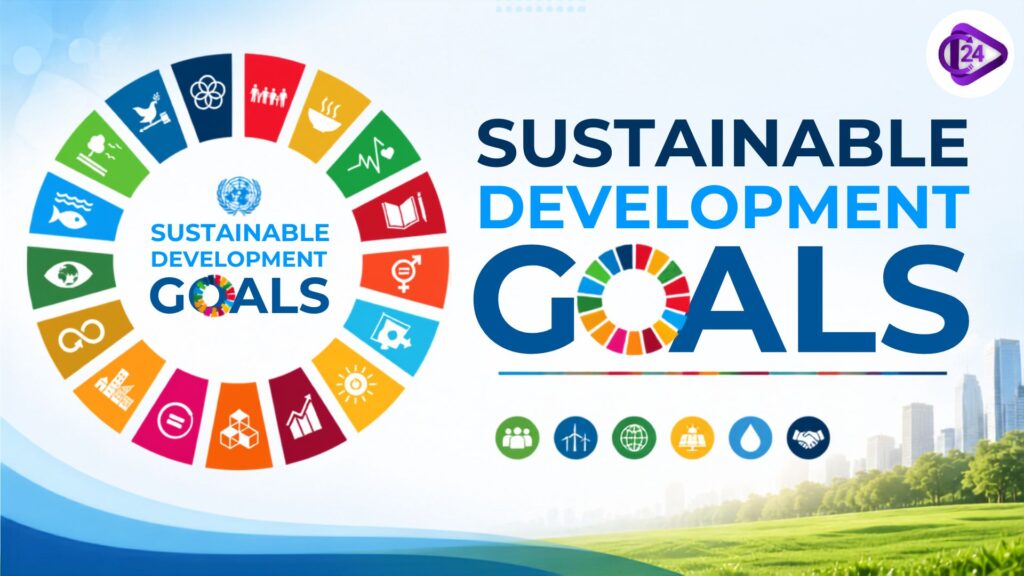
The Sustainable Development Goals (SDGs) are a collection of 17 global goals set by the United Nations in 2015 as part of the 2030 Agenda for Sustainable Development. These objectives serve as a global, subject-matter framework to address international problems such as poverty, hunger, inequality, climate change and environmental degradation, peace and economic development. The SDGs set out a plan to end poverty, achieve gender equality and human rights for all while also ensuring that humanity lives within the planet’s limits by 2030. Every goal contains measurable targets and indicators. All of this is happening with the full or partial efforts of government schemes and policies in achieving sustainable development goals within India by 2030.
What are Sustainable Development Goals (SDGs)?
-
- Sustainable Development Goals(SDGs)- The SDGs are a collection of 17 global goals set by the United Nations General Assembly in October 2015 as part of the 2030 Agenda for Sustainable Development.
- The SDGs are a followup of the set of the Millennium Development Goals (MDGs) between 2000 and 2015, which came into force on 1 January 2016.
- SDGs are primarily aiming to balance three important dimensions of sustainable development.
- Economic growth
- Social development
- Environmental protection
- The SDGs are your globally agreed roadmap to solving the greatest challenges we face: poverty, hunger, inequality and climate change (and all interrelated issues relating to this), biodiversity loss, health and quality education for all, by 2030.
- The System includes 17 Goals,169 Targets and 232 global indicators to monitor the achievement of the SDGs across nations, with accountability converged.
- Deeply rooted in the principle of ‘Leave No One Behind’, the SDGs underline inclusive development, seeking to change a world where no one is left behind.
- The targets include a large list: ending poverty, ensuring food security, ensuring healthy lives and promoting well-being for everyone, ensuring inclusive quality education and promoting lifelong learning opportunities for all, achieving gender equality and empowering women and girls everywhere; ensuring access to affordable, reliable, sustainable electricity for all, etc.
- These goals are universal and apply to all 193 UN Member States, which have committed to achieving them by 2030 with national policies, international cooperation and a sustainable debt strategy.
- NITI Aayog, which has been set up as the nodal institution to facilitate and monitor SDGs in India, is spearheading the implementation of various SDGs through policy frameworks.
- The SDGs act as a global framework to make the world more peaceful, prosperous, resilient and sustainable.
List of 17 Sustainable Development Goals (SDGs)
- SDG 1 No Hunger: End poverty in all its forms everywhere and ensure that all people have access to essential services, resources, social protection and equal economic opportunities.
- SDG 2 Zero Hunger: End hunger, achieve food security and improved nutrition, and promote sustainable agriculture for a world free of worry about having access to safe drinking water and sufficient food.
- SDG 3 – Good Health and Well-Being: Ensure healthy lives and promote well-being for all people of all ages by improving healthcare facilities and reducing preventable diseases.
- SDG 4: Ensure inclusive and equitable quality education and promote lifelong learning opportunities for all.
- SDG 5 Gender Equality: End all forms of discrimination against all women and girls everywhere.
- SDG 6 Clean Water and Sanitation: Ensure availability and sustainable management of clean water and sanitation facilities for all.
- SDG 7 Affordable & Clean Energy: Access to affordable, reliable, sustainable and modern energy for all; promote renewable energy
- SDG 8 Decent Work and Economic Growth: Encourage sustainable economic growth, full and productive employment and decent work for all.
- SDG 9 Industry, Innovation and Infrastructure: Build resilient infrastructure, promote sustainable industrialisation, and encourage innovation and technological advancement.
- SDG 10 Reduced Inequalities: Make social, economic and political inclusion for all
- SDG 11 Sustainable Cities and Communities: To make cities and human settlements inclusive, safe, resilient and sustainable through improved urban planning.
- SDG 12 Responsible Consumption & Production: Ensure sustainable consumption and production patterns by improving resource efficiency and reducing waste.
- SDG 13 Climate Action: Take urgent action to combat climate change and its impacts, based on climate mitigation and adaptation.
- SDG 14 Life Below Water: Protect aquatic ecosystems and conserve whale life to ensure the sustainable use of oceans, seas, and marine resources.
- SDG 15 Life on Land: Protect, restore and promote sustainable use of terrestrial ecosystems; sustainably manage forests, combat desertification, halt and reverse land degradation, and halt biodiversity loss.
- Goal 16 -Peace, Justice and Strong Institutions: Promote peaceful societies, provide access to justice for all and build effective, accountable institutions at all levels.
- SDG 17 Partnerships for the Goals: Strengthening global solidarity, in particular in a spirit of partnership, and bringing together finance, technology, trade and finance.
Sustainable Development Goals (SDGs) Targets
- The Sustainable Development Goals (SDGs) are a collection of 17 Goals and 169 Targets that were adopted by all United Nations Member States in September 2015 as part of the resolution that had the title ‘Transforming our World: The 2030 Agenda for Sustainable Development’.
- The targets give specific goals and measurable outcomes which contribute to the sustainable development of various economic, social, and environmental aspects.
- Targets associated with each SDG will help countries to plan policies, implement programmes and assess progress towards the 2030 Agenda.
- There are 169 SDG Targets to eradicate poverty, hunger, good health and well-being, quality education, gender equality, clean water and sanitation, energy sustainable economic growth environment adaptation and mitigation, and global partnership
- They are supported by global indicators to measure progress and compare performance across countries.
- The SDG objectives fundamentally rely on the spirit of “Leave No One Behind” and aspire to ensure that all vulnerable communities and marginalised people are included in this development effort.
- SDG targets urge governments, international organisations, and the private sector, as well as civil society, to work together to overcome the root causes of poverty and hunger.
- Top-down planning model, where countries develop their own national strategies with consideration of local priorities30; such plans are aligned with the global SDG framework.
- Though there is no separate institutional mechanism for implementation or follow-up of the SDGs, NITI Aayog serves as the nodal institution in India to coordinate actions related to SDGs through its task forces on various areas such as social integration and forest sustainability, monitor national progress on SDGs and prepare the SDG India Index.
- Strong policy action, adequate financing, technological innovation, international cooperation and sustainable resource management is urgently needed to achieve the SDG targets by 2030.
Objectives of Sustainable Development Goals (SDGs)
- No Hunger: End hunger, achieve food security and improved nutrition and promote sustainable agriculture.
- Good Health and Well-Being: To ensure healthy lives and promote well-being for all at all ages.
- Ensure inclusive and equitable quality education and promote lifelong learning opportunities for all.
- Goal of Gender Equality: Empowerment of women and girls and elimination of all forms of discrimination and inequality;
- Get clean water and sanitation: Ensure availability of water and sustainable management of water resources for all
- Promote sustained, inclusive and sustainable economic growth, full and productive employment and decent work for all.
- Construct sustainable infrastructure: Establish resilient facilities, facilitate innovation and foster sustainable industrialisation.
- Reduced Inequalities: Reduce inequalities within and among countries.
- Sustainable Cities and Communities: Build inclusive, safe, resilient and sustainable cities and human settlements.
- Protect our Planet: Encourage production, consumption, and waste generation on land and links between the use of chemical products.
- Promote Climate Action: We deal with climate change and focus on climate adaptation & mitigation.
- Promote peaceful societies and provide access to justice for all. Build effective, accountable and inclusive institutions at all levels
- Strengthening the Global Partnership: Strengthen our global partnership for sustainable development through high-level international cooperation, financing and technology transfer.
Important Links
Significance of Sustainable Development Goals
- Provides a Global Development Framework: SDGs provide a common roadmap for all countries to work towards sustainable and inclusive development by 2030.
- Brings Balance Between Development and Environment: These objectives guarantee that economic evolution does not translate into harm to nature or depreciation of natural assets.
- Facilitates Measurement of Progress on Development: SDGs provide 169 targets and a set of global indicators which help governments to measure progress towards achievements as well as areas that demand remedial action.
- Facilitates Long-Term Policy Planning: SDGs serve as a benchmark for countries to design development policies, government programmes and investment priorities.
- An inclusive growth strategy: The SDG approach will make sure that development does not only reach certain segments of society but all who are in need and vulnerable against nature’s disasters.
- Accelerates Global Cooperation: SDGs Foster collaboration among countries, international organisations, the private sector, research institutions and civil society!
- Promotes Human Development: By aiming to reduce inequalities and enhance holistic human development through efforts targeting health, education, equality as well as livelihoods, SDGs contribute towards improving overall quality of life.
- Promotes Climate Resilience: The Sustainable Development Goals (SDGs) promote sustainable practices and environmental preservation, allowing countries to prepare for climate-related risks.
- Encourages Responsible Resource usage: They advocate for better resource utilisation of water, energy, land and other natural resources for future generations.
- Strengthens Governance and Accountability: Monitoring SDGs helps to improve transparency, governance and accountability in public policy.
- Fosters global peace and stability: Goals on justice, institutions and equality support peaceful and stable societies bieden.
- Aid to Developing Countries: The SDGs offer a structure through which developing countries can more effectively combat key issues of poverty, infrastructure gaps, healthcare, education and economic disparity.